The Problem
Your Supply Is Higher and Noisier Than Your Equipment Needs
UK equipment is rated for 230 V, but the grid is permitted to deliver anywhere from 216 V up to 253 V — and most industrial sites are fed nearer the top of that band. Running motors, transformers, and lighting above their rated voltage doesn't make them work better; it makes them draw more power, run hotter, and wear out faster, while the extra energy simply dissipates as heat. You pay for every one of those surplus volts.
The voltage you receive is rarely steady, either. It sags when a large motor starts or a neighbouring site switches a heavy load, swells when demand drops off, and runs imbalanced across the three phases. Each disturbance stresses equipment, trips sensitive controls, and quietly erodes the efficiency of everything connected downstream.
What Causes It
Over-Voltage, Motor Starts, and Load Switching
Three forces push your voltage away from where it should be. First, utility over-voltage: networks are deliberately run high so the furthest customer on a feeder still receives enough — which means sites closer to the substation are routinely over-supplied. Second, motor starts and large loads: an induction motor can draw six or more times its running current as it spins up, dragging local voltage down for seconds at a time. Third, load switching across your own plant and your neighbours' — compressors cycling, furnaces firing, banks coming on and off — pushes the voltage up and down all day.
The result is a supply that swings around a set-point that was never tuned to your equipment in the first place. A fixed connection cannot follow it. Without active correction, every circuit on site lives with whatever the grid happens to deliver that second — and absorbs the cost in wasted energy and shortened equipment life.
The Solution
Dynamic, Solid-State Voltage Optimisation
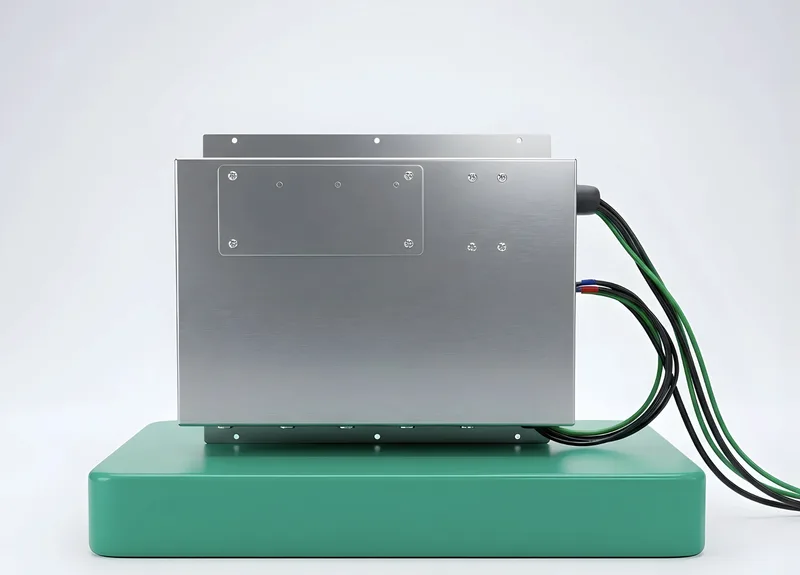
The HarmoniQ Alpha is a dynamic, solid-state voltage optimisation and line conditioning system. It measures the incoming supply thousands of times a second and continuously conditions it — trimming over-voltage, riding through sags and swells, and correcting imbalance between phases — so every downstream circuit receives clean, stable, optimised voltage tuned to what your equipment is actually rated for.
Because the Alpha is solid-state and responds in real time, it is fundamentally different from a fixed-tap transformer or a mechanical servo stabiliser. There is no fixed step that's right at one moment and wrong the next, and no motor-driven brushes lagging seconds behind the load. It tracks the supply continuously, so optimisation holds as motors start, production shifts, and the grid moves through the day — acting as a true industrial voltage stabiliser and power line conditioner in one.
Dynamic, solid-state voltage optimisation and line conditioning — real-time correction of over-voltage, sags, swells, and phase imbalance, delivering clean optimised voltage to every circuit. No fixed taps, no servo motors, no brushes to wear out. Sized to your site and installed in parallel at the switchboard.
Dynamic conditioning vs fixed-tap / servo voltage stabilisers + Read more− Close
The traditional ways to manage voltage both have a moving part at their heart — or no movement at all when you need it most. A fixed-tap transformer sets the output to one ratio chosen at commissioning. It works while the supply stays near where it was that day, but it cannot follow a grid that swings 216 V to 253 V, so for much of the time it leaves you either still over-volted or, worse, under-volted during a sag. A servo (electro-mechanical) voltage stabiliser drives a motorised brush along a winding to chase the set-point. It can adjust, but only as fast as a physical motor moves — seconds, not milliseconds — so it lags fast events like motor starts entirely, and the brushes and gears are wear parts that need maintenance and eventually fail.
The HarmoniQ Alpha is solid-state and dynamic. It conditions voltage continuously and in real time, with no fixed step to get wrong and no mechanism to wear out — correcting over-voltage, sags, swells, and imbalance as they happen rather than after the fact. It is voltage optimisation designed for a modern plant full of drives and fast-switching loads, not the switchgear of forty years ago.
The Impact
What Optimising Voltage Is Worth
| Metric | Before | After HarmoniQ | Improvement |
|---|---|---|---|
| Average supply voltage | 245 V | 230 V optimised | −6.1% |
| Energy consumption | Baseline | Optimised | −4–10% |
| Voltage sags / swells reaching plant | Frequent | Conditioned out | Ride-through |
| Nuisance trips & control faults | Recurring | Sharply reduced | Fewer stoppages |
| Indicative annual saving | £36,000–£90,000 | energy + avoided downtime | |
Every site's supply voltage, load mix, and tariff are different. Our engineers will measure your actual incoming voltage profile and model the precise energy saving and stability gain for your specific connection — get in touch for a site assessment.
Beyond the Energy Saving
Longer Equipment Life, Fewer Trips, Lower Carbon
Optimising voltage does more than trim a line on your bill. Running equipment at its rated voltage rather than above it cuts heat and stress, extending the life of the motors, drives, and transformers you already own and reducing maintenance. Conditioning out sags, swells, and imbalance means fewer nuisance trips and control faults — less unplanned downtime and fewer lost batches. And every kilowatt-hour you stop wasting is a measurable Scope 2 carbon reduction that supports your ESG reporting and net-zero roadmap.