The Problem
Modern Loads Pollute Your Own Network
Variable frequency drives, rectifiers, UPS systems, induction furnaces, welders, and switched-mode power supplies are all non-linear loads — they draw current in sharp pulses rather than a smooth sine wave. Those pulses are harmonics: currents at multiples of the supply frequency that the equipment injects back into your electrical system.
The more drives and rectifiers you run, the more distorted your current waveform becomes. Total harmonic distortion (THD) climbs, the voltage waveform starts to flatten and notch, and the pollution one machine creates is dumped onto the busbar every other machine shares. It is a problem your own equipment manufactures and then has to live with.
What It Costs
Harmonics Are Heat, Waste, and Unplanned Downtime
Harmonic currents do no useful work, but they still flow through every conductor on site. That extra current means higher I²R losses and real wasted energy on your bill. Worse, harmonics drive eddy-current and skin-effect heating that runs cables hot, overloads neutral conductors, and forces transformers to be derated — you lose capacity you have already paid to install.
The damage compounds over time. Distorted voltage overheats motor windings and capacitors and shortens their service life. High-frequency components trip breakers and drives for no obvious reason, blow fuses, and corrupt sensitive control and metering electronics. The result is a plant that runs hotter, wastes energy continuously, and suffers nuisance trips and premature failures nobody can quite explain.
The Solution
Real-Time Active Harmonic Cancellation
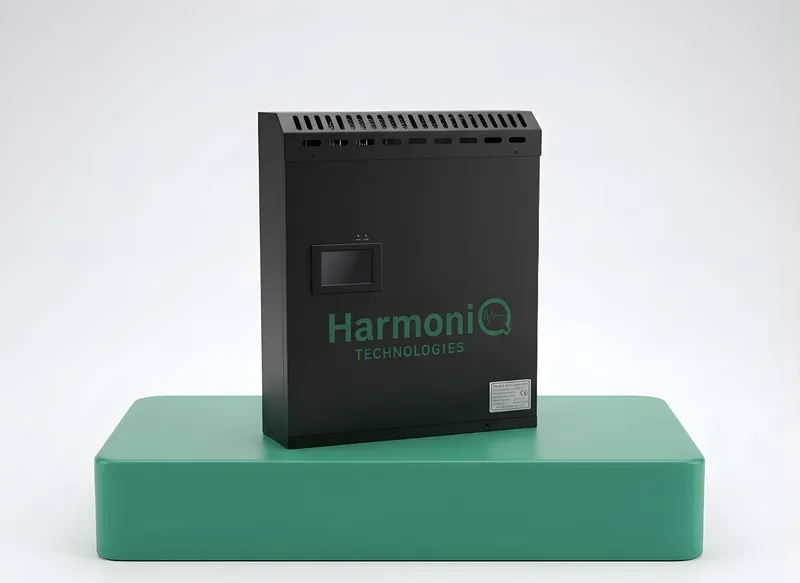
The HarmoniQ Delta is an active harmonic filter that cancels harmonics at the source. It continuously measures the distorted current your loads draw, then injects an equal and opposite current in real time — so the harmonics cancel before they spread across your network. The waveform the rest of your site sees is clean, and current THD is driven below 5%, holding you inside IEEE 519 and IEC 61000 limits.
Because it tracks the load thousands of times a second, the Delta adapts as drives ramp, furnaces cycle, and production shifts through the day — correcting across the full harmonic spectrum rather than tuning to a single frequency. It is sized to your site and installed in parallel at the switchboard, so it cleans the network without sitting in series with your loads.
Real-time, broadband harmonic mitigation that drives current THD below 5% and holds your site inside IEEE 519 and IEC 61000. No tuned reactors to detune, no resonance risk, no fixed steps — it tracks and cancels across the whole spectrum as loads change. Sized to your site and installed in parallel at the switchboard, the Delta carries a minimum performance guarantee, proven at your own meter.
Active vs passive (detuned) filters & capacitor resonance + Read more− Close
A passive harmonic filter is a fixed network of reactors and capacitors tuned to absorb one or two specific harmonic orders — usually the 5th and 7th. It is cheap and simple, but it only treats the frequencies it was built for, its performance drifts as components age, and it does nothing for the higher-order harmonics that modern six- and twelve-pulse drives produce. Detuned capacitor banks go further by adding a series reactor to shift the bank's resonant point away from a dominant harmonic — but they still correct in fixed steps and remain blind to the rest of the spectrum.
The deeper hazard is resonance. Any capacitor placed on a system carrying harmonics can form a resonant circuit with the supply impedance. If that resonant point lands near a harmonic your loads produce, it does not absorb that harmonic — it amplifies it, overheating the capacitors and, in the worst case, destroying them. The HarmoniQ Delta is active and broadband: it injects a precise cancelling current across the full spectrum, adapts continuously as loads change, and adds no capacitance to your network — so it carries no resonance risk and never needs retuning.
The Impact
What Cleaning Up Harmonics Is Worth
| Metric | Before | After HarmoniQ | Improvement |
|---|---|---|---|
| Current THD | 28% | <5% | IEEE 519 met |
| Transformer derating for harmonics | ~12% capacity lost | Restored | Capacity released |
| Nuisance trips & drive faults | Recurring | Eliminated | Uptime restored |
| Harmonic losses in cables & transformers | Wasted continuously | Prevented | Lower energy use |
| Indicative annual saving | £45,000–£95,000 | losses + avoided downtime + life | |
Every site's load mix, THD profile, and tariff are different. Our engineers will measure your actual harmonic spectrum and model the exact distortion reduction, recovered capacity, and energy saving for your specific connection — get in touch for a site assessment.
Beyond Compliance
Longer Equipment Life, Restored Capacity, Lower Carbon
Meeting IEEE 519 clears the compliance hurdle, but the real return is what clean power does to the rest of your plant. Removing harmonic heating lets motors, transformers, and capacitors run at their rated temperature, which extends the life of assets you already own and ends the unplanned failures that harmonics quietly cause. Restoring transformer and cable capacity frees real headroom on your existing connection — often enough to add load or defer an upgrade. And every kilowatt-hour of harmonic loss you stop wasting is a measurable Scope 2 carbon reduction that supports your ESG reporting and net-zero roadmap.