The Problem
Low Power Factor Is a Bill You Pay Twice
Every motor, transformer, drive, and welder on your site draws reactive power — current that builds the magnetic fields these loads need but does no useful work. The more reactive power you draw, the lower your power factor falls below the ideal of 1.0.
You pay for that twice. First, many utilities bill reactive energy directly — a per-kVArh charge or a penalty whenever power factor drops below a set threshold (typically 0.95). Second, reactive current inflates the total kVA flowing through your connection, so you hit kVA demand and capacity charges sooner, and you run out of usable headroom on a connection you've already paid to install.
What Causes It
Reactive Loads Add Up Across the Network
Induction motors, transformers, fluorescent and LED ballasts, induction heating, and lightly-loaded drives are all inductive — they pull current that lags the voltage. Individually each is small; across a full plant they combine into a continuous reactive draw that drags your whole site's power factor down and loads every cable and transformer between the incomer and the equipment.
The lower your power factor, the more current it takes to deliver the same real work (kW). That extra current means higher I²R losses in your conductors, hotter transformers running closer to their limit, and less spare capacity for new lines, EV chargers, or production expansion.
The Solution
Solid-State Power Factor Correction, Network-Wide
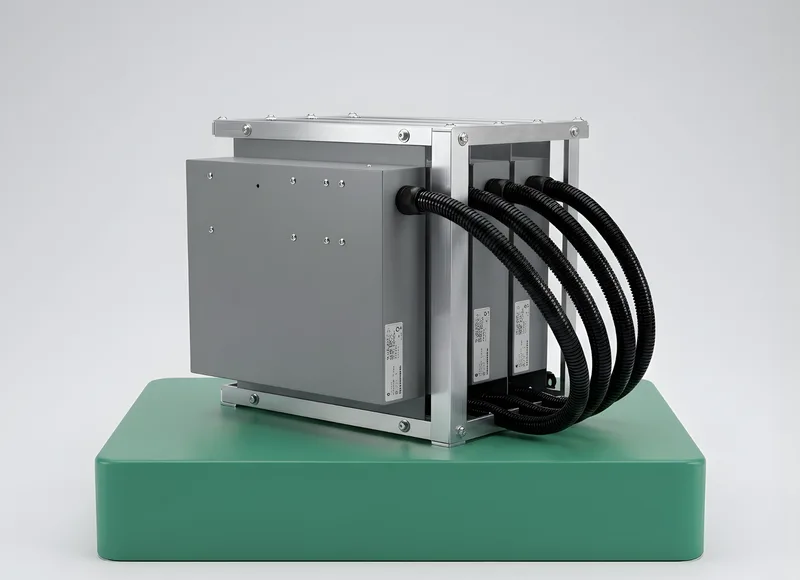
The HarmoniQ Sigma is a solid-state power factor correction system that corrects true power factor to 0.98 or better — dynamically, in real time, across your entire electrical network rather than only at the incoming meter. It tracks the load thousands of times a second and adjusts continuously, so correction holds as motors start, compressors cycle, and production changes through the day.
Because the Sigma corrects across the network and not just at the boundary, the cleaner, lower current reaches every downstream cable, board, and motor — so they run cooler and draw less, on top of removing the utility penalty at the meter.
Solid-state, real-time true power factor correction to 0.98+ across the whole network. No switched-capacitor steps, no contactors, no moving parts to wear out — and no resonance risk with the harmonics already on your system. Sized to your site and installed in parallel at the switchboard.
Why not just install capacitor banks? + Read more− Close
Switched-capacitor banks correct power factor in fixed steps at the incoming feed — enough to avoid the utility penalty at the meter, which is why they're common. But they have real limits. They respond in steps and seconds, so they lag fast-changing loads and can leave you over- or under-corrected. They sit only at the boundary, so the reactive current still flows through your internal network. And critically, a capacitor bank placed on a system carrying harmonics can form a resonant circuit with the supply impedance — amplifying those harmonics and, in the worst case, failing the capacitors themselves.
The Sigma is solid-state and dynamic: it corrects continuously rather than in steps, works across the network rather than at one point, and carries no resonance risk. It's power factor correction designed for a modern plant full of drives and non-linear loads, not the switchgear of forty years ago.
The Impact
What Correcting Power Factor Is Worth
| Metric | Before | After HarmoniQ | Improvement |
|---|---|---|---|
| Power factor | 0.80 | 0.98 | +22.5% |
| Reactive-power (kVArh) penalty | Charged monthly | Eliminated | −100% |
| Peak demand (kVA) | 2,800 | 2,286 | −18.4% |
| Spare connection capacity | Near limit | ~500 kVA freed | Capacity released |
| Indicative annual saving | £70,000–£130,000 | penalties + demand + losses | |
Every site's loads, tariff, and penalty structure are different. Our engineers will model the exact power factor improvement, penalty savings, and capacity released for your specific connection — get in touch for a site assessment.
Beyond the Penalty
Released Capacity, Longer Equipment Life, Lower Carbon
Correcting power factor does more than clear a line on your bill. Cutting reactive current frees real capacity on your existing connection — often enough to add load or defer an expensive utility upgrade. Lower current means lower losses and cooler cables and transformers, which extends the life of the assets you already own. And every kilowatt-hour you stop wasting is a measurable Scope 2 carbon reduction that supports your ESG reporting and net-zero roadmap.