The Cost of Power
Cheap Grid Power — Until You Count the Diesel
On paper, Zambia has some of the cheapest electricity in Africa. Business and commercial sites pay roughly $0.045 per kWh, and the grid is built on low-cost hydro — around 80% of generation comes from water. On a normal grid, that low tariff would make the energy-savings argument a weak one. But Zambia’s grid has not been normal: a severe drought has forced sites to bridge long daily outages on diesel generators at around $0.45 per kWh — roughly ten times the grid rate. The real price of a kilowatt-hour in Zambia is not what ZESCO charges; it is what it costs to keep the lights on when ZESCO cannot.
That gap reframes the whole question. Where a high-tariff market like the UK rewards you for wasting fewer cheap-to-meter kilowatt-hours, Zambia rewards you for getting the most usable, stable power out of every expensive diesel and captive-solar kilowatt-hour you are forced to generate yourself — and for keeping product, production and equipment alive through an unstable supply. Every percentage point of wasted or distorted current is far more costly when it is being produced behind the meter at $0.45/kWh.
| Who pays / what for | Typical cost | Notes |
|---|---|---|
| Business / commercial (grid) | ~$0.045/kWh (2025) | Among the cheapest in Africa — the grid kWh is not where the cost is |
| Mining (negotiated, MV/HV) | ~$0.09/kWh | Higher rate, but taken at medium/high voltage — a different connection |
| Diesel-genset backup | ~$0.45/kWh | ~10× the grid — the cost that actually bites during load-shedding |
| Households (ZESCO, ERB-approved) | up to ~ZMW 3.45/kWh | Top residential band from Nov 2025; first 200 units stay on a protected lifeline rate |
Commercial, mining and diesel-backup figures are drawn from HarmoniQ’s Zambia market research (GlobalPetrolPrices 2025 and sector reporting), and are quoted in US dollars, as industrial and backup costs in Zambia commonly are; the kwacha (ZMW) ranged roughly 22.7–29.1 to the dollar across 2024–25. The household figure is the ERB-approved ZESCO residential top-band rate effective from 1 November 2025, with the first 200 units on a protected lifeline tariff. Figures are current as of 2024–2025 and are revised regularly — verify against the Energy Regulation Board (ERB) and ZESCO tariff schedule at the time of reading. All figures are unit rates and exclude fixed and demand charges.
How You’re Billed
A Zambian Site Pays for Capacity and Reactive Power — Then Pays Again for Diesel
The headline cents-per-kWh is only part of the story. A larger metered Zambian site pays for the energy it uses, for the capacity it reserves, and — for maximum-demand customers — for the maximum demand (in kVA) it places on the network. On top of the grid bill sits a second, far larger bill that does not appear on any ZESCO statement at all: the cost of running diesel generators and captive solar through load-shedding. Power quality moves both.
| Component | What it is | Cut by power quality? |
|---|---|---|
| Energy (grid kWh) | The units you consume at the commercial tariff | Indirectly — lower losses |
| Network & service charges | The cost of delivering power over the ZESCO network | Partly |
| Maximum-demand charge (kVA) | A charge on the apparent-power demand maximum-demand customers place on the network | Yes — lower apparent power means a lower charge |
| Reactive power drawn | The reactive current your motors and drives pull, which inflates apparent-power demand and losses | Yes — power factor correction cuts it directly |
| Diesel & captive-solar backup | Self-generation to bridge load-shedding — diesel at ~$0.45/kWh | Yes — correction frees backup capacity for real load |
So the answer to two questions Zambian operators often ask: yes, larger sites are billed for maximum demand — through the kVA maximum-demand charge — and yes, poor power factor costs you, by inflating that demand, raising losses, and — most expensively in Zambia — wasting the limited capacity of the diesel generators and inverters you rely on during shedding. All of those fall as power factor rises towards unity, which is exactly what correction delivers.
Power Factor & Regulation
No Mandatory Penalty — the Pull Here Is Commercial
Unlike the Gulf utilities, Zambia does not impose a mandatory nationwide power-factor connection code that fines sites below a set threshold. The reason to correct power factor here is therefore commercial, not regulatory: a site running at 0.80 power factor draws far more apparent-power and reactive current than the same site corrected to 0.98+, which inflates any maximum-demand charge, wastes transformer headroom, and — critically during load-shedding — forces an undersized generator or solar-battery system to carry reactive current it could otherwise spend on real, useful load.
On harmonics and supply quality, the rapid spread of variable-speed drives, rectifiers and the inverter-based captive solar and battery systems now rolling out across Zambian sites is pushing distortion up sharply on weak, genset-fed boards. Holding that distortion in check — so that solar, storage and the existing load can coexist on one board without tripping, overheating or equipment damage — increasingly requires active harmonic filtering, not a one-off survey.
Electricity tariffs, maximum-demand charges and connection rules are set by ZESCO and approved by the Energy Regulation Board (ERB); Zambia does not operate a Gulf-style mandatory power-factor penalty, so the case for correction is commercial. Equipment is also subject to Zambia Bureau of Standards (ZABS) requirements. Confirm the demand charges, connection conditions and standards that apply to your site with ZESCO and the ERB — they vary by tariff category and are updated periodically, especially following the recent emergency-tariff adjustments.
Why Power Quality Matters Here
A Drought-Hit Hydro Grid, Bridged on Diesel and Solar
One structural force makes power quality a Zambian boardroom issue above all others: reliability. Around 80% of Zambia’s power comes from hydro concentrated on a single, drought-exposed source — Lake Kariba, behind roughly 80% of the country’s hydro supply. An El Niño drought, the worst in Southern Africa in 40 years, drove Kariba’s usable storage below 8% and forced ZESCO to run the Kariba North Bank station (1,080 MW capacity) at a fraction of its output. Daily load-shedding lengthened from around 8 hours to 17–21 hours a day through 2024 and into 2025. For a commercial or industrial site, that is not an inconvenience — it is the central operating cost.
Every qualifying site responded the only way it could: diesel generators at ~$0.45/kWh, and a rush into captive solar and batteries — solar imports rose roughly eight-fold to ~424 MW in the year to mid-2025, and battery-storage deployment jumped more than ten-fold. This matters for power quality in two compounding ways. First, the boards these sites now run on are weak, genset- and inverter-fed, and unstable, with sagging, fluctuating voltage that damages motors, refrigeration and electronics. Second, the new solar and battery kit is inverter-based and harmonic-rich, injecting distortion onto those same boards. For maximum-demand sites, poor power factor also inflates the kVA charge on the grid supply they still draw. Even with relief projected as the rains return, the structural exposure — an ~80% hydro system on one drought-prone lake — is unchanged, and the weak-grid and inverter problems persist after the drought.
The Solution
Solid-State Stabilisation, Correction and Filtering, Network-Wide
HarmoniQ installs a coordinated, solid-state system at the low-voltage switchboard — exactly where Zambian sites feel the weak grid, the genset-fed boards, and the new inverter-based solar and battery kit. We deploy three products as the site requires: HarmoniQ Alpha as the integrated platform that stabilises voltage and ties correction, filtering and conditioning together, the HarmoniQ Delta for harmonic mitigation, and the HarmoniQ Sigma for real-time power factor correction. No switched-capacitor steps, no contactors, and no resonance risk with the harmonics already on your system.
Holds voltage steady at the point of use through the transitions between grid, generator and solar — protecting sensitive loads in hospitals, breweries, processing lines and telecom rooms — and unifies correction, filtering and conditioning with the visibility to prove the result at the meter, continuously.
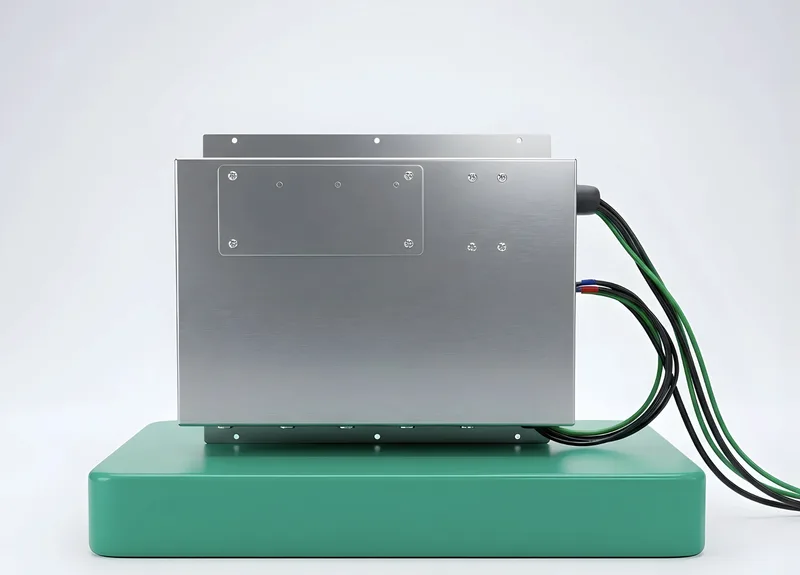
Active harmonic filtering that eliminates distortion in real time — the component that lets the VFD-driven motors, rectifier loads and the non-linear inverters of captive solar and battery systems coexist on one board, without distortion-driven tripping, overheating or equipment damage.
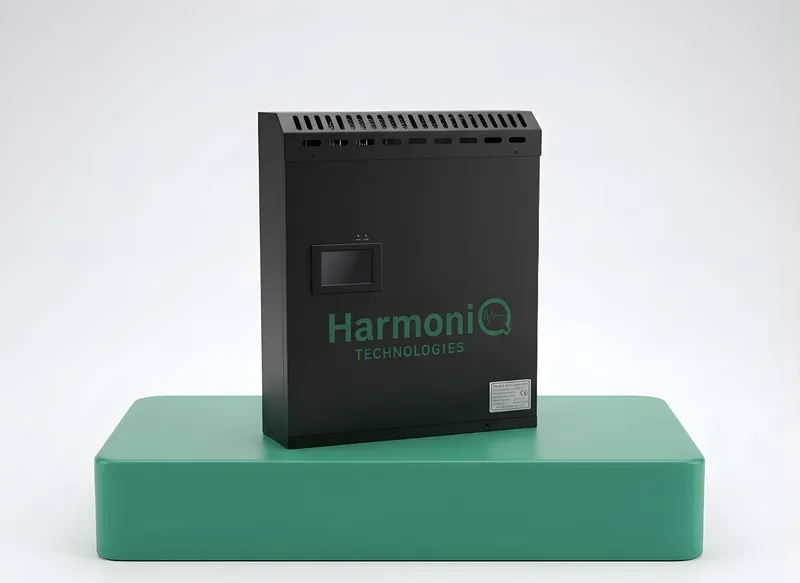
Real-time true power factor correction to 0.98+ across the whole network — cutting apparent-power demand and any maximum-demand charge, and freeing transformer, generator and inverter capacity so an undersized genset or captive solar-plus-battery can carry more real load through load-shedding without tripping or over-sizing the plant.
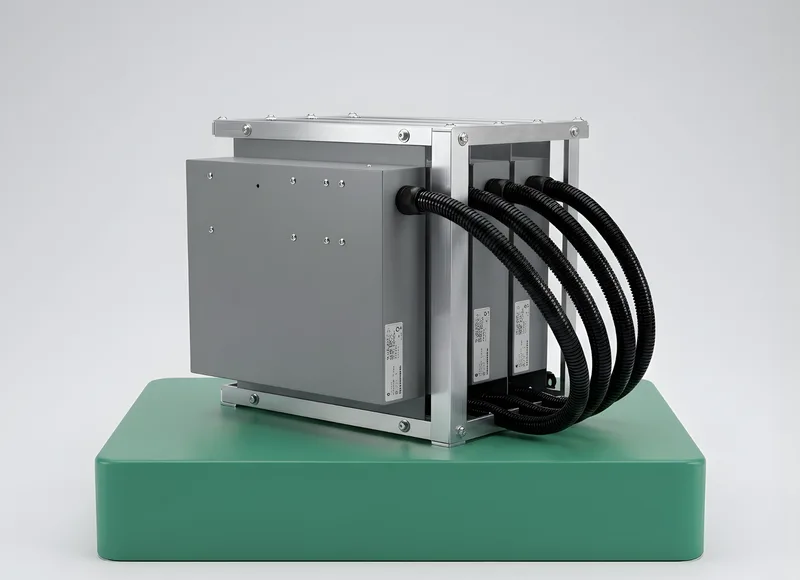
Why not just install capacitor banks? + Read more− Close
Switched-capacitor banks correct power factor in fixed steps at the incoming feed — enough, in theory, to lift you over a demand threshold at the meter. But they respond in steps and seconds, so they lag fast-changing loads; they sit only at the boundary, so reactive current still flows through your internal network; and on a system carrying harmonics — as nearly every modern Zambian site now does, with its drives, rectifiers and captive-solar inverters — a capacitor bank can form a resonant circuit with the supply, amplifying those harmonics. On a weak, genset-fed board they do nothing at all for voltage stability.
HarmoniQ is solid-state and dynamic: it corrects continuously rather than in steps, works across the network rather than at one point, stabilises voltage, and carries no resonance risk. Paired with active filtering, it is power factor correction and harmonic mitigation designed for a plant full of drives, gensets and solar inverters, not the switchgear of forty years ago.
What It’s Worth
The Value Is in Keeping the Site Running
| Lever | What changes | Effect |
|---|---|---|
| Reliability & backup quality | Stable, clean supply through grid–genset–solar switching | Protects critical load; avoids lost-production hours during shedding |
| Backup-fuel efficiency | Correction lets an undersized genset / solar-battery carry more real load | More useful output per litre of diesel and per solar kWh |
| Equipment-life extension | Less harmonic, thermal and voltage-sag stress on motors, drives & electronics | Longer asset life — acute on a weak grid |
| Capacity release | Power factor 0.80 → 0.98 frees ~15–20% of transformer / genset / inverter capacity | Defers upgrades and over-sizing of backup plant |
| Grid energy & loss reduction | ~2–3% loss reduction | Modest — the grid kWh is cheap |
| Where the value lands | A ~1.2 MW site bridging ~12 hours a day of shedding on diesel can spend more on backup fuel in a deep-shedding month than on a whole year of grid electricity — so even a modest gain in usable, stable backup load is worth far more than any grid-kWh saving | |
Every site’s loads, backup setup and reactive profile are different, and the figures above are illustrative of the mechanism — not a quote. Our engineers will model the exact power factor improvement, backup capacity and fuel released, losses reduced and equipment protected for your specific site — get in touch for a site assessment, or see the method on our power factor correction and demand-charge pages.