The Cost of Power
A Price That Depends Entirely on Where You Are
There is no single US electricity price — the country is dozens of markets, with seven regional grids, thousands of utilities and fifty state regulators. The commercial average sits around 13.9 cents per kWh, but that figure hides an enormous spread: Hawaii runs near 35 cents, California and most of the Northeast — Connecticut, Massachusetts, New York, Maine — run roughly 18–22 cents, while the Southeast and Texas sit near 8–10 cents. For a factory, data centre or commercial estate in a high-tariff state, the price of a kilowatt-hour is reason enough to stop wasting any.
Because the spread is so wide, the savings case is strongest where the tariff is highest. In the high-cost states even a few percentage points of avoided loss is real money, and the power-factor and demand charges built into most US commercial tariffs add billable levers on top. In the low-tariff states the case leans instead on demand charges, power factor and freeing up capacity. Either way, every percentage point of wasted current is charged at a rate that, in much of the country, is rising fast.
| Who pays | Typical average price | Notes |
|---|---|---|
| Commercial (national average) | ~13.9 ¢/kWh | Ranges from ~8–10¢ (SE, TX) to ~18–35¢ (CA, Northeast, HI) |
| Industry (national average) | ~8.6 ¢/kWh | Lower on average, but state spread is just as wide |
| Households (residential, national average) | ~18.6 ¢/kWh | For reference — prices vary by state and utility |
The commercial, industrial and residential averages are US Energy Information Administration (EIA) Electric Power Monthly figures (preliminary, early 2026); the state ranges are drawn from EIA state price data. All are national or state averages and exclude demand charges and standing charges, which can be a large part of an industrial bill. Prices move every month and vary enormously by state and utility — verify the rate that applies to you against the EIA Electric Power Monthly and your own utility’s tariff schedule at the time of reading.
How You’re Billed
A US Industrial Bill Is Mostly Not the Energy You Use
The headline cents-per-kWh is only part of the story. A commercial or industrial site in the US pays for the energy itself, for the delivery network — and, critically for power quality, for peak demand, billed in dollars per kilowatt ($/kW), and very often for a poor power factor, either as a direct penalty or through a reactive (kVAR) charge. On many US bills those demand and power-factor lines rival or exceed the energy charge — and both move directly when you correct power factor.
| Component | What it is | Cut by power quality? |
|---|---|---|
| Energy (commodity) | The kWh you consume, at the supply price | Indirectly — lower network losses |
| Delivery / distribution | Moving power over the utility’s network to your site | Partly |
| Demand charge ($/kW) | A charge on your peak demand in any billing period — often billed on apparent power (kVA) or kW÷PF | Yes — correcting power factor lowers the demand you are billed for |
| Power-factor penalty / reactive (kVAR) charge | A surcharge when power factor falls below the tariff threshold, or a direct charge on reactive energy | Yes — power factor correction clears it directly |
| Taxes & riders | State and local taxes and assorted utility riders | No |
So the answer to two questions US operators often ask: yes, you are billed for peak demand — in dollars per kilowatt, frequently on apparent power or kW divided by power factor — and yes, many tariffs bill you for poor power factor, through a penalty or a reactive (kVAR) charge. Both fall as power factor rises towards unity, which is exactly what correction delivers.
Power Factor & Regulation
No Single National Penalty — but Charges That Reward Correction
The US has no single nationwide power-factor rule; the cost of low power factor is set utility by utility, in the published tariff schedule. The pattern, though, is consistent: many commercial tariffs penalise power factor below roughly 0.90 to 0.95, either by billing demand on apparent power (kW÷PF) or by levying a direct reactive charge — commonly in the region of a few dollars per kVAR. A site running at 0.80 power factor pays measurably more than the same site corrected to 0.98+, both in reactive charges and in the demand it is billed for.
On harmonics, US connections are referenced to IEEE 519, which sets distortion limits at the point of common coupling — the boundary between your site and the utility. Installation follows the National Electrical Code (NEC / NFPA 70), inspected state and locally, and equipment must hold a UL listing. As variable-speed drives, rectifiers, EV charging and non-linear UPS systems multiply on US sites, staying inside IEEE 519 limits increasingly requires active harmonic filtering — and utilities increasingly require it at the point of interconnection.
Demand charges, power-factor penalties and reactive (kVAR) charges are set by each utility and published in its tariff schedule — thresholds (often power factor below ~0.90–0.95) and rates vary by utility and state. Harmonic distortion is referenced to IEEE 519 at the point of common coupling; installation follows the NEC (NFPA 70) and equipment carries a UL listing. Confirm the charges, thresholds and limits that apply to your connection with your utility — they vary by utility and state and are updated periodically.
Why Power Quality Matters Here
A High-Cost-in-Parts, Fast-Tightening, Inverter-Heavy Grid
Several structural forces make power quality a US boardroom issue, not just an engineering one. First, the tariff in the high-cost states — California, the Northeast and Hawaii run roughly 18 to 35 cents per kWh, where avoided loss is straightforwardly money. Second, the demand and power-factor charges built into most US commercial tariffs, which are billable today regardless of the energy rate. Third, capacity: after a decade of flat demand, an AI and data-centre building wave has restarted load growth — the EIA projects US grid demand up around 17% by 2030, and capacity prices in the PJM region rose roughly ten-fold for 2026/27. Freeing transformer and switchgear headroom on the connection you already have has gone from a nice-to-have to a board-level concern.
Reliability is the more regional driver. The US average sits around five to eight customer-hours lost a year, but with sharp weather-driven spikes — so in storm-exposed regions, ride-through and clean, stable power matter alongside cost, charges and capacity.
The Solution
Solid-State Correction and Filtering, Network-Wide
HarmoniQ installs a coordinated, solid-state system at the low-voltage switchboard — the 480 V main distribution board where US sites carry the bulk of their load, where the demand and power-factor charges bite, and where the inverter-heavy grid injects distortion. We deploy three products as the site requires: HarmoniQ Alpha as the integrated platform tying correction, filtering and voltage optimisation together, the HarmoniQ Delta for harmonic mitigation, and the HarmoniQ Sigma for real-time power factor correction. No switched-capacitor steps, no contactors, and no resonance risk with the harmonics already on your system.
Unifies correction, filtering and voltage optimisation across multiple boards or sites — with the visibility to prove power factor, reactive power and peak demand at the meter, continuously.
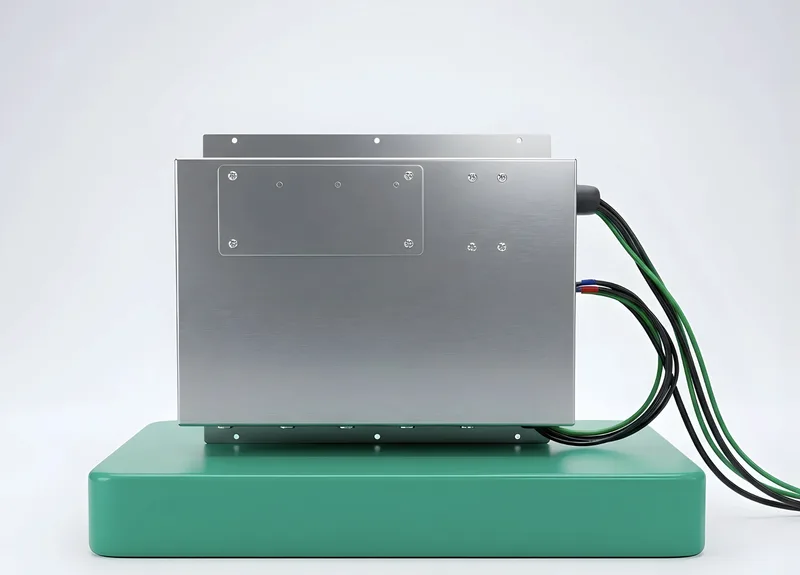
Active harmonic filtering that holds distortion within IEEE 519 limits at the point of common coupling — the component that matters most where VFD-driven HVAC, rectifiers, EV charging and non-linear UPS systems push harmonic levels up, and where utilities require it at interconnection.
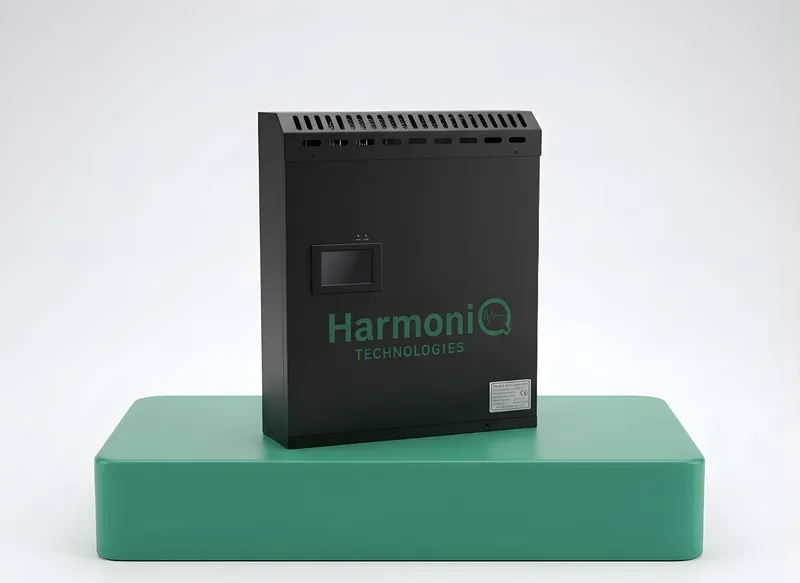
Real-time true power factor correction to 0.98+ across the whole network — clearing the power-factor penalty and reactive (kVAR) charge, cutting the demand charge billed in $/kW, and freeing transformer headroom so you can add load without a costly utility upgrade as the grid tightens.
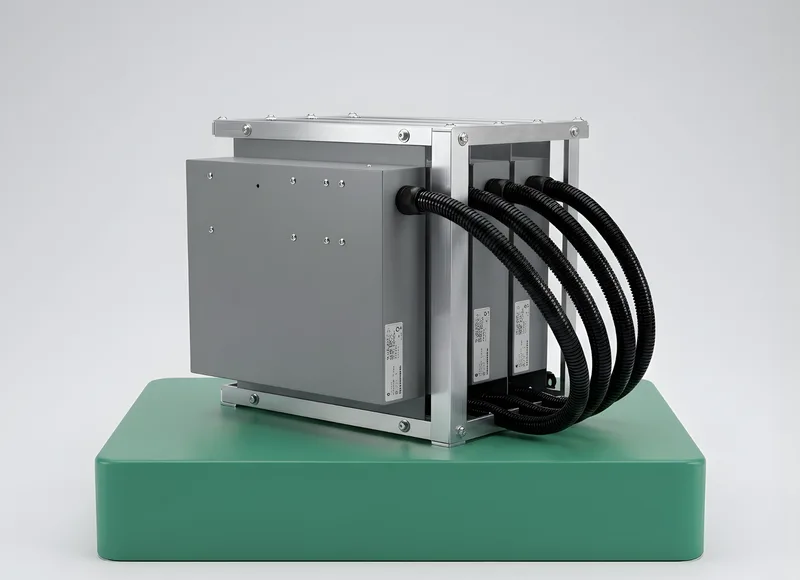
Why not just install capacitor banks? + Read more− Close
Switched-capacitor banks correct power factor in fixed steps at the incoming feed — enough, in theory, to lift you over a reactive threshold at the meter. But they respond in steps and seconds, so they lag fast-changing loads; they sit only at the boundary, so reactive current still flows through your internal network; and on a system carrying harmonics — as nearly every modern US site does, with its drives, rectifiers and inverters — a capacitor bank can form a resonant circuit with the supply, amplifying those harmonics.
HarmoniQ is solid-state and dynamic: it corrects continuously rather than in steps, works across the network rather than at one point, and carries no resonance risk. Paired with active filtering, it is power factor correction and harmonic mitigation designed for a plant full of drives and inverters, not the switchgear of forty years ago.
What It’s Worth
High Tariff in Parts, Real Charges Everywhere — the Savings Compound
| Lever | What changes | Effect on the bill |
|---|---|---|
| Energy & loss reduction (~2–4%) | Lower network losses across the site | ~$35,000 a year on a bill of this size |
| Power factor → 0.98+ | Reactive energy and billed demand fall | Power-factor penalty cleared; demand charge ($/kW) cut — tens of thousands more |
| Capacity release | PF 0.80→0.98 frees ~15–20% of transformer / switchgear headroom | Defer or avoid a costly utility upgrade — a six-figure avoided capex |
| Indicative annual saving | A six-figure sum on a site of this size in a high-tariff state — plus the capacity released | |
Every site’s loads, tariff and reactive profile are different, and the figures above are illustrative of the mechanism — not a quote. Our engineers will model the exact power factor improvement, demand and reactive charges avoided, losses reduced and capacity released for your specific connection — get in touch for a site assessment, or see the method on our power factor correction and demand-charge pages.