The Cost of Power
The True Cost Is the Grid Plus the Generator
In Syria the headline tariff tells you very little. Emerging from fourteen years of war, the country received only about two to four hours of mains power a day through 2025, with the transitional government targeting a phased rise towards roughly 14 hours by mid-2026. The rest of the day, most businesses run on private diesel generators. So for a factory, hospital or processing plant, the real price of a kilowatt-hour is a blend — a few subsidised grid hours plus many expensive, self-generated ones — and the larger cost is often not on the bill at all, but in the trips, stoppages and equipment damage that an unstable supply inflicts.
A November 2025 tariff reform sharply raised official prices and introduced tiered rates: 1,700–1,800 SYP/kWh for public institutions, factories and heavy industry, with a subsidised first tier for low-income households. But the Syrian pound is volatile, so converting these rates to a confident, durable US-dollar figure is not possible — and in any case many sites pay private-generator rates rather than the tariff. The practical point is simple: where supply is scarce and self-generated, every kilowatt-hour wasted to poor power quality is paid for twice — once in fuel, and again in the wear it puts on hard-to-replace machinery.
| Who pays | Official tariff (Nov 2025) | Notes |
|---|---|---|
| Public institutions & factories | 1,700 SYP/kWh | A confident USD/kWh value is not available given currency volatility |
| Heavy industry (e.g. smelters) | 1,800 SYP/kWh | Sharply raised in the November 2025 tiered reform |
| Effective cost on diesel self-generation | Set off-grid, not by tariff | Many sites’ real cost of power is generator fuel, not the grid rate |
| Households (subsidised first tier, ≤300 kWh) | ~600 SYP/kWh (~US$0.05) | 60% subsidised first tier; second tier ~1,400 SYP/kWh (web-sourced — see Sources) |
Grid-supply hours and the industrial tariff (1,700–1,800 SYP/kWh, November 2025) are drawn from Syrian transitional-period reporting via HarmoniQ’s internal market assessment; the household first-tier figure (~600 SYP/kWh, roughly US$0.05, 60% subsidised) is web-sourced from The National (5 Nov 2025) and Enab Baladi (Nov 2025). These figures are current as of late 2025 / June 2026 and the situation is changing month to month — the Syrian pound is volatile, so all USD conversions are indicative only. Verify the prevailing tariff, exchange rate and supply hours locally before relying on any figure here. No dependable published reliability indices (SAIDI/SAIFI) are available for the transition period.
How You’re Billed
Two Bills, Not One — the Grid and the Generator
Unlike a market with a single metered tariff, a Syrian site typically pays for power in two streams. The first is the grid supply — a relatively small number of subsidised hours, billed at the official tariff. The second, and usually the larger, is self-generation — diesel fuel, generator maintenance and the standby capacity a site has to own to keep running when the mains is off. Where grid power is rationed, it is this second stream, and the reliability of supply behind it, that dominates the economics.
| Component | What it is | Cut by power quality? |
|---|---|---|
| Grid energy (official tariff) | The few subsidised mains hours a site receives, at the SYP tariff | Indirectly — lower losses on what you draw |
| Diesel fuel for self-generation | The fuel burned to run the site when the grid is off — often the largest single cost | Yes — better power factor reduces the generation a load needs |
| Generator capacity owned | The size of standby generation a site has to buy and maintain to cover its load | Yes — freed apparent-power headroom can mean smaller, fewer sets |
| Equipment wear & downtime | The cost of motors, drives and process gear damaged by unstable, distorted supply, plus lost production | Yes — stabilisation and filtering protect the asset |
So the question that matters in Syria is not “what is the reactive charge?” — the transition-period grid code and any power-factor rules are not reliably documented, and should be verified locally. It is “how much generation must I own and fuel, and how much equipment am I losing, because my supply is weak?” Both of those move with power quality.
Power Factor & Regulation
A Grid Code in Transition — Verify Before You Rely On It
Syria does not currently publish a dependable, transition-period grid code, power-factor obligation or harmonic-distortion limit that can be cited with confidence. Formal reliability indices and connection requirements for this period are not reliably available, and conditions vary region to region as the network is rebuilt. We therefore make no claim about a nationwide power-factor penalty or a fixed harmonic limit in Syria — any such requirement must be confirmed on the ground.
What does not depend on a published rule is the physics. Correcting power factor towards unity reduces the apparent power a load draws, which directly reduces the size of generation needed to run it — valuable where every kVA of supply is scarce. Holding distortion down protects motors, drives and refrigeration regardless of any compliance limit. In other words, the engineering case in Syria rests on continuity and equipment protection, not on clearing a regulatory threshold. As reconstruction proceeds and a modern grid code is adopted, formal limits are likely to follow international practice — but until then, treat connection requirements as unconfirmed.
No dependable Syrian grid code, power-factor rule or harmonic-distortion limit is published for the transition period, and reliability indices (SAIDI/SAIFI) are not reliably available. We do not state a nationwide power-factor penalty or a fixed harmonic limit for Syria. Confirm the requirements that apply to your connection — including any power-factor, harmonic or conformity (IEC/CE) expectations — with your supplier, your contractor and the relevant authority before relying on them. Requirements are evolving and vary by region.
Why Power Quality Matters Here
A Weak, Generator-Fed Grid in the Middle of Reconstruction
In Syria, power quality is not a compliance line-item — it is a daily operational problem, driven by the state of the grid. First, reliability: with mains power available only a few hours a day and the rest self-generated, voltage sags, swells and instability are routine, and they fall hardest on the motors, drives, refrigeration and process equipment that a reviving industry depends on. Generating output fell roughly 75% between 2011 and 2023, more than thirty power stations were knocked out, and usable capacity remains a fraction of demand — so an unstable, undersized supply is the baseline a site must design around, not the exception.
Second, self-generation: a diesel generator is a much weaker, higher-impedance source than a stiff grid, so harmonics and voltage swings are worse on a generator-fed network, not better — exactly when sensitive equipment can least afford it. Third, reconstruction: rebuilding the power and industrial sectors is a top national priority, with more than US$28 billion of foreign investment commitments announced in 2025 (including a roughly US$7 billion, ~5,000 MW generation programme and a Ministry of Electricity target of 12 GW by 2030). As damaged plants are re-equipped and suppressed demand returns, protecting that new, hard-to-replace equipment from a still-fragile supply is precisely where power quality earns its place.
Unlike high-tariff markets such as the UK or Germany, the case in Syria is led by keeping the lights on and the line running, not by shaving a reactive charge off a bill. Where the grid barely holds voltage, stabilisation and harmonic control matter enormously to any site that has to keep operating.
The Solution
Solid-State Stabilisation and Filtering, Network-Wide
HarmoniQ installs a coordinated, solid-state system at the low-voltage switchboard as a parallel, removable retrofit — exactly where a Syrian site running on intermittent mains and on-site generation needs stabilisation, and without breaking circuits or shutting the line down. We deploy three products as the site requires: HarmoniQ Alpha to hold voltage steady on a weak or generator-fed supply, the HarmoniQ Delta for harmonic mitigation, and the HarmoniQ Sigma for real-time power factor correction. No switched-capacitor steps, no contactors, and no resonance risk with the harmonics already on your system.
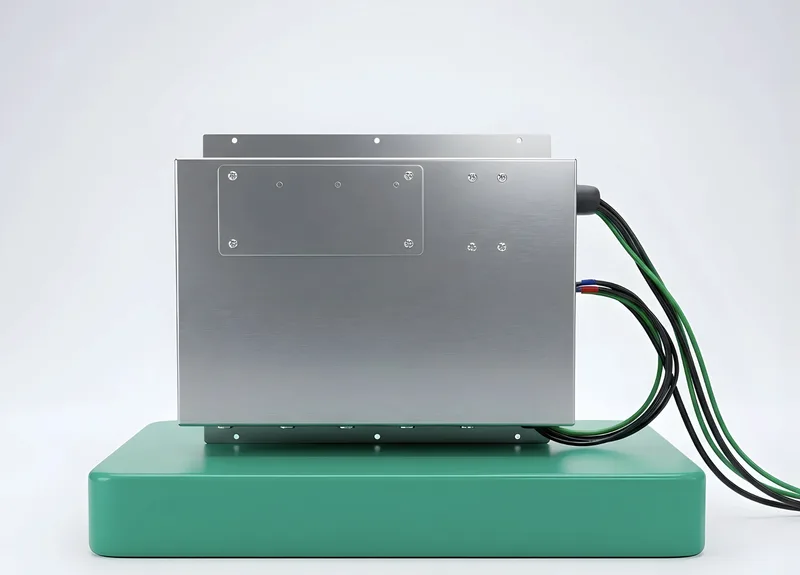
The most relevant component for Syria. It dynamically matches source impedance to load impedance thousands of times a second, holding voltage steady at the point of use — protecting sensitive loads in hospitals, pharmaceutical and food lines and process plants from the sags, swells and instability that are routine on a weak grid and on diesel-generator supply.
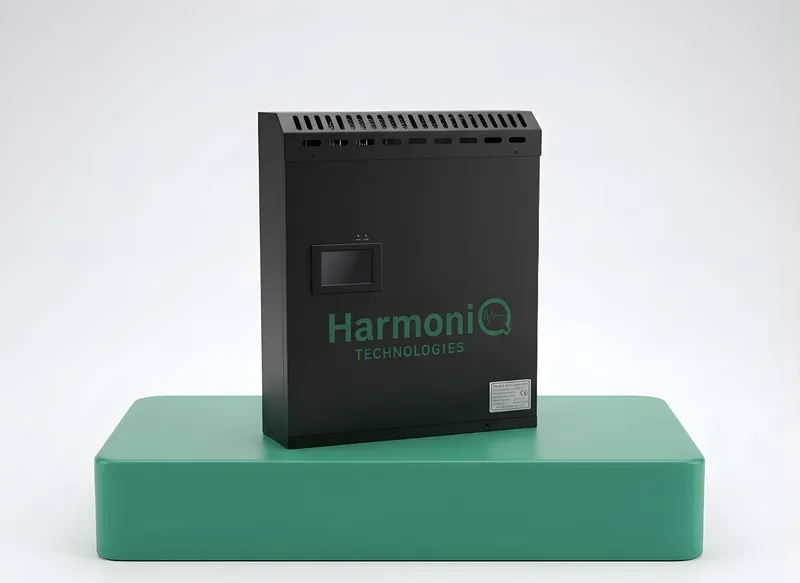
Active harmonic filtering in real time — critical for the VFD-driven motors, refrigeration compressors and rectifier loads common in food processing, textiles and pharmaceuticals, where harmonics are worse on an undersized, generator-fed network and shorten the life of equipment that is hard to replace.
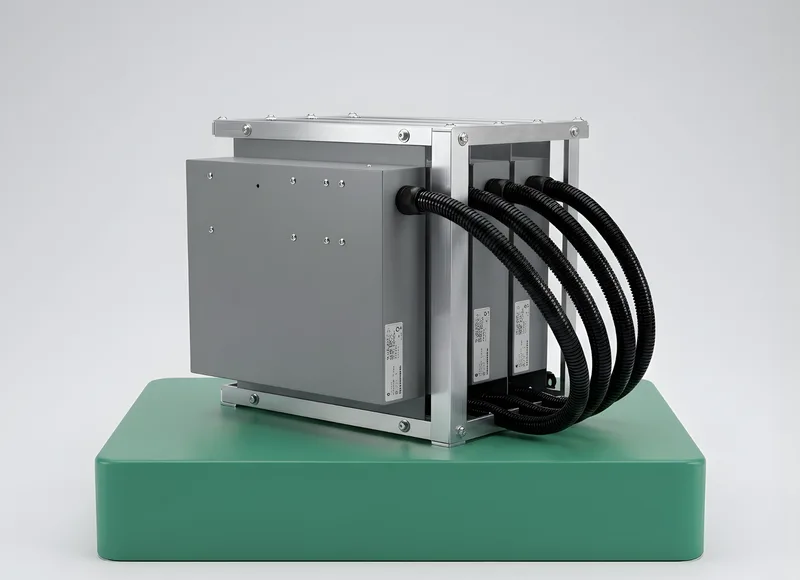
Real-time true power factor correction to 0.98+ across the whole network — reducing apparent-power demand and freeing transformer and switchgear capacity. On a generator-backed site this also reduces the size of generation a load needs to run, which matters where every kVA of available supply is scarce.
Why not just install capacitor banks? + Read more− Close
Switched-capacitor banks correct power factor in fixed steps at the incoming feed. But they respond in steps and seconds, so they lag fast-changing loads; they sit only at the boundary, so reactive current still flows through your internal network; and on a system carrying harmonics — as nearly every drive- and refrigeration-heavy plant does — a capacitor bank can form a resonant circuit with the supply, amplifying those harmonics. On a weak, generator-fed network those weaknesses are sharper still, and a passive bank does nothing for the voltage instability that is the core problem in Syria.
HarmoniQ is solid-state and dynamic: it corrects continuously rather than in steps, works across the network rather than at one point, stabilises voltage as well as correcting power factor, and carries no resonance risk. Paired with active filtering, it is power quality designed for a plant running on an unreliable grid and a diesel generator, not the switchgear of forty years ago.
What It’s Worth
Value in Continuity and Protection, Not a Bill Saving
| Lever | What changes | Effect on the site |
|---|---|---|
| Voltage stability / continuity | Voltage held steady on a weak or generator-fed supply | Fewer trips and stoppages — the line keeps running |
| Equipment protection | Less harmonic and voltage stress on motors, drives and process gear | Longer life for equipment that is hard and slow to replace |
| Power factor → 0.98+ | Lower apparent-power demand | Less generation to run a given load — scarce kVA freed, fuel saved |
| The core value | Keeping production running and protecting hard-to-replace equipment — not a tariff saving | |
Syria’s currency and tariff are too distorted to put a confident money figure on any of this, so we deliberately do not — the value here is continuity and protection, which our engineers quantify in your terms: hours of production protected, generation capacity freed, equipment stress reduced. Every site’s loads and supply profile are different, and the levers above describe the mechanism, not a quote. Get in touch for a site assessment, or see the method on our power factor correction and voltage optimisation pages.