The Cost of Power
Structurally Cheap and Clean — but Increasingly Volatile in the South
Sweden has long had some of the cheaper, cleaner electricity in Europe, built on abundant hydro and nuclear. By EU standards the tariff is mid-pack: the energy component runs at roughly €0.067–0.097 per kWh by price band, ex-tax, and delivered cost for a mid-size site lands at around €0.11–0.13 per kWh once networks and charges are added. That is high enough that every kilowatt-hour shaved is worth chasing — but in Sweden cost is the second-tier lever, not the headline. The structural shift in how the bill is charged matters more.
There is a sharp regional split Swedish operators know well. The north — price areas SE1 and SE2, rich in hydro — is structurally cheap and stable. The south — SE3 around Stockholm and Gothenburg, and SE4 around Malmö — is structurally pricier and HVDC-coupled to continental Europe, so it imports continental price volatility. For a factory, data centre or commercial estate in the south, the unit rate is both higher and far less predictable, and every percentage point of wasted current is charged at a rate that can swing hard.
| Measure | Typical price | Notes |
|---|---|---|
| Energy component (ex-tax, by band) | ~€0.067–0.097/kWh | Among the cheaper energy components in the EU, built on hydro and nuclear |
| Delivered cost, mid-size site (all-in) | ~€0.11–0.13/kWh | Energy plus network and charges — mid-pack by EU standards |
| North (SE1 / SE2) | Lower, more stable | Hydro-rich; structurally cheap |
| South (SE3 Stockholm/Gothenburg, SE4 Malmö) | Higher, more volatile | HVDC-coupled to continental Europe; rising price volatility |
The energy-component and delivered-cost figures are from HarmoniQ’s Sweden market research and are indicative of mid-size industrial and commercial sites. Figures are current as of 2025–2026 and are revised periodically — verify against Energimarknadsinspektionen (Ei) and your own distribution operator at the time of reading. Prices are per kWh, vary sharply by price area (SE1–SE4) and exclude site-specific demand and capacity charges; EUR/SEK is converted at prevailing market rates.
How You’re Billed
A Swedish Industrial Bill Is About to Be Reshaped
The headline price per kWh is only part of the story — and in Sweden it is the part that is changing least. A metered Swedish site pays for the energy itself, for the networks that deliver it, and for taxes and levies. But the decisive shift is in the network charge: every distribution operator is legally required to introduce capacity (effekt) tariffs by 31 December 2026, billing peak demand (kW) and reactive power directly. Today a winter reactive-power charge already applies; from the end of 2026 the same site faces an explicit capacity charge on top. Both line items move directly when you correct power factor.
| Component | What it is | Cut by power quality? |
|---|---|---|
| Energy (wholesale / commodity) | The kWh you consume, at the traded price for your price area | Indirectly — lower network losses |
| Network charges (nättariff) | Distribution and transmission fees for delivering power over the grid | Partly |
| Taxes & levies (energiskatt) | The electricity tax and other levies | No |
| Reactive-power charge (kvarh) | A charge that applies when reactive draw exceeds ~50% of active power in winter months | Yes — power factor correction cuts it directly |
| Capacity / effekt charge (kW & reactive) | A charge on peak demand and reactive power that every operator must introduce by 31 December 2026 | Yes — lower peak kW and reactive draw mean a lower charge |
So the answer to the question Swedish operators are starting to ask: yes, you are about to be billed for peak demand — through the capacity (effekt) tariff every operator must introduce by the end of 2026 — and yes, poor power factor already costs you, through today’s winter reactive-power charge and, from 2026, through the reactive element of the capacity charge as well. This is the structural point: on the same site, power factor and harmonic correction will start paying twice — once on energy, once on the new capacity charge.
Power Factor & Regulation
A Winter Reactive Charge Today — a Reactive Capacity Charge from 2026
A reactive-power charge already applies on Swedish networks when reactive draw exceeds roughly 50% of active power during the winter months. A site running with poor power factor pays it today. From 31 December 2026, under the capacity (effekt) tariffs every distribution operator is required to introduce, that reactive draw is billed again as part of an explicit capacity charge alongside peak kW. Correcting power factor to 0.98+ cuts the winter reactive charge now and lowers both the reactive and the peak-demand elements of the capacity charge as it lands — which is why, in Sweden, the case for correction is structural and legislated rather than price-dependent. The regulator setting the framework is Energimarknadsinspektionen (Ei).
On harmonics and supply quality, Swedish connections must hold voltage quality within EN 50160 and the distribution operators’ connection rules, with equipment and assemblies complying with the IEC 61000 series for electromagnetic compatibility and IEC 61439 for low-voltage assemblies. Sweden runs one of the most inverter-saturated grids anywhere — in 2024 it added roughly 40 TWh of wind, around 4 TWh of solar and 610 MW of new grid batteries — and with ubiquitous variable-speed drives and EV charging on top, harmonic distortion at low-voltage boards is rising. Staying inside those limits increasingly requires active harmonic filtering, not just a one-off survey.
The winter reactive-power charge and the threshold at which it applies are set per distribution operator and published in their terms of connection; voltage-quality limits follow EN 50160, with equipment compliance under the IEC 61000 series and IEC 61439 for LV assemblies. The capacity (effekt) tariff timing — every operator to introduce one by 31 December 2026 — is the operators’ stated requirement under the framework set by Energimarknadsinspektionen (Ei). Confirm the reactive-power threshold, the capacity-tariff design and the harmonic limits that apply to your connection with your distribution operator and with Ei — they vary by region and are updated periodically.
Why Power Quality Matters Here
A Reshaped Bill on a World-Leading Wind, Solar and Battery Grid
Three structural forces make power quality a Swedish boardroom issue, and none of them is keeping the lights on. First, the tariff shift: from 31 December 2026 every distribution operator must bill peak demand and reactive power directly through capacity (effekt) tariffs, so power factor and harmonic correction move from a soft efficiency story to a line item that is charged twice — on energy and on capacity. This is the single most important reason power quality matters here. Second, the generation mix: Sweden runs one of the most inverter-saturated grids on earth, having added roughly 40 TWh of wind, 4 TWh of solar and 610 MW of grid batteries in 2024 alone — that inverter-heavy supply, with ubiquitous VFDs and EV charging behind the meter, raises harmonic distortion at exactly the commercial and industrial sites we serve. Third, the tariff itself — structurally cheap but, in the southern SE3 and SE4 price areas, increasingly volatile and HVDC-coupled to continental prices, so every kilowatt-hour shaved still counts.
What does not drive the case in Sweden is reliability. The grid is among the most reliable in Europe — on the order of 84 customer-minutes lost per year and roughly one interruption a year — so unlike sites in parts of Africa or the Gulf, Swedish operators are not buying uptime. Where capacity does bite is the queue: grid congestion and connection queues raise the premium on using the connection you already have efficiently, which is exactly what correction delivers.
The Solution
Solid-State Correction and Filtering, Network-Wide
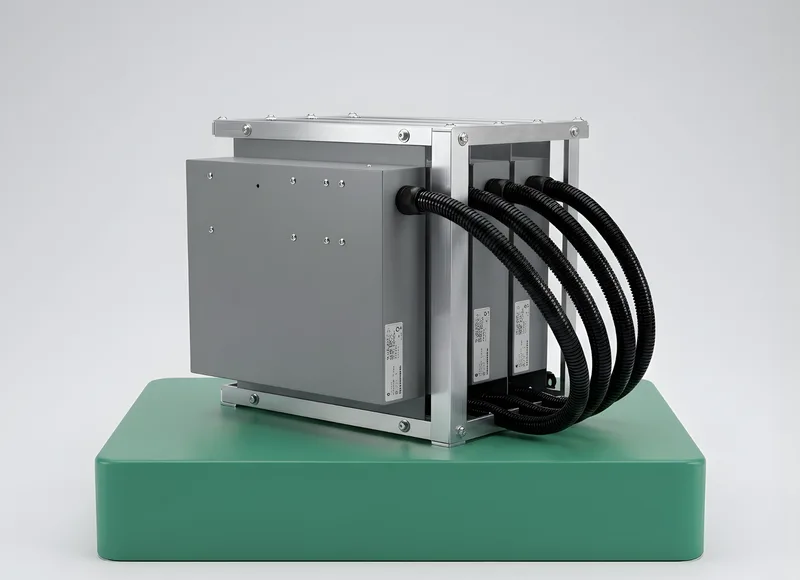
HarmoniQ installs a coordinated, solid-state system at the low-voltage switchboard — where Swedish sites carry their VFD-dense, inverter-fed load, where peak demand and reactive draw are set, and where the wind-, solar- and battery-heavy grid injects distortion. We deploy three products as the site requires: HarmoniQ Alpha as the integrated platform tying correction, filtering and voltage optimisation together, the HarmoniQ Delta for harmonic mitigation, and the HarmoniQ Sigma for real-time power factor correction. No switched-capacitor steps, no contactors, and no resonance risk with the harmonics already on your system.
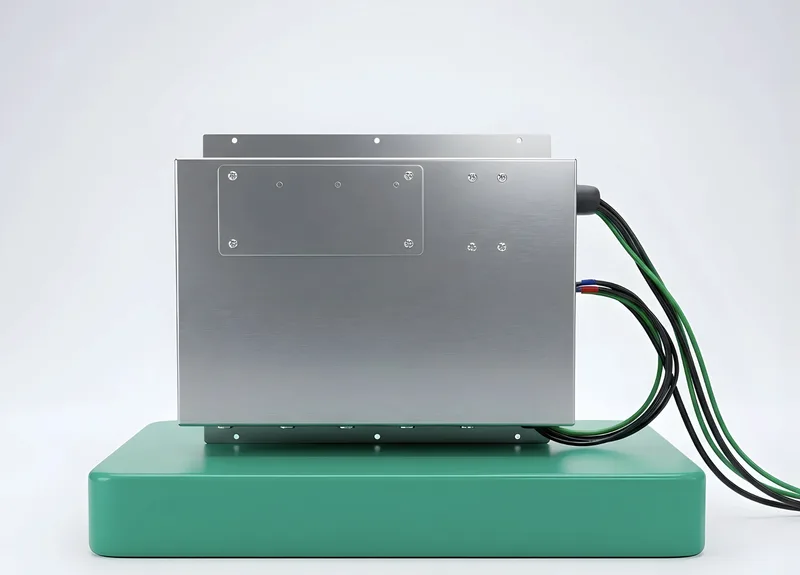
Dynamically matches source impedance to load impedance up to 20,000 times a second, stabilising voltage at the point of use — especially valuable under the weak-grid, high-renewable conditions an inverter-saturated system produces, and for sensitive data-hall, cleanroom and process loads.
Active harmonic filtering that holds distortion within EN 50160 and the distribution connection rules — the component that matters most on Sweden’s wind-, solar- and battery-heavy grid, where VFD-driven motors, pumps and chillers, EV charging and on-site inverters all push harmonic levels up at low-voltage boards.
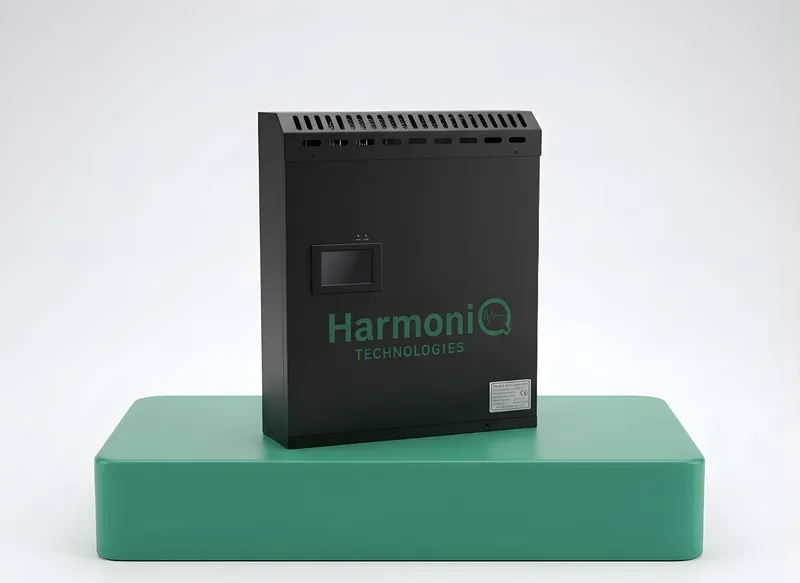
Real-time true power factor correction to 0.98+ across the whole network — cutting today’s winter reactive-power charge and lowering both the peak-demand and reactive elements of the capacity (effekt) tariffs every Swedish operator must introduce by 31 December 2026, while freeing 5–10% of transformer and switchgear capacity behind a congested connection.
Why not just install capacitor banks? + Read more− Close
Switched-capacitor banks correct power factor in fixed steps at the incoming feed — enough, in theory, to keep reactive draw below the winter threshold at the meter. But they respond in steps and seconds, so they lag fast-changing loads; they sit only at the boundary, so reactive current still flows through your internal network; and on a system carrying harmonics — as nearly every modern Swedish site does, with its drives, EV charging and inverters, on a grid saturated with wind, solar and batteries — a capacitor bank can form a resonant circuit with the supply, amplifying those harmonics.
HarmoniQ is solid-state and dynamic: it corrects continuously rather than in steps, works across the network rather than at one point, and carries no resonance risk. Paired with active filtering, it is power factor correction and harmonic mitigation designed for a plant full of drives and inverters on an inverter-heavy grid — and for a bill that, from 2026, charges peak demand and reactive power directly — not the switchgear of forty years ago.
What It’s Worth
Capacity-Charge Avoidance First, Then Harmonics and Energy
| Lever | What changes | Effect on the site |
|---|---|---|
| Capacity / effekt-charge avoidance (from 2026) | Peak kW and reactive draw cut before the capacity tariff lands | Lower the new capacity charge every operator must introduce by 31 December 2026 |
| Winter reactive-power charge | Reactive draw held below the ~50%-of-active threshold | Today’s winter charge removed |
| Harmonic filtering to EN 50160 | Lower distortion, cooler transformers & cables on an inverter-heavy grid | Lower losses, longer asset life, protected processes |
| Active-energy reduction (3–8%) | On ~€0.12/kWh, across ~7 GWh a year | A real second-tier saving — on top of the capacity and reactive charges avoided |
Every site’s loads, tariff and reactive profile are different, and the figures above illustrate the mechanism — not a quote. The energy saving is genuine but second-tier in Sweden, where power is structurally cheap; the headline value is avoiding the capacity (effekt) charge from 2026 and the winter reactive charge today, plus the harmonics held inside EN 50160. Our engineers will model the exact peak demand and reactive draw cut, distortion reduced, power factor improvement and losses reduced for your specific connection — get in touch for a site assessment, or see the method on our power factor correction and demand-charge pages.