The Cost of Power
Newly Cost-Reflective Tariffs — the Savings Case Now Works
For years, subsidised power meant efficiency barely moved the needle in Sri Lanka. That changed after the 2022 economic crisis. Under the IMF programme, the Ceylon Electricity Board (CEB) raised tariffs to cost-reflective levels in 2022–23 — bills for many users tripled — and the country now sits mid-range for the region. Industrial and business electricity runs at roughly $0.060–0.075 per kWh. For an apparel plant, tea factory, hotel, or commercial building, the price of a kilowatt-hour is now high enough that every wasted unit is worth eliminating.
This is the mirror image of a cheap-power market. Because tariffs are now cost-reflective, the old argument that “industrial power is too cheap for efficiency to matter” simply does not hold here — and a high-cost mid-commercial tier (Colombo offices, hotels, processing plants) feels the tariff just as acutely. Every percentage point of wasted current is charged at a rate that, for the first time in a generation, makes the case for correction.
| Who pays | Typical all-in price | Notes |
|---|---|---|
| Industry / business (qualifying sites) | ~$0.060–0.075/kWh | Raised to cost-reflective levels in 2022–23; mid-range for the region |
| Commercial-weighted (the rate qualifying sites pay) | ~$0.072/kWh | The blended rate apparel, hotels and Colombo commercial actually pay |
| Lower industrial block | ~$0.060/kWh | Even the floor is meaningful now tariffs are cost-reflective |
| Households (CEB domestic, incl. taxes) | ~$0.078/kWh (Sept 2025) | Block-structured tariff; the higher consumption blocks are charged dearly |
Industrial and commercial-weighted tariffs are from the CEB / PUCSL tariff schedule and GlobalPetrolPrices, valued in US dollars as the research does; the household figure is the CEB domestic average unit rate from GlobalPetrolPrices (the underlying CEB / PUCSL domestic tariff effective 12 June 2025 is a progressive block structure). Figures are current as of 2024–2025, predate the CEB unbundling that took effect on 9 March 2026, and are revised regularly — verify against the PUCSL electricity tariff and the CEB tariff schedule at the time of reading. All prices are unit rates and exclude fixed and demand charges.
How You’re Billed
A Sri Lankan Industrial Bill Is More Than the Energy You Use
The headline cents-per-kWh is only part of the story. A large CEB-supplied site pays for the energy itself, for fixed and fuel-adjustment charges — and, critically for power quality, for the maximum demand it places on the grid (in kVA) and for the reactive energy it draws beyond its free allowance. Those last two move directly when you correct power factor.
| Component | What it is | Cut by power quality? |
|---|---|---|
| Energy (per kWh) | The units you consume, at the cost-reflective tariff block | Indirectly — lower network losses |
| Fixed & fuel-adjustment charges | Standing charges and any fuel-adjustment surcharge in force | No |
| Maximum-demand charge (kVA) | A charge on the kVA maximum demand you place on the network, on tariffs above 42 kVA (industry, hotel, government, general-purpose) | Yes — lower kVA means a lower charge |
| Reactive-power penalty (kvarh) | A penalty on reactive energy drawn beyond the free allowance, which corresponds to a 0.98 lagging power factor | Yes — power factor correction clears it directly |
So the answer to two questions Sri Lankan operators often ask: yes, you are billed for kVA — through the maximum-demand charge on tariffs above 42 kVA — and yes, you are billed for poor power factor, through the reactive-power penalty once you slip below a 0.98 power factor. Both fall as power factor rises towards unity, which is exactly what correction delivers.
Power Factor & Regulation
A 0.98 Power-Factor Threshold That Rewards Correction
Sri Lanka’s bulk-supply tariffs apply a free reactive-energy allowance corresponding to a 0.98 lagging power factor, and levy a penalty on reactive energy drawn below it. The larger tariff categories — industry, hotel, government and general-purpose loads above 42 kVA — are also billed on maximum demand in kVA. The practical effect is that a motor- and drive-heavy site running below 0.98 pays a recurring penalty plus a higher demand charge, both of which fall away the moment it is corrected to 0.98+. Hotels, for instance, typically sit at 0.80–0.87 power factor — squarely in penalty territory.
On harmonics, distortion is held within IEC 61000 limits. As variable-speed drives, rectifiers, non-linear UPS and behind-the-meter solar multiply on Sri Lankan sites — and as the grid’s inverter-based renewable share rises towards a ~70% renewable-electricity target for 2030 — staying inside those limits increasingly requires active harmonic filtering, not just a one-off survey.
The free reactive-energy allowance to a 0.98 power factor and the penalty below it, together with the kVA maximum-demand charge on tariffs above 42 kVA, are set in the CEB “Allowed Charges” / PUCSL tariff schedule and the CEB Distribution and Supply Services Codes (which also require demand forecasts above 250 kVA); harmonic limits follow the IEC 61000 series. Note that the CEB was unbundled on 9 March 2026 into successor distribution companies and a National System Operator, which reshapes the connection and metering interface. Confirm the current reactive-power penalty rate, the kVA-charge schedule and the owning entity that apply to your connection with the relevant successor distribution company (or LECO) — they are updated periodically.
Why Power Quality Matters Here
Cost-Reflective Tariffs on a Single-Island Grid
Three structural forces make power quality a Sri Lankan boardroom issue, not just an engineering one. First, the tariff — already covered, and cost-reflective for the first time in a generation, so the energy-savings lever finally works. Second, the grid: Sri Lanka runs an isolated single-island system with no interconnectors, drawing ~16–17 TWh a year against a peak of ~2.8–3.0 GW, and roughly 55% of generation is low-carbon — hydro ~37%, solar ~14%, wind ~4% — a mix that is increasingly inverter-heavy and exposed to dry years and fuel-import shocks. That raises harmonic distortion and voltage volatility at exactly the commercial and industrial sites we serve. Third, capacity: freeing transformer and switchgear headroom on the connection you already have lets a growing apparel plant or hotel add load without a costly upgrade.
Unlike the high-cost grids of Western Europe, resilience is a live concern in Sri Lanka. The 2022 crisis brought rolling load-shedding, and an islandwide blackout in February 2025 left the single-island grid dark for around six hours — fresh memory that keeps uptime, alongside cost and capacity, on the agenda for operators of sensitive loads in hospitals, data halls and process plants.
The Solution
Solid-State Correction and Filtering, Network-Wide
HarmoniQ installs a coordinated, solid-state system at the low-voltage switchboard — where Sri Lanka’s qualifying sites carry their cost, where the reactive-power penalty and kVA maximum-demand charge are measured, and where the inverter-heavy grid injects distortion. We deploy three products as the site requires: HarmoniQ Alpha as the integrated platform tying correction, filtering and voltage optimisation together, the HarmoniQ Delta for harmonic mitigation, and the HarmoniQ Sigma for real-time power factor correction. No switched-capacitor steps, no contactors, and no resonance risk with the harmonics already on your system.
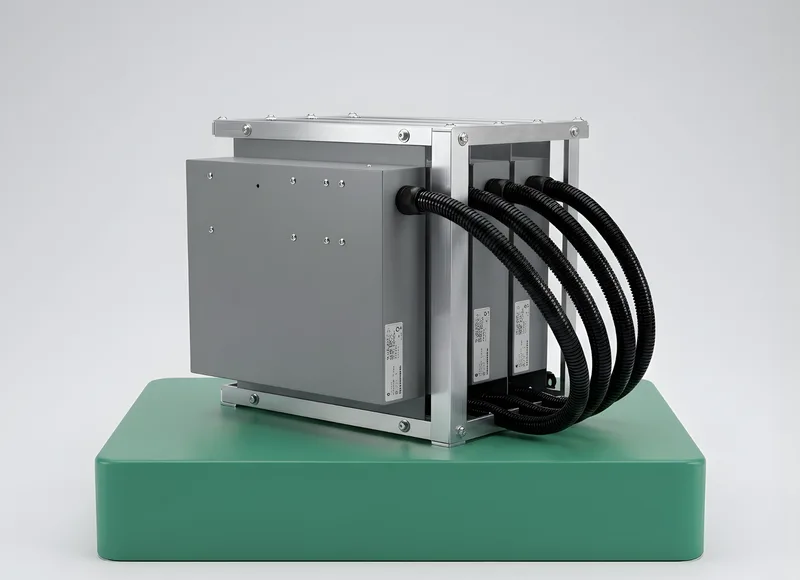
Unifies correction, filtering and voltage optimisation across multiple boards or sites — stabilising voltage at the point of use for sensitive loads, and providing the visibility to prove power factor, reactive energy and kVA demand at the meter, continuously.
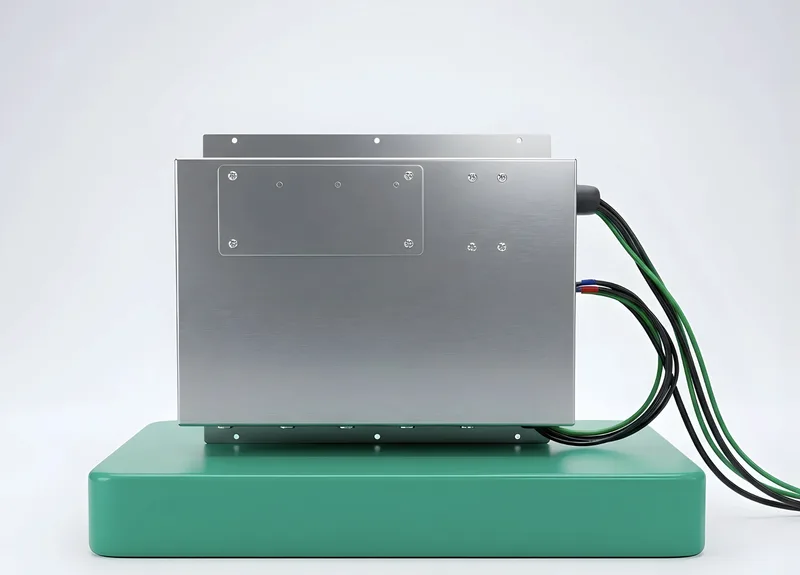
Active harmonic filtering that holds distortion within IEC 61000 limits — the component that matters most for the VFD-driven machinery, rectifier loads and non-linear UPS that dominate Sri Lanka’s garment lines, cold stores and commercial sites, and increasingly so as inverter-based renewables grow.
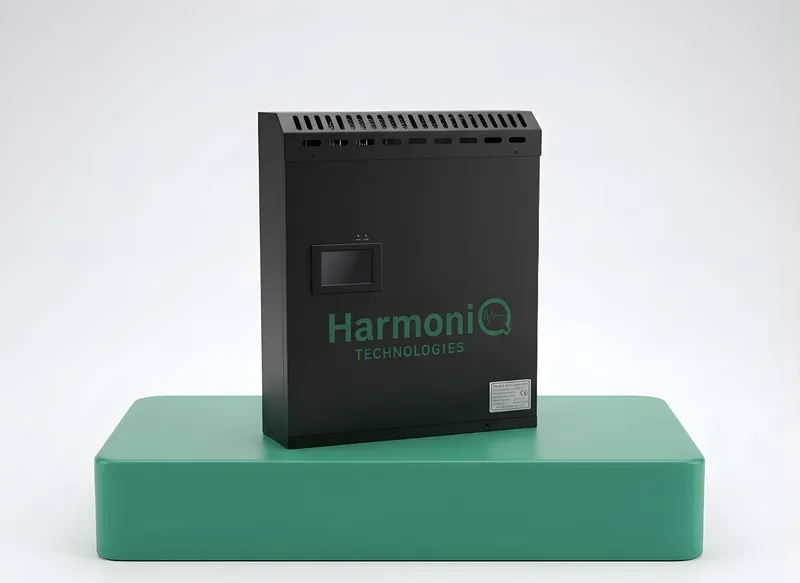
Real-time true power factor correction to 0.98+ across the whole network — clearing CEB’s reactive-power penalty threshold and cutting the billed kVA maximum demand, and freeing transformer headroom so a growing apparel plant or hotel can add load without a costly connection upgrade.
Why not just install capacitor banks? + Read more− Close
Switched-capacitor banks correct power factor in fixed steps at the incoming feed — enough, in theory, to lift you over the 0.98 threshold at the meter. But they respond in steps and seconds, so they lag fast-changing loads; they sit only at the boundary, so reactive current still flows through your internal network; and on a system carrying harmonics — as nearly every modern Sri Lankan plant does, with its drives, rectifiers and inverters — a capacitor bank can form a resonant circuit with the supply, amplifying those harmonics.
HarmoniQ is solid-state and dynamic: it corrects continuously rather than in steps, works across the network rather than at one point, and carries no resonance risk. Paired with active filtering, it is power factor correction and harmonic mitigation designed for a plant full of drives and inverters, not the switchgear of forty years ago.
What It’s Worth
Every Lever Pulls the Same Way
| Lever | What changes | Effect on the bill |
|---|---|---|
| Power factor → 0.98+ | Reactive energy clears the 0.98 threshold; kVA maximum demand falls | Reactive-power penalty cleared; kVA demand charge cut |
| Energy & loss reduction | 2–3% loss reduction — now meaningful on cost-reflective tariffs | Lower losses on every unit consumed |
| Capacity release | ~15–20% of transformer / switchgear headroom freed | Add load on a growing plant without a costly upgrade |
| Indicative annual saving | A worthwhile recurring sum on a site of this size — the kind a group finance team will act on across a portfolio, plus the capacity released | |
Every site’s loads, tariff and reactive profile are different, and the figures above are illustrative of the mechanism — not a quote. Our engineers will model the exact power factor improvement, reactive-power penalty and kVA charges avoided, losses reduced and capacity released for your specific connection — get in touch for a site assessment, or see the method on our power factor correction and demand-charge pages.