The Cost of Power
Cheap Energy — but a Real Reactive Charge and a Scarce Megawatt
Saudi Arabia pairs the largest industrial base in the Middle East with some of the most heavily subsidised electricity in the world. The industrial tariff sits at roughly SAR 0.18 per kWh (about USD 0.048) — around a third of a typical OECD industrial rate. So the usual headline argument does not apply here: in the Kingdom, the case for stopping waste is not built on an expensive kilowatt-hour. It is built on two things the subsidy does not touch — the reactive-power charge the Saudi Electricity Company applies the moment power factor falls below 0.95, and the grid capacity a fast-growing, cooling-heavy site has to fight for.
Because energy is so cheap, the value of correcting power factor in Saudi Arabia is led by what the subsidy cannot soften. Reactive current is billed directly through the SEC inefficient-consumption charge regardless of how low the energy rate is; the same reactive current inflates the kVA your connection has to carry, eating capacity you have already paid for under a summer peak where air-conditioning is roughly 70% of building load. Every percentage point of wasted current still costs — just not mainly in energy.
| Who pays | Typical tariff | Notes |
|---|---|---|
| Industry | ~SAR 0.18/kWh (~USD 0.048) | Heavily subsidised; among the lowest industrial rates in the world |
| Commercial | 22 / 32 halala per kWh (~USD 0.059–0.085) | Higher slab above 6,000 kWh a month; commercial estates pay well above industry |
| Large non-residential users | +2 halala/kWh fuel surcharge | A fuel-cost adder applied to non-eligible large consumers, on top of the slab rate |
| Households (SEC residential tariff) | 18 / 30 halala per kWh (~USD 0.048–0.080) | 18 halala up to 6,000 kWh a month, 30 halala above — industry pays roughly the entry residential rate |
Industrial, commercial and large-consumer tariffs are drawn from the SEC / SERA published tariff framework; the household figures are the SEC residential tariff (18 halala per kWh for the first 6,000 kWh a month, 30 halala above), confirmed against SERA and Saudi Electricity Company tariff listings in 2025–2026. The Saudi riyal is pegged at SAR 3.75 to the US dollar. Figures are current as of 2025–2026 and are revised periodically — verify against the Saudi Electricity Regulatory Authority (SERA) and your own SEC tariff at the time of reading. All figures are unit rates and exclude VAT, municipal fees and standing charges.
How You’re Billed
A Saudi Industrial Bill Is More Than the Energy You Use
The subsidised halala-per-kWh is only part of the story. A metered Saudi site pays for the energy itself — and, critically for power quality, for the peak demand (in kVA) it places on the network and for the excess reactive energy it draws once it slips past the SEC threshold. Those last two move directly when you correct power factor, and they do not depend on the energy rate, which is precisely why they matter so much in a low-tariff market.
| Component | What it is | Cut by power quality? |
|---|---|---|
| Energy (consumption) | The kWh you consume, at the subsidised slab tariff | Indirectly — lower network losses |
| Fuel-cost surcharge | A small per-kWh adder (+2 halala) on large non-residential users | Indirectly — scales with the kWh you waste |
| Demand / capacity (kVA) | A charge tied to the peak apparent power your connection carries | Yes — lower kVA means a lower charge and freed capacity |
| Inefficient-consumption charge (kVArh) | A charge on excess reactive energy once it exceeds 48.4% of active energy — the ratio for a 0.95 power factor — at 5 halalas per excess kVArh | Yes — power factor correction cuts it directly |
So the answer to two questions Saudi operators often ask: yes, you are billed for kVA — through the demand charge, where reactive current inflates the peak your connection has to carry — and yes, you are billed for poor power factor, through the inefficient-consumption charge once you fall below the 0.95 threshold. Both fall as power factor rises towards unity, which is exactly what correction delivers, and both are independent of how cheap the energy is.
Power Factor & Regulation
The SEC 0.95 Requirement — and the Charge for Missing It
Saudi Arabia’s power sector runs through a single buyer, the Saudi Power Procurement Company, feeding the Saudi Electricity Company (SEC), which owns most transmission and distribution, with the Saudi Electricity Regulatory Authority (SERA) as the independent regulator. Under the published tariff framework, SEC applies a minimum power factor of 0.95 to industrial subscribers and levies an “Inefficient Energy Consumption” charge of 5 halalas per excess kVArh whenever a site’s reactive energy exceeds 48.4% of its active energy — the reactive-to-active ratio that corresponds to a 0.95 power factor. Industrial subscribers are also expected to hold a load factor of roughly 80%, rewarding steady demand over spiky consumption. A site running at 0.82–0.90 power factor — typical for motor- and chiller-heavy plants — therefore pays a recurring charge that disappears the moment it is corrected to 0.98+, alongside lower demand fees.
On harmonics and equipment, Saudi connections must meet the IEC 61000 series for emissions and IEC 61439 for low-voltage assemblies, referenced through SASO standards as a condition of connecting larger non-linear loads. As variable-speed-driven chillers, rectifiers, non-linear UPS and behind-the-meter solar multiply across the Kingdom’s cooling, data-centre and commercial sites, staying inside those limits increasingly requires active harmonic filtering — not just a one-off survey.
The 0.95 minimum power factor, the 5-halalas-per-excess-kVArh inefficient-consumption charge, the 48.4%-of-active-energy threshold and the ~80% load-factor expectation are drawn from the SEC / SERA published tariff framework; harmonic and equipment limits follow the IEC 61000 and IEC 61439 series as referenced by SASO. Confirm the charge, threshold and limits that apply to your connection with the Saudi Electricity Regulatory Authority (SERA) and SEC — they are revised periodically and the precise power-factor threshold can vary with the connection and tariff category.
Why Power Quality Matters Here
Cheap Power, a Cooling-Driven Peak, and a Vision 2030 Build-Out
Three structural forces make power quality a Saudi boardroom issue, not just an engineering one — and notably, the tariff is not the lead one. First, the reactive charge and capacity: with energy subsidised, the cost of low power factor surfaces almost entirely through the SEC inefficient-consumption charge and the kVA your connection carries, both of which correction removes. Second, the cooling-driven peak: national consumption reached about 343 TWh in 2024, summer peak demand sits near 62–65 GW and is projected towards roughly 84 GW by 2030, with air-conditioning around 70% of building load — so freeing transformer and switchgear headroom on the connection you already have has real and rising value. Third, the Vision 2030 build-out: NEOM and its industrial city Oxagon, the King Salman Energy Park (SPARK) and the clusters under the National Industrial Development and Logistics Programme are energising new low-voltage distribution now — greenfield boards where power quality is far cheaper to design in than to retrofit after the first SEC bill arrives.
What matters less in Saudi Arabia is resilience. The SEC grid is broadly reliable, with regional variation, so — unlike sites in parts of Africa — Kingdom operators are driven by the reactive charge, capacity and compliance rather than by keeping the lights on. There is also a clean efficiency overlay: the Saudi Energy Efficiency Center (SEEC), under the Saudi Energy Efficiency Program (Tarsheed), pushes large industrial consumers towards measurable cuts in energy intensity, and power factor correction is one of the cleanest ways to meet those targets — it cuts wasted current, and the carbon behind it, without touching production.
The Solution
Solid-State Correction and Filtering, Network-Wide
HarmoniQ installs a coordinated, solid-state system at the low-voltage switchboard — where Saudi sites carry their load, where the SEC 0.95 reactive charge bites, where the cooling-driven peak constrains capacity, and where SASO compliance is evaluated. We deploy three products as the site requires: HarmoniQ Alpha as the integrated platform tying correction, filtering and voltage optimisation together, the HarmoniQ Delta for harmonic mitigation, and the HarmoniQ Sigma for real-time power factor correction. No switched-capacitor steps, no contactors, and no resonance risk with the harmonics already on your system.
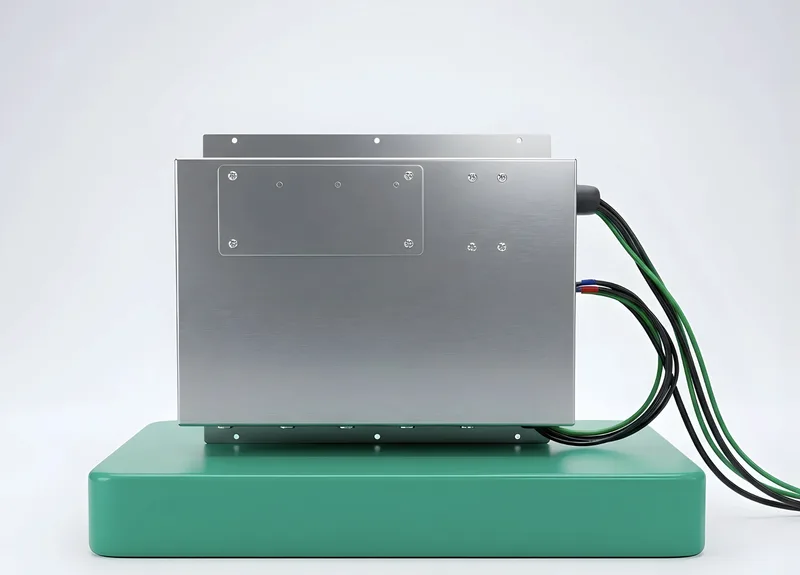
Unifies correction, filtering and voltage optimisation across multiple boards or sites — with the visibility to prove power factor, reactive energy and kVA demand at the meter, continuously. The natural fit for the criticality-led tail: hospitals, data halls and sensitive process plant.
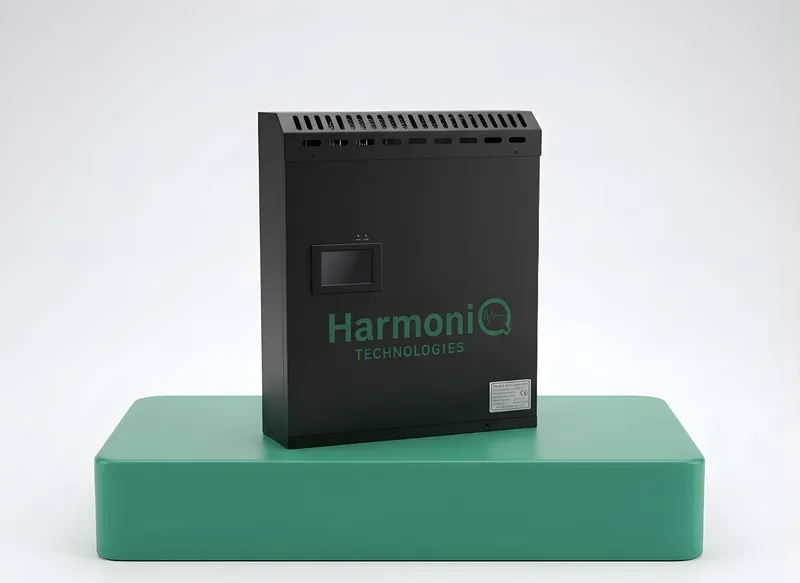
Active harmonic filtering that holds distortion within the IEC 61000 limits referenced by SASO — the component that matters most for the Kingdom’s VFD-driven chillers, rectifier loads and non-linear UPS, cutting transformer and neutral heating and easing nuisance trips in high-ambient Saudi switchrooms.
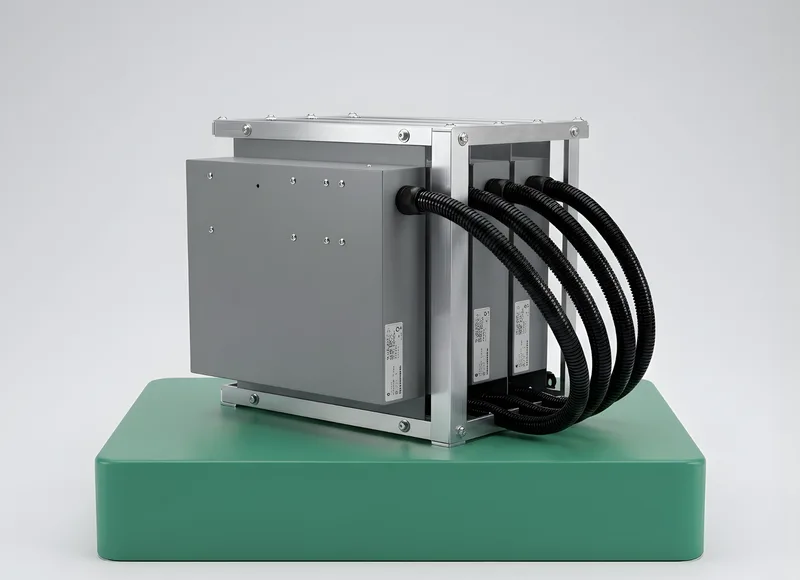
Real-time true power factor correction to 0.98+ across the whole network — clearing the SEC 0.95 requirement to remove the inefficient-consumption charge and cut demand fees, and freeing roughly 15–20% of transformer and switchgear capacity so a cooling-heavy site can add load without a costly upgrade. It tracks the load thousands of times a second, so correction holds as motors start, chillers cycle and shifts change.
Why not just install capacitor banks? + Read more− Close
Switched-capacitor banks correct power factor in fixed steps at the incoming feed — enough, in theory, to lift you over the 0.95 line at the meter, which is why they are common across the region. But they respond in steps and seconds, so they lag fast-changing loads and can leave you over- or under-corrected; they sit only at the boundary, so reactive current still flows through your internal network; and on a system carrying harmonics — as nearly every Saudi industrial site does, with its drives, rectifiers and chillers — a capacitor bank can form a resonant circuit with the supply, amplifying those harmonics and, in the worst case, failing the capacitors themselves in the Kingdom’s high ambient temperatures.
HarmoniQ is solid-state and dynamic: it corrects continuously rather than in steps, works across the network rather than at one point, and carries no resonance risk. Paired with active filtering, it is power factor correction and harmonic mitigation designed for a modern plant full of drives and chillers, not the switchgear of forty years ago.
What It’s Worth
Cheap Energy, a Real Charge — the Value Is Capacity and the Charge
| Metric | Before | After HarmoniQ | Improvement |
|---|---|---|---|
| Power factor | 0.82 | 0.98 | +19.5% |
| Reactive energy vs. active | ~70% (above 48.4% limit) | ~20% (well inside limit) | Within SEC threshold |
| SEC inefficient-consumption charge | Charged monthly | Eliminated | −100% |
| Peak demand (kVA) | 5,000 | 4,184 | −16.3% |
| Spare connection capacity | Near limit | ~800 kVA freed | Capacity released |
| Indicative annual saving | SAR 1.0M–1.8M (~USD 270K–480K) | charge + demand + losses | |
How the inefficient-consumption charge adds up — worked example + Read more− Close
Take a site drawing 5,000,000 kWh of active energy in a month at a power factor of 0.82. At 0.82, reactive energy runs at roughly 70% of active energy — about 3,490,000 kVArh. SEC only allows reactive energy up to 48.4% of active, i.e. 2,420,000 kVArh. The excess is therefore about 1,070,000 kVArh.
At 5 halalas per excess kVArh (0.05 SAR), that is roughly SAR 53,500 in a single month, or on the order of SAR 640,000 a year — from the reactive-energy charge alone, before the demand and loss savings that come with it. Correcting to 0.98 pulls reactive energy down to about 20% of active, comfortably inside the 48.4% threshold, and the charge falls away entirely. Your exact numbers depend on your tariff, load profile and starting power factor — this is the mechanism, not a quote.
Every site’s loads, tariff and reactive profile are different, and the figures above are illustrative of the mechanism — not a quote. Our engineers will model the exact power factor improvement, SEC inefficient-consumption charge avoided, demand reduction, losses reduced and capacity released for your specific connection — get in touch for a site assessment, or see the method on our power factor correction and demand-charge pages.