The Cost of Power
Among Asia’s Highest Tariffs — and Rising
Industrial electricity in Pakistan has become some of the most expensive in the region. After years of steep increases tied to the country’s IMF programme — the average base tariff was set around Rs 32.7 per kWh in July 2024, dipped to Rs 31.6 per kWh for FY2025–26, then was rebased back up to Rs 33.38 per kWh for CY2026 (Rs 33.48 for industry) — the all-in price a business actually pays, including taxes and surcharges, reached roughly Rs 43 per kWh (about US$0.155/kWh) in September 2025. For a textile mill, factory, data centre or commercial estate, the price of a kilowatt-hour is the single biggest reason to stop wasting any.
That tariff hits Pakistani exporters especially hard. Electricity for the textile sector — which makes up close to 60% of Pakistan’s exports and around 46% of its manufacturing — runs at roughly 13 US cents per kWh, against about 9.5 cents in India, 10.2 in Bangladesh and 7 in Vietnam. So the usual argument that “industrial power is cheap, efficiency doesn’t move the needle” simply does not hold here. Every percentage point of wasted current is charged at one of Asia’s higher unit rates, on top of a bill the government has had to repeatedly raise to plug the sector’s circular debt.
| Who pays | Typical price | Notes |
|---|---|---|
| Industry / business (all-in, incl. taxes & distribution) | ~Rs 43.0/kWh (~US$0.155, Sep 2025) | Among the highest business tariffs in Asia — about 142% of the Asian average |
| System average base tariff (all consumers) | ~Rs 33.4/kWh (CY2026) | Rebased up from ~Rs 31.6/kWh (FY2025–26); ~Rs 33.5/kWh for industry |
| Textile / exporter benchmark | ~13 US cents/kWh | Roughly double Vietnam (~7¢) and above India (~9.5¢) and Bangladesh (~10.2¢) |
| Residential (all-in, incl. taxes & distribution) | ~Rs 17.5/kWh (~US$0.063, Sep 2025) | Protected, lifeline-style slabs keep homes well below the industrial rate |
All-in industrial/business and residential prices are from GlobalPetrolPrices (September 2025) and include the cost of power, distribution and all taxes and fees; the average base tariff (Rs 32.73/kWh July 2024, Rs 31.59/kWh FY2025–26, Rs 33.38/kWh for CY2026 determined January 2026) is from NEPRA as reported by Profit/Pakistan Today and Business Recorder; the textile/exporter benchmark is from the Pakistan Textile Council via Profit. Figures were reviewed in June 2026; rupee values move with the exchange rate, and tariffs are revised by NEPRA every quarter for fuel and capacity adjustments — verify against the NEPRA tariff schedules and your distribution company at the time of reading. All prices are unit rates and exclude fixed and demand charges.
How You’re Billed
A Pakistani Industrial Bill Is More Than the Energy You Use
The headline rupee-per-kWh is only part of the story. An industrial site metered on a two-part tariff pays for the energy itself, for fuel-price and quarterly tariff adjustments, for taxes and surcharges — and, critically for power quality, for the maximum demand it places on the network, measured and billed in kW or kVA, and for a low-power-factor penalty if its power factor slips. And where the grid cannot be relied on, a site also carries the separate, often larger cost of the fuel its own generators burn. Several of those line items move directly when you correct power factor.
| Component | What it is | Cut by power quality? |
|---|---|---|
| Energy charge (kWh) | The units you consume at your tariff category, with peak / off-peak rates for larger users | Indirectly — lower network losses |
| Fixed / maximum-demand charge (kW or kVA) | A charge on the sanctioned load or maximum demand (MDI) you place on the network | Yes — lower apparent power means a lower charge |
| Low-power-factor (LPF) penalty | A surcharge applied when average power factor falls below the 0.90 threshold | Yes — power factor correction removes it directly |
| Fuel Price Adjustment & Quarterly Tariff Adjustment | Pass-through of fuel and capacity costs, revised regularly by NEPRA | Indirectly — on the units you save |
| Taxes & surcharges | General Sales Tax, electricity duty, financing-cost and other surcharges | No |
| Captive / generator fuel (where self-generating) | Gas or diesel burned to make your own power when the grid is unavailable or uneconomic | Yes — better power factor means the same real kW for less fuel |
So the answer to two questions Pakistani operators often ask: yes, you are billed for demand — through the fixed / maximum-demand charge on the kW or kVA you draw — and yes, you are billed for poor power factor, through the low-power-factor penalty once you slip below 0.90. Both fall as power factor rises towards unity, which is exactly what correction delivers — and on a self-generating site, the same correction trims the fuel the generator burns.
Power Factor & Regulation
A Low-Power-Factor Penalty Below 0.90 — on the Bill
Unlike markets with no reactive charge at all, Pakistani distribution companies apply a clear power-factor rule. Under the NEPRA-approved terms and conditions of the tariff, the average power factor of a two-part-tariff (industrial / commercial) consumer at the point of supply shall not be less than 90% (0.90); where it falls below that threshold, a low-power-factor penalty is levied — the schedule of tariff sets it at a 2% increase in fixed charges for each 1% the power factor falls below 90%. A motor- and drive-heavy plant sitting at 0.80–0.88 power factor therefore pays a recurring penalty that disappears the moment it is corrected to 0.98+, alongside a lower maximum-demand charge.
On harmonics and supply quality, Pakistani connections operate under the NEPRA Distribution Code, with industrial power-quality practice referencing international limits — IEEE 519 (which caps voltage total harmonic distortion at 5%) and the IEC 61000 series. As variable-speed drives, rectifiers, non-linear UPS and behind-the-meter solar multiply on Pakistani sites, staying inside those limits increasingly requires active harmonic filtering — not just a one-off survey.
The low-power-factor penalty below a 0.90 power factor is set in the NEPRA-approved terms and conditions of each distribution company’s tariff and applied to two-part-tariff (industrial / commercial) consumers; the standard clause sets the penalty at a 2% increase in fixed charges for each 1% the power factor falls below 90%, but the exact threshold, basis and rate vary by tariff category and are updated periodically. Harmonic and supply-quality requirements follow the NEPRA Distribution Code together with IEEE 519 and the IEC 61000 series as applied at industrial connections. Confirm the penalty, threshold and limits that apply to your connection with your distribution company (DISCO) and NEPRA — verify the current figures before relying on them.
Why Power Quality Matters Here
A High-Cost Tariff, an Unreliable Grid and Expensive Self-Generation
Three structural forces make power quality a Pakistani boardroom issue, not just an engineering one. First, the tariff — already covered, among the highest in Asia and raised repeatedly under the IMF programme. Second, grid reliability: Pakistan has suffered repeated nationwide failures — the January 2023 collapse left around 220 million people without power — and although the country now runs a generation surplus, load-shedding still persists for financial and network reasons, ranging from a couple of hours a day in well-served areas to eight hours or more in others. Third, the cost of coping with that unreliability: many industrial sites run their own captive generation, and around 1,180 captive power plants burn gas and diesel to keep production going — so the true cost of power on those sites is the blended grid-plus-captive figure, not the grid tariff alone.
That self-generation is now unusually expensive. Roughly half of all industrial gas has been used for in-house electricity generation, and under the IMF programme the government has sharply raised the gas price for captive plants — the base rate was lifted to around Rs 3,500 per MMBtu in early 2025, far above the protected domestic slabs — and added an off-grid levy on top that pushes the all-in captive gas price to roughly Rs 4,900 per MMBtu (April 2026) to drive industry back onto the network. With captive plants typically only around 30% efficient, a unit of self-generated power can cost well above the grid — fuel-oil (RFO) generation was reported at around Rs 37–38/kWh, with gas-backed generation cheaper, in early 2024 (Profit). A weak feeder sags and browns out; an islanded generator is a soft, high-impedance source easily distorted by the drives, rectifiers and UPS on the board. Holding voltage steady, correcting power factor and filtering harmonics at the low-voltage switchboard protects the motors, drives and refrigeration that would otherwise trip, overheat or fail — and trims the fuel burned to run them.
The Solution
Solid-State Correction and Filtering, Network-Wide
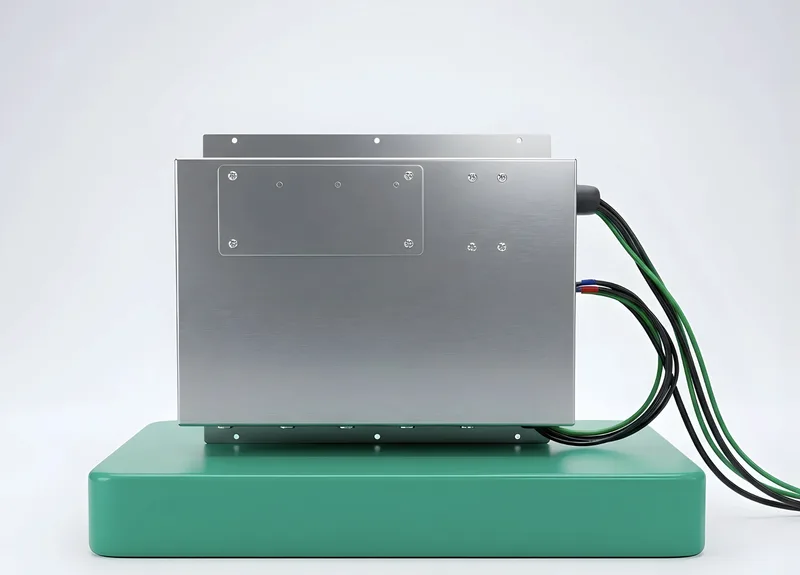
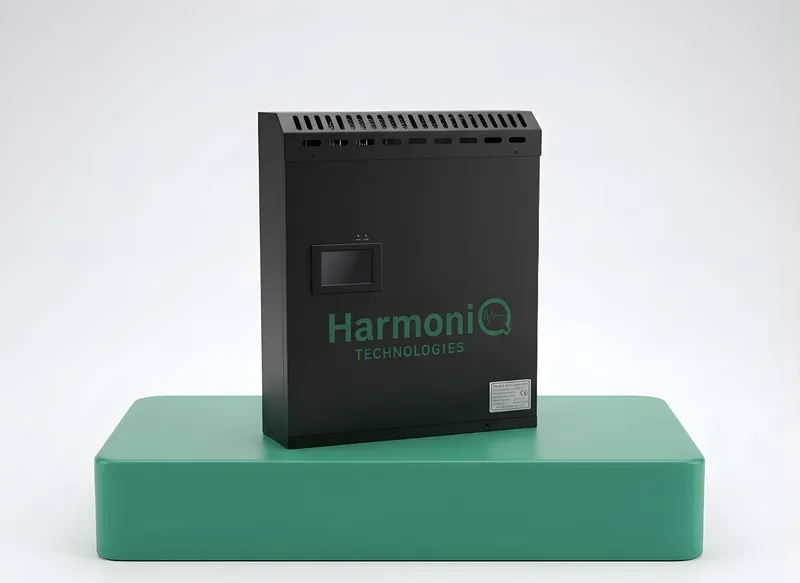
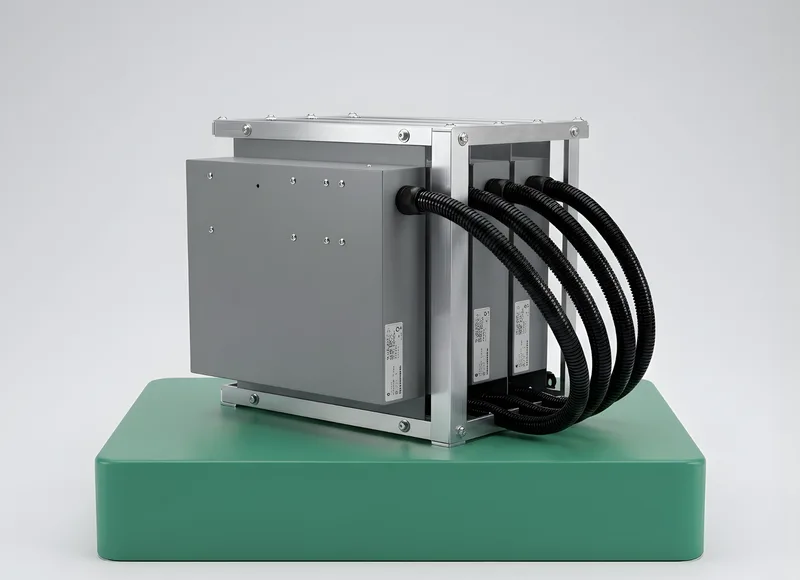
HarmoniQ installs a coordinated, solid-state system at the low-voltage switchboard — where Pakistani sites carry their cost, where the maximum-demand charge and the low-power-factor penalty bite, and where a weak grid feeder or an islanded generator injects distortion. We deploy three products as the site requires: HarmoniQ Alpha as the integrated platform tying correction, filtering and voltage stabilisation together, the HarmoniQ Delta for harmonic mitigation, and the HarmoniQ Sigma for real-time power factor correction. No switched-capacitor steps, no contactors, and no resonance risk with the harmonics already on your system.
Unifies correction, filtering and voltage stabilisation across multiple boards or sites — holding voltage steady through feeder sags and genset load steps, with the visibility to prove power factor, harmonics and maximum demand at the meter, continuously.
Active harmonic filtering that holds distortion within IEEE 519 and IEC 61000 limits — the component that matters most where the drives, rectifiers and non-linear UPS common in Pakistani textile mills, factories and data centres push harmonic levels up, and sharper still on a weak feeder or small islanded genset.
Real-time true power factor correction to 0.98+ across the whole network — clearing the 0.90 threshold to remove the low-power-factor penalty and cut the maximum-demand charge, and — on self-generating sites — letting your generator deliver the same real kilowatts on less fuel and with less capacity tied up.
Why not just install capacitor banks? + Read more− Close
Switched-capacitor banks correct power factor in fixed steps at the incoming feed — enough, in theory, to lift you over the 0.90 threshold at the meter. But they respond in steps and seconds, so they lag fast-changing loads; they sit only at the boundary, so reactive current still flows through your internal network; and on a system carrying harmonics — as nearly every modern Pakistani site does, with its drives, rectifiers and inverters — a capacitor bank can form a resonant circuit with the supply, amplifying those harmonics. On a small islanded generator, that resonance risk is sharper still.
HarmoniQ is solid-state and dynamic: it corrects continuously rather than in steps, works across the network rather than at one point, stabilises voltage on a weak source, and carries no resonance risk. Paired with active filtering, it is power factor correction and harmonic mitigation designed for a plant full of drives and inverters — whether on the grid or on its own generator — not the switchgear of forty years ago.
What It’s Worth
High Tariff, a Real Penalty, Costly Fuel — the Savings Compound
| Lever | What changes | Effect on the bill |
|---|---|---|
| Power factor → 0.98+ | Average power factor clears the 0.90 threshold; maximum demand falls | Low-power-factor penalty removed; demand charge cut |
| Lower fuel burn (self-generating sites) | The genset delivers the same real kW on less fuel and less spinning capacity | Captive gas / diesel cost cut |
| Harmonic filtering to IEEE 519 | Lower distortion, cooler transformers & cables | Lower losses, longer asset life |
| Capacity release | Power factor 0.80→0.98 frees ~15–20% of transformer / genset headroom | Add load, or downsize the generator |
| Indicative annual saving | A material recurring sum on a site of this size — plus the capacity released and the failures avoided | |
Every site’s loads, grid-versus-captive split, tariff and reactive profile are different, and the figures above are illustrative of the mechanism — not a quote. Our engineers will model the exact power factor improvement, the low-power-factor penalty and maximum-demand charge avoided, the fuel and losses reduced and the capacity released for your specific site — get in touch for a site assessment, or see the method on our power factor correction and demand-charge pages.