The Cost of Power
A Subsidised Grid Moving to Cost-Reflective Pricing
Oman is changing the question that the rest of the Gulf rarely asks. Historically its electricity was deeply subsidised — and for households it still is — but the Authority for Public Services Regulation (APSR) now applies a Cost-Reflective Tariff (CRT) to every non-residential customer consuming more than 100 MWh a year. For those large commercial and industrial sites, the price of a unit is built up from the real wholesale, transmission, distribution and supply costs — so for a factory, cooling plant or industrial estate, wasted current is now charged at a price that genuinely moves the bill, not a token rate.
That makes Oman a hybrid case. The energy-savings argument that barely carries in subsidised Qatar or Kuwait does carry for an Omani large consumer on the cost-reflective tariff — and it sits alongside the same structural levers that matter across the Gulf: the capacity (kVA) and peak demand you reserve, the country’s 0.9 power-factor and harmonic requirements, and the heat that punishes every amp you draw and do not need. The energy line, the capacity and the code all move in the same direction when power factor is corrected.
| Who pays | Typical price | Notes |
|---|---|---|
| Large industrial / commercial — cost-reflective, low voltage (0.415 kV) | ~32 Bz/kWh (≈$0.083) | 2025 CRT flat tariff at LV; seasonal summer tariff rises to ~38 Bz/kWh |
| Large industrial / commercial — cost-reflective, 33 kV | ~25 Bz/kWh (≈$0.065) | Higher-voltage connections pay a lower CRT flat rate (11 kV ~26 Bz; HV ~21 Bz) |
| Business / commercial (representative average) | ~$0.166/kWh (OMR 0.064) | GlobalPetrolPrices, Sept 2025; above the global commercial average |
| Households (representative average) | ~$0.036/kWh (OMR 0.014) | Sept 2025; still subsidised, so the residential unit rate moves little |
The cost-reflective flat and seasonal tariffs by connection voltage are from the APSR / Nama Statement of Charges — Cost Reflective Tariffs 2025; the business and household averages are from GlobalPetrolPrices (September 2025). The Omani rial is pegged at OMR 0.3845/USD (1 OMR ≈ US$2.60) by the Central Bank of Oman, and 1 baisa = OMR 0.001. Figures reflect the published 2025 tariff and are current as of June 2026; the cost-reflective tariff is recalculated and published by the end of each December — verify the rates and eligibility that apply to your connection with APSR at the time of reading. Prices are unit rates and exclude the supply standing charge and capacity-related charges.
How You’re Billed
A Cost-Reflective Bill Is Built From Four Parts — Two Move With Power Factor
For a large Omani site, the bill is not a single subsidised rate. Under the cost-reflective tariff it is built up from four components: the energy charge (the wholesale Bulk Supply Tariff, which varies by season and time of day), a Transmission Use of System charge levied on the peak demand you place on the grid, a Distribution Use of System charge per kWh at your connection voltage, and a Supply charge for administering your account. The transmission demand charge and the capacity behind it are where power factor bites.
| Component | What it is | Cut by power quality? |
|---|---|---|
| Energy — Bulk Supply Tariff (BST) | The kWh you consume, priced by season and time of day (~12–46 OMR/MWh across the year on the MIS) | Indirectly — lower network losses, and on a cost-reflective rate that saving is real |
| Transmission Use of System (peak demand) | A charge on your contribution to system peak — a coincident-peak charge of 7,691 OMR/MW and a non-coincident peak charge of 1,839 OMR/MW (2025) | Yes — correcting power factor lowers the kVA and peak demand you draw for the same kW |
| Distribution Use of System (DUoS) | An energy charge per kWh at your connection voltage (e.g. 4.0 Bz/kWh at 33 kV, 5.0 Bz/kWh at 11 kV) | Partly — lower losses on the current you draw |
| Reserved capacity (kVA) & transformer headroom | The apparent-power capacity your connection and transformer must carry to serve your load | Yes — correction frees ~15–20% of headroom on the asset you already have |
| Supply charge | A standing charge per account — 50 OMR/customer/annum (2025) | No — fixed administrative cost |
So the answer for an Omani large consumer is unusually favourable for the Gulf: yes, you are billed for peak demand — through the Transmission Use of System charge levied per MW — and yes, a poor power factor inflates the kVA and demand you reserve, raising that charge and locking up transformer headroom. Correcting power factor lowers the apparent power you draw for the same useful work, which trims the demand charge, frees capacity, and — because the tariff is cost-reflective — saves real money on the energy line too.
Power Factor & Regulation
A 0.9 Power-Factor Requirement and Tight Harmonic Limits
Oman codifies power quality in two places. On power factor, the Omani electrical standard OES-4 (Electrical Installations in Buildings) requires equipment — air-conditioning plant, motors above 0.5 HP and discharge lighting — to incorporate correction to obtain a power factor of 0.9 or better, agreed with the relevant Distribution Company. For a motor- and chiller-heavy commercial or industrial site, meeting that 0.9 requirement at the installation, rather than appliance by appliance, is exactly what network-wide correction delivers.
On harmonics, the Oman Distribution Code (DCC.4.3) is notably strict: the maximum total harmonic distortion at 66 kV, 33 kV and 11 kV is 2.0%, with no individual harmonic above 1.5%, and at low voltage the limit is 2.5% — tighter than the planning levels used in many markets, and aligned with the IEC 61000 series and IEEE 519 referenced in Omani regulation. As variable-speed-driven chillers, rectifiers and non-linear UPS multiply across Oman’s cooling, industrial and data-centre sites — and as the grid adds inverter-based solar — holding distortion inside those limits increasingly requires active harmonic filtering, not a one-off survey.
The 0.9 power-factor requirement for installed equipment is set in the Omani standard OES-4 (Electrical Installations in Buildings); the harmonic limits — 2.0% THD at 66/33/11 kV (1.5% per individual harmonic) and 2.5% at LV — are from the Oman Distribution Code, clause DCC.4.3, which aligns with the IEC 61000 series and IEEE 519. Connection and reactive-compensation requirements at HV are governed by the Distribution Code and the Oman Grid Code. Confirm the exact power-factor, harmonic and connection requirements that apply to your installation with APSR and your Distribution Company — the codes are updated periodically and we have not independently audited every clause here.
Why Power Quality Matters Here
Cost-Reflective Power, Constrained Capacity, Punishing Heat
Four forces make power quality a real issue in Oman, and they reinforce each other. First, the cost-reflective tariff — already covered — means a large consumer genuinely pays for wasted current, so avoided losses show up on the bill. Second, capacity: correcting power factor from around 0.80 to 0.98 frees roughly 15–20% of transformer and switchgear headroom, and on a fast-growing, fast-cooling economy that released headroom is what lets a site add chillers, lines or new process load on the connection it already has. Third, ambient heat: Omani summers drive peak demand through air-conditioning — cooling dominates the May–July peak — and at temperatures that have exceeded 50 °C, every amp of reactive or distorted current you draw and do not need turns into extra heat in cables, motors and transformers, accelerating ageing precisely when cooling load is highest. Fourth, harmonics: the VFD-driven chillers, rectifiers and non-linear UPS that dominate Oman’s buildings push distortion towards the Distribution Code’s tight 2.0–2.5% limits.
What matters less in Oman is resilience. The grid is reliable — APSR reports transmission-network reliability of around 99.9% — so unlike sites in parts of Africa, the case here is rarely about keeping the lights on. It is about cost, capacity, compliance and heat. Oman’s wholesale market pool demand reached 38.97 TWh in 2024, up 7.4% on the year, with the peak set on 25 June and renewables supplying 4.4% of pool generation — and the load we serve runs from cooling and commercial buildings to the country’s LNG, smelter and Duqm-area industrial complexes.
The Solution
Solid-State Correction and Filtering, Network-Wide
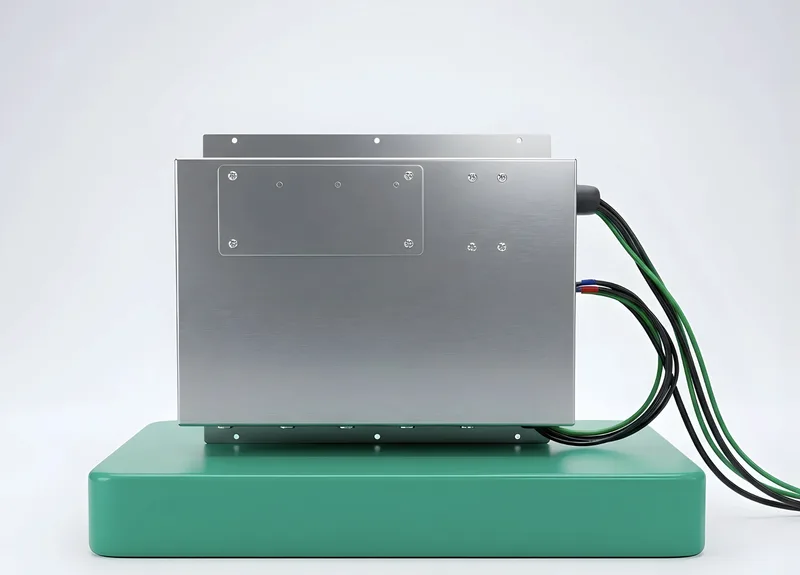
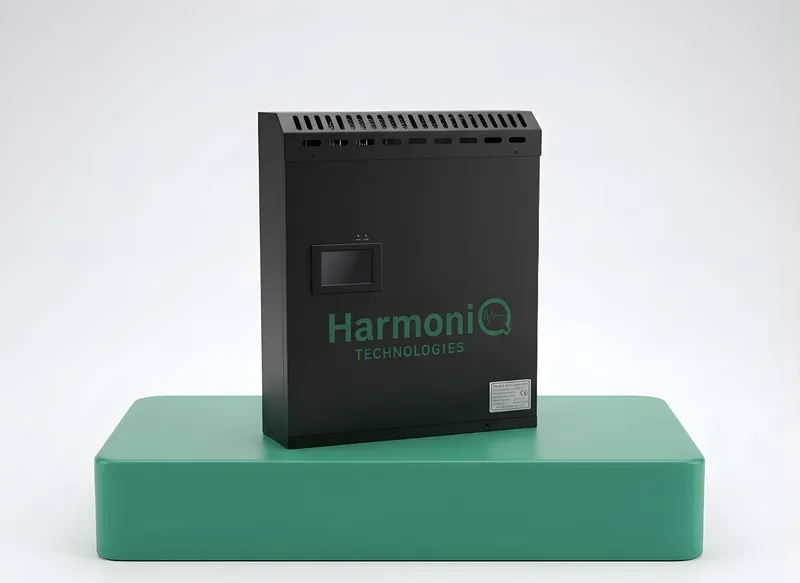
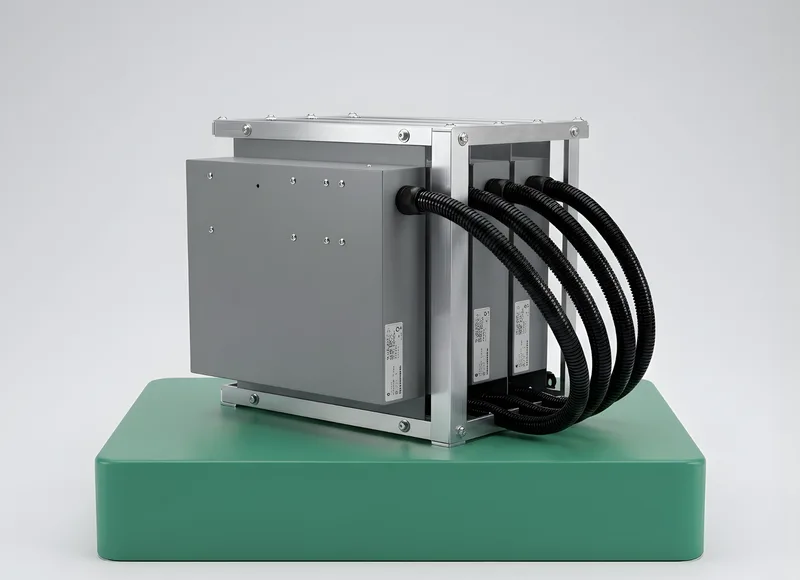
HarmoniQ installs a coordinated, solid-state system at the low-voltage switchboard — where Oman’s large sites carry their cost, where the peak-demand charge and reserved capacity bite, and where the country’s cooling and industrial loads inject distortion. We deploy three products as the site requires: HarmoniQ Alpha for voltage stability at the point of use, the HarmoniQ Delta for harmonic mitigation, and the HarmoniQ Sigma for real-time power factor correction. No switched-capacitor steps, no contactors, and no resonance risk with the harmonics already on your system.
Real-time impedance matching for voltage stability at the point of use — the selective add-on for the criticality-led tail of process plant, data halls and sensitive industrial loads, with the visibility to prove power factor, harmonics and demand at the meter, continuously.
Active harmonic filtering that holds distortion within the Oman Distribution Code’s tight 2.0–2.5% THD limits — the natural companion in Oman’s VFD-driven cooling, industrial and data-centre sites, where chillers, rectifiers and non-linear UPS all push harmonic levels up.
Real-time true power factor correction to 0.98+ across the whole network — meeting OES-4’s 0.9 requirement, lowering the kVA and peak demand behind the cost-reflective Transmission Use of System charge, and freeing ~15–20% of transformer and switchgear capacity so a growing site can connect more load.
Why not just install capacitor banks? + Read more− Close
Switched-capacitor banks correct power factor in fixed steps at the incoming feed — enough, in theory, to lift you over the 0.9 mark at the meter, and they are cheap and locally available. But they respond in steps and seconds, so they lag the fast-changing loads of a chiller plant; they sit only at the boundary, so reactive current still flows through your internal network and still heats it in Oman’s summer; and on a system carrying harmonics — as nearly every modern Omani cooling, industrial or data-centre site does — a capacitor bank can form a resonant circuit with the supply, amplifying those harmonics rather than removing them, and pushing you against the Distribution Code’s 2.0–2.5% limits instead of inside them.
HarmoniQ is solid-state and dynamic: it corrects continuously rather than in steps, works across the network rather than at one point, and carries no resonance risk. Paired with active filtering, it is power factor correction and harmonic mitigation designed for a plant full of drives and inverters, not the switchgear of forty years ago — and it meets the 0.9 requirement while freeing the capacity a capacitor bank alone leaves locked up.
What It’s Worth
Energy, Capacity and Compliance — the Savings Stack Up
| Lever | What changes | Effect for the site |
|---|---|---|
| Power factor → 0.98+ | Reactive current falls; the installation meets OES-4’s 0.9 requirement | Lower kVA and peak demand — the cost-reflective Transmission Use of System charge falls |
| Capacity release | ~15–20% of transformer / switchgear headroom freed | Add chillers, lines or process load without a larger connection |
| Loss reduction on a cost-reflective rate | Lower resistive losses in cables and transformers | Real money saved — the energy line genuinely moves, unlike on a subsidised tariff |
| Harmonic filtering to 2.0–2.5% THD | Lower distortion, cooler transformers, motors & cables in the heat | Code met, less thermal stress, longer asset life |
| Where the value sits | Released capacity and met code — plus a real, recurring energy saving, because Oman’s large consumers now pay a cost-reflective rate | |
Every site’s loads, tariff band and reactive profile are different, and the figures above are illustrative of the mechanism — not a quote. In Oman the honest picture is better than in most of the Gulf: the cost-reflective tariff means avoided losses show up on the bill, on top of the capacity released and the 0.9 and harmonic requirements met. Our engineers will model the exact power factor improvement, peak demand and capacity freed, harmonic headroom and losses reduced for your specific connection — get in touch for a site assessment, or see the method on our power factor correction and demand-charge pages.