The Cost of Power
Historically Cheap Hydro — Now Split Sharply North–South
For decades Norway ran on some of the cheapest electricity in Europe, drawn from abundant hydropower. That picture has changed. Since 2021 the southern bidding zones — NO1 around Oslo, NO2 around Kristiansand and NO5 around Bergen — have decoupled from the cheap north and now track continental and UK prices through the interconnectors. Business energy-only prices in the south reached around 110 øre/kWh (~€0.094/kWh) in Q1 2026 — roughly double the 2024 average — while the far north (NO4) stays near-free at about €0.02–0.04/kWh. Because some 75–80% of commercial and light-industrial sites sit in the high-priced south, for most Norwegian operators the price of a kilowatt-hour is now real money — and a strong reason to stop wasting any.
But the cost of energy is not the only lever, and in Norway it is not even the most certain one. The value HarmoniQ delivers rests first on levers that hold everywhere, regardless of which zone a site sits in: clearing the power factor 0.95 threshold to avoid the reactive-power charge, holding harmonics within the Norwegian compliance limits on a grid that is roughly 88–90% renewable, and releasing capacity behind a congested southern grid. The energy saving is a genuine fourth lever — strong, but concentrated in the southern zones where prices have climbed.
There is a nuance Norwegian operators know well. Where a site sits now matters almost as much as what it does. A data centre or food plant in Oslo, Bergen or Kristiansand pays a southern-zone rate that has swung up with the continent; an identical plant in Tromsø or Finnmark still pays close to historic hydro prices. Blended across the country, a delivered business rate of around €0.085/kWh is a fair guide — but the average hides the divide, and for the three-quarters of sites in the south every percentage point of wasted current is now charged at a continental, not a Norwegian, unit rate.
| Where | Typical price | Notes |
|---|---|---|
| Southern zones — NO1 / NO2 / NO5 (energy-only) | ~€0.094/kWh | ~110 øre/kWh in Q1 2026, roughly double 2024; tracks continental and UK prices via the interconnectors |
| Far north — NO4 (energy-only) | ~€0.02–0.04/kWh | Still near historic hydro levels, decoupled from the south |
| Blended delivered business rate | ~€0.085/kWh | A national guide — the average hides the north–south split |
| Where the sites are | ~75–80% in the south | Most commercial and light-industrial load sits in the high-priced zones |
Zone prices, the blended delivered rate and the geographic split are from HarmoniQ’s Norway market research. Figures are current as of 2025–2026 and are revised periodically — verify against NVE/RME (the Norwegian energy regulator) and your distribution operator at the time of reading. Prices are per kWh and exclude site-specific demand, grid (nett) and capacity charges; energy-only figures are converted at roughly €1 ≈ NOK 11.7.
How You’re Billed
A Norwegian Industrial Bill Is More Than the Energy You Use
The headline price per kWh is only part of the story. A metered Norwegian site pays for the energy itself, for the grid (nett) that delivers it, and for taxes and levies — and, critically for power quality, for the capacity it reserves at its connection and for the reactive power it draws above power factor 0.95. Two of those line items move directly when you correct power factor — and in the congested southern grid, where new connection capacity is scarce and queues are long, the headroom you free up is worth far more than the charge alone.
| Component | What it is | Cut by power quality? |
|---|---|---|
| Energy (wholesale / commodity) | The kWh you consume, at the zone’s traded price | Indirectly — lower network losses |
| Grid charges (nettleie) | Distribution and transmission fees for delivering power over the grid | Partly |
| Taxes & levies | The electricity tax and other levies set nationally | No |
| Demand / capacity charge (kW / kVA) | A charge on the apparent-power demand and capacity you reserve at your connection | Yes — lower apparent power means a lower charge, and freed capacity |
| Reactive-power charge (kvarh) | A charge on reactive energy drawn above power factor 0.95, set per distribution operator | Yes — power factor correction cuts it directly |
So the answer to two questions Norwegian operators often ask: yes, you are billed for demand and capacity — through the apparent-power charge — and yes, poor power factor costs you, both through the reactive-power charge above 0.95 and, in the south, through the connection capacity it wastes. Both fall as power factor rises towards unity, which is exactly what correction delivers — and neither depends on which bidding zone you happen to sit in.
Power Factor & Regulation
A 0.95 Reactive Threshold — and Tightening Harmonic Limits
Norwegian distribution operators charge for reactive power drawn above power factor 0.95. This is the most monetisable, price-independent lever on a Norwegian site: it applies whether you sit in the expensive south or the near-free north, and it does not move with the wholesale market. A site running below 0.95 is drawing reactive current it is billed for and reserving apparent-power capacity it does not need. Correcting to 0.98+ removes the reactive charge and releases that capacity — which on a congested southern grid is among the most valuable things power factor correction can do in Norway.
On harmonics and supply quality, Norwegian connections must hold voltage quality within the Forskrift om leveringskvalitet (FoL), harmonised with EN 50160 — total harmonic distortion at or below 8% over ten minutes and 5% on a weekly basis on the low-voltage network, with harmonic limits tightened by a December 2024 amendment. Equipment emissions follow the IEC 61000 series, and low-voltage assemblies follow IEC 61439. As variable-speed drives, refrigeration, rectifiers, non-linear UPS and behind-the-meter solar multiply on Norwegian sites — on top of a grid that is already roughly 88–90% hydro with fast-growing wind — staying inside those limits increasingly requires active harmonic filtering, not just a one-off survey.
The reactive-power charge above power factor 0.95 is set per distribution operator and published in their terms of connection; voltage-quality limits follow the Forskrift om leveringskvalitet (FoL), harmonised with EN 50160 (THD ≤8% over ten minutes, ≤5% weekly on LV, tightened by a December 2024 amendment), with equipment emissions under the IEC 61000 series and LV assemblies under IEC 61439. The energy regulator is NVE/RME and the transmission operator is Statnett. Confirm the power-factor threshold, charges and limits that apply to your connection with your distribution operator and with NVE/RME — they vary by region and are updated periodically.
Why Power Quality Matters Here
Europe’s Most Inverter-Heavy Grid — and a Congested South
Three structural forces make power quality a Norwegian boardroom issue, not just an engineering one. First, the generation mix: Norway runs on roughly 88–90% hydropower plus fast-growing wind — the highest renewable and inverter penetration in Europe. Wind and solar inverters and the variable-speed drives behind aquaculture pumping and feeding, refrigeration, HVAC and data-centre rectifiers all inject distortion, raising harmonic levels and voltage volatility at exactly the commercial and industrial sites we serve. It is the single most important reason power quality matters here. Second, capacity: the southern grid is congested, with connection queues that raise the value of any headroom you can free behind your own meter rather than waiting years for a new connection. Third, the tariff in the south — already covered: prices that have roughly doubled into 2026 and are paid by the three-quarters of sites that sit in the high-priced zones.
What matters less in Norway is resilience. The grid is among the most reliable on earth — around 99.98% availability, with only two to three hours of interruption a year — so unlike sites in parts of Africa or the Gulf, Norwegian operators are driven by the reactive charge, harmonics, capacity and cost rather than by keeping the lights on. One feature is distinctively Norwegian: aquaculture and seafood processing form a large, motor-heavy and overwhelmingly low-voltage cluster, the kind of drive-dense load where reactive current and harmonics build up fastest — and where correction at the low-voltage switchboard pays off directly.
The Solution
Solid-State Correction and Filtering, Network-Wide
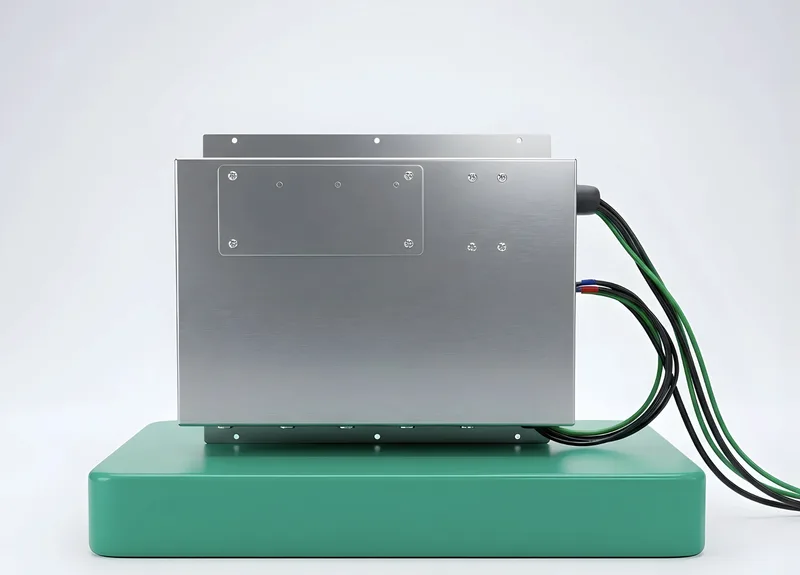
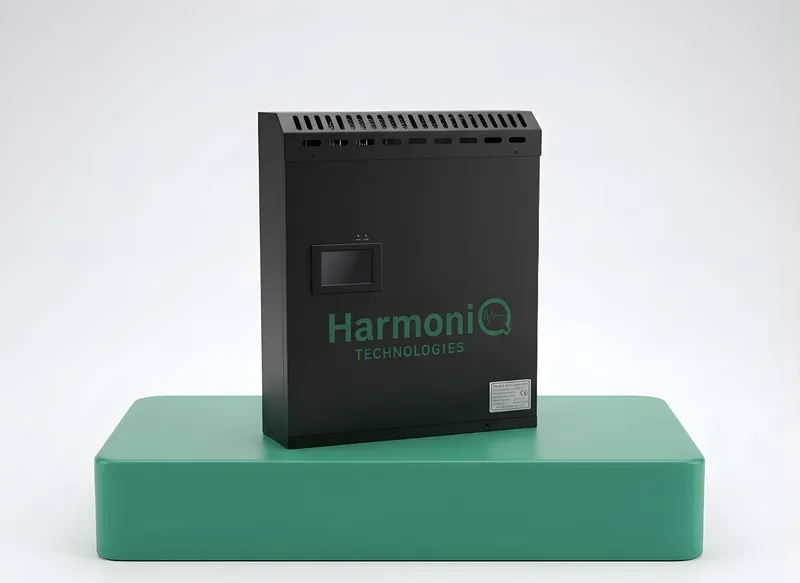
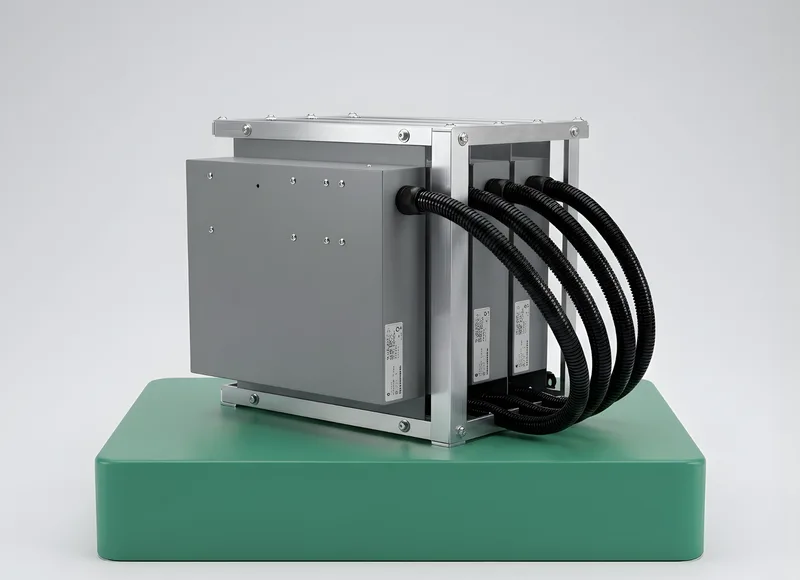
HarmoniQ installs a coordinated, solid-state system at the low-voltage switchboard — where Norwegian sites carry their VFD-dense, inverter-fed load, where the reactive charge is cleared and capacity unlocked, and where the roughly 88–90% renewable grid injects distortion. We deploy three products as the site requires: HarmoniQ Alpha as the integrated platform tying correction, filtering and voltage optimisation together, the HarmoniQ Delta for harmonic mitigation, and the HarmoniQ Sigma for real-time power factor correction. No switched-capacitor steps, no contactors, and no resonance risk with the harmonics already on your system.
Dynamically matches source impedance to load impedance up to 20,000 times a second, stabilising voltage at the point of use — especially valuable under the high-renewable, inverter-saturated conditions an 88–90% hydro-and-wind system produces, and for sensitive data-hall, cleanroom and process loads.
Active harmonic filtering that holds distortion within the Forskrift om leveringskvalitet and EN 50160 limits (THD ≤8% over ten minutes, ≤5% weekly on LV) — the component that matters most on Europe’s most inverter-heavy grid, where VFD-driven chillers, aquaculture pumps and feeders, rectifiers, non-linear UPS and on-site solar all push harmonic levels up.
Real-time true power factor correction to 0.98+ across the whole network — clearing the power factor 0.95 threshold so the reactive-power charge falls away, cutting apparent-power demand, and freeing 5–10% of transformer and switchgear capacity so a growing site can add load without waiting years for a connection on a congested southern grid.
Why not just install capacitor banks? + Read more− Close
Switched-capacitor banks correct power factor in fixed steps at the incoming feed — enough, in theory, to lift you over the 0.95 threshold at the meter. But they respond in steps and seconds, so they lag fast-changing loads; they sit only at the boundary, so reactive current still flows through your internal network; and on a system carrying harmonics — as nearly every modern Norwegian site does, with its drives, refrigeration, rectifiers and inverters, on a grid that is already roughly 88–90% renewable — a capacitor bank can form a resonant circuit with the supply, amplifying those harmonics.
HarmoniQ is solid-state and dynamic: it corrects continuously rather than in steps, works across the network rather than at one point, and carries no resonance risk. Paired with active filtering, it is power factor correction and harmonic mitigation designed for a plant full of drives and inverters on an inverter-heavy grid, not the switchgear of forty years ago.
What It’s Worth
Reactive Charge and Capacity First, Then Harmonics and Energy
| Lever | What changes | Effect on the site |
|---|---|---|
| Power factor → 0.98+ | Clears the 0.95 threshold; reactive-power charge falls away | Reactive charge removed — certain in any zone, north or south |
| Capacity release (5–10%) | Reactive and distorted current cut; transformer / switchgear headroom freed | Add load without waiting years on a congested southern grid |
| Harmonic filtering to EN 50160 / FoL | Lower distortion, cooler transformers & cables on an 88–90% renewable grid | Lower losses, longer asset life, protected processes |
| Active-energy reduction (3–8%) | On ~€0.094/kWh in the south, across ~7 GWh a year | Strong in the southern zones — far smaller in the near-free north — plus the reactive charge cleared and capacity released everywhere |
Every site’s loads, tariff and reactive profile are different, and the figures above are illustrative of the mechanism — not a quote. The energy saving is genuine but concentrated in the high-priced southern zones — which is why in Norway the levers that hold value everywhere are the reactive charge cleared at power factor 0.95, the harmonics held inside the FoL and EN 50160 limits, and the capacity unlocked behind your meter. Our engineers will model the exact reactive charge removed, capacity released, distortion reduced and losses reduced for your specific connection and zone — get in touch for a site assessment, or see the method on our power factor correction and demand-charge pages.