The Cost of Power
The Grid Tariff Hides the True Cost of Power
The official grid tariff in Nigeria looks moderate. After the 2024 cost-reflective reform, customers on the top service band — Band A, the feeders rated for around 20 hours of supply a day — pay roughly ₦210 per kWh, about $0.13/kWh. But that is not what most sites actually pay for most of their power. Because public supply is unreliable, the vast majority of commercial and industrial load runs on self-generated diesel and gas, and self-generated power costs an estimated $0.28–0.45 per kWh effective. The number that matters to a factory, tower operator or data centre is therefore the blended grid-plus-generator cost — and it is far above the headline grid rate.
This flips the usual savings argument. Where a cheap, reliable grid makes efficiency a marginal gain, in Nigeria most kilowatt-hours are produced by a generator burning fuel at four to five times the Band A rate. Every percentage point of wasted current, every avoidable harmonic loss and every unnecessary kVA of demand is charged at that high effective cost — so reducing the load a generator has to carry, and keeping its power clean, pays back unusually fast.
| Who pays / what for | Typical cost | Notes |
|---|---|---|
| Self-generation (diesel) — the true cost of most C&I power | ~$0.28–0.45/kWh | What most factories, towers and commercial sites actually pay for the bulk of their load |
| Grid — Band A (best ~20-hour feeders) | ~₦210/kWh (~$0.13/kWh) | Lower on paper, but reaches a minority of customers and not most hours for most sites |
| Blended grid + generator (what a site truly bears) | ~$0.23/kWh and up | Weighted towards the dominant, costly self-generation; the figure that drives the savings case |
| Households — grid, Band A (~20-hour feeders) | ~₦209/kWh (~$0.13/kWh) | Homes on the top band pay close to the C&I grid rate |
| Households — grid, lower bands (fewer supply hours) | from ~₦63/kWh (Band B) | Lower per-unit, but fewer hours — so many homes top up with their own generators too |
The Band A grid tariff (~₦210/kWh ≈ $0.13/kWh, July 2024) is from NERC and DisCo schedules via Stears/Proshare; the $0.28–0.45/kWh effective cost of diesel self-generation is from the PwC Africa Energy Review and academic LCOE models (2023–2024); the blended ~$0.23/kWh reflects costly self-generation weighted against cheaper Band A grid hours. The household band rates (Band A ~₦209/kWh, Band B ~₦63/kWh) are web-sourced from NERC service-band tariffs reported by Stears and Nairametrics. Figures are current as of 2024–2025, dollar values move with the naira (~₦1,535/$ at end-2024), and tariffs are revised by NERC regularly — verify against the NERC tariff schedules and your DisCo at the time of reading. All prices are unit rates and exclude fixed and demand charges.
How You’re Billed
A Nigerian Site Pays Twice — the Grid Bill and the Fuel Bill
The headline naira-per-kWh is only part of the story, and on most sites it is the smaller part. A Nigerian commercial or industrial site carries two costs of power at once: the grid bill from its DisCo for the hours the feeder is live, and the far larger fuel and maintenance bill for the generator that covers the rest. On the grid side, a maximum-demand-metered site pays not only for the energy it uses but for the capacity it reserves, billed in kVA, and for its maximum demand. On the generator side, the cost is fuel — and the harder the generator has to work to carry reactive current and distortion, the more fuel it burns. Power quality moves both.
| Component | What it is | Cut by power quality? |
|---|---|---|
| Grid energy (kWh) | The units delivered by your DisCo at the service-band tariff | Indirectly — lower losses on the live feeder |
| Grid maximum-demand / capacity charge (kVA) | A charge on the apparent-power demand and capacity you reserve at your connection | Yes — lower apparent power means a lower charge |
| Generator fuel (diesel / gas) | The dominant cost on most sites — fuel burned to make your own power at $0.28–0.45/kWh | Yes — better power factor and stability mean the same real kW for less fuel |
| Generator capacity & wear | The size of genset you must run and the maintenance it needs | Yes — correcting power factor frees genset capacity and eases load |
| Equipment losses & failures | Motors, drives and refrigeration stressed by a weak, distorted source | Yes — cleaner, steadier power means fewer losses and trips |
So the answer to the question Nigerian operators ask most: the biggest lever is not the grid tariff at all — it is the fuel your generator burns. A site running at 0.80 power factor forces its genset to deliver apparent power it never turns into useful work; correcting towards unity lets the same generator carry the same real load on less fuel, frees capacity, and — on the grid hours — cuts the kVA and maximum-demand charges too.
Power Factor & Regulation
No Reactive Penalty to Clear — the Reward Is Fuel and Reliability
Nigeria does not impose a nationwide power-factor penalty in the way some Gulf utilities do, and there is no mandatory power-factor connection approval to clear before you can operate. The sector was reformed by the Electricity Act 2023 and grid tariffs set by the Nigerian Electricity Regulatory Commission (NERC) under its service-band framework, but the economic case for correcting power factor here does not rest on avoiding a regulated charge. It rests on something larger: every var of reactive current and every unit of distortion a generator has to supply is paid for in fuel, and a weak, sagging supply is paid for in lost production and failed equipment.
That makes the practical effect stronger, not weaker, than in markets with an explicit penalty. A motor- and drive-heavy plant sitting at 0.80–0.85 power factor is burning more diesel than it needs to and tying up generator capacity it has paid for. Correcting to 0.98+ cuts the fuel waste and frees the capacity. On harmonics, the loads driving distortion are the same the world over — variable-speed drives, rectifiers and non-linear UPS — and on a small, islanded genset, which is a weak, high-impedance source, that distortion does more damage than it would on a strong grid. Keeping it off the generator and the downstream equipment is an engineering necessity, not a box-ticking exercise.
Grid tariffs and service bands are set by NERC under the Electricity Act 2023 and published in DisCo Multi-Year Tariff Order schedules; there is no nationwide reactive-power penalty or mandatory power-factor connection gate, so the value case is built on fuel and reliability rather than a regulated charge. Maximum-demand (kVA) charges, where they apply, are set in your DisCo’s tariff order. Harmonic and connection requirements follow the relevant international standards together with any DisCo and grid-code conditions. Confirm the charges, demand-metering basis and any harmonic or connection conditions that apply to your site with your DisCo and NERC — they are reviewed periodically and vary by distributor.
Why Power Quality Matters Here
A Failing Grid and an Expensive Self-Generation Economy
Two structural forces make power quality a Nigerian boardroom issue, not just an engineering one. First, grid reliability: against around 12.5 GW of installed capacity, the grid typically dispatches only ~4–5 GW to a country of 200 million-plus — one of the lowest per-capita supplies on earth — and it fails outright with alarming regularity, with twelve full national grid collapses in 2024 alone. Public supply simply cannot be relied on, so almost every substantial site backs itself with its own generation. Second, the cost of that self-generation: an estimated ~14 GW of captive and standby plant now runs across the country, burning diesel and gas at $0.28–0.45/kWh, and for many manufacturers power is around 40% of factory operating cost. The generator is the single largest controllable cost on most sites — and the hardest currency to find.
That is why, unlike a high-tariff but reliable market, the Nigerian case is led by keeping the lights on and cutting the cost of doing so yourself. A weak feeder sags, swells and browns out; an islanded generator is a soft source that wavers under load steps and is easily distorted by the drives, rectifiers and UPS systems on the board. Holding voltage steady, correcting power factor and filtering harmonics at the low-voltage switchboard protects the motors, drives, IT and refrigeration that would otherwise trip, overheat or fail — and trims the fuel burned to run them.
The Solution
Solid-State Stabilisation, Correction and Filtering, Network-Wide
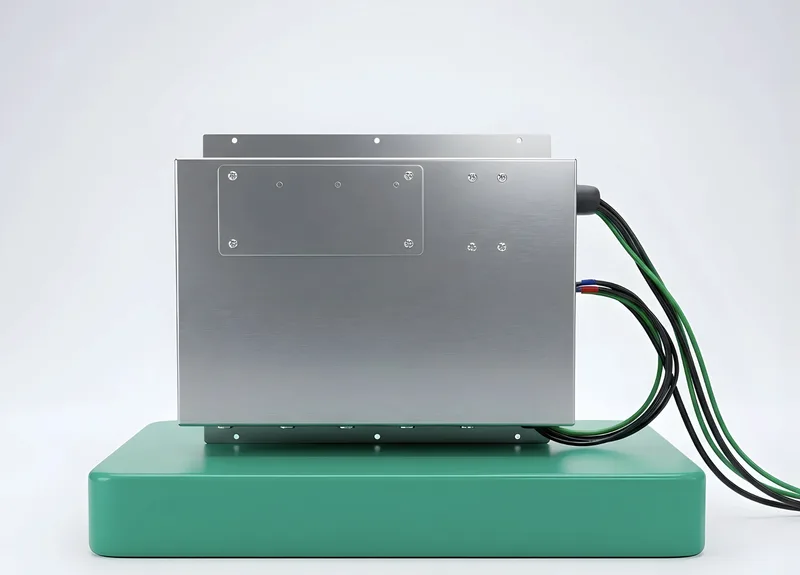
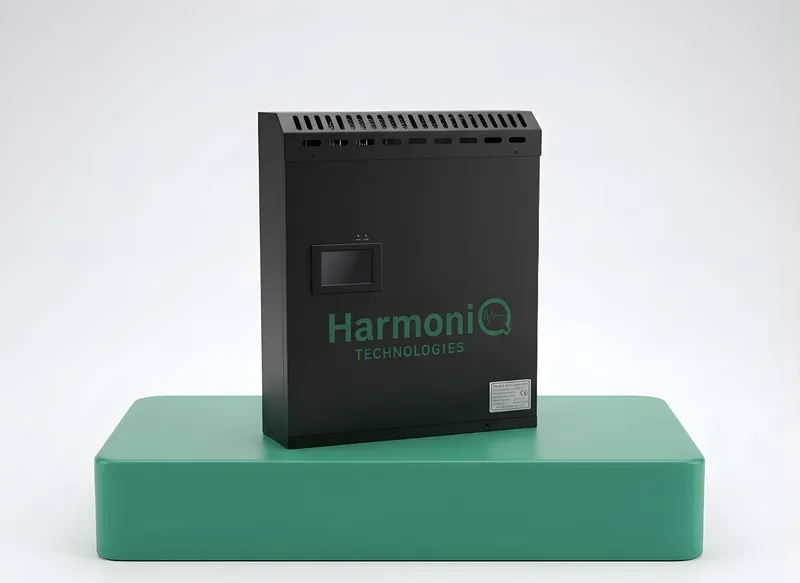
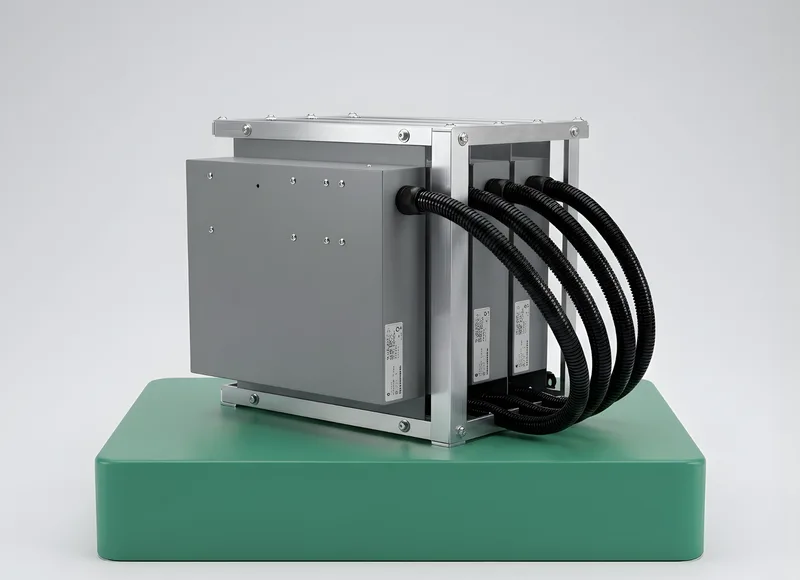
HarmoniQ installs a coordinated, solid-state system at the low-voltage switchboard — exactly where Nigerian sites take supply from a weak grid feeder and from their own gensets, and exactly where unstable voltage, poor power factor and harmonics do their damage. We deploy three products as the site requires: HarmoniQ Alpha as the integrated platform tying voltage stabilisation, correction and filtering together, the HarmoniQ Delta for harmonic mitigation, and the HarmoniQ Sigma for real-time power factor correction. No switched-capacitor steps, no contactors, and no resonance risk with the harmonics already on your system.
Holds voltage steady through feeder sags, swells and genset load steps while unifying correction and filtering across the board — with the visibility to prove power factor, voltage stability and demand at the meter, continuously.
Active harmonic filtering that keeps distortion off a weak, high-impedance source — the component that matters most where a small islanded genset feeds the drives, rectifiers and non-linear UPS common in Nigerian factories, towers, data centres and commercial buildings.
Real-time true power factor correction to 0.98+ across the whole network — so your generator delivers the same real kilowatts on less fuel and with less capacity tied up, and your grid maximum-demand and kVA charges fall on the hours the feeder is live.
Why not just install capacitor banks? + Read more− Close
Switched-capacitor banks correct power factor in fixed steps at the incoming feed — enough, in theory, to lift you towards a target at the meter. But they respond in steps and seconds, so they lag fast-changing loads; they sit only at the boundary, so reactive current still flows through your internal network; and on a system carrying harmonics — as nearly every modern Nigerian site does, with its drives, rectifiers and inverters — a capacitor bank can form a resonant circuit with the supply, amplifying those harmonics. On a small islanded generator, that resonance risk is sharper still.
HarmoniQ is solid-state and dynamic: it corrects continuously rather than in steps, works across the network rather than at one point, stabilises voltage on a weak source, and carries no resonance risk. Paired with active filtering, it is power factor correction and harmonic mitigation designed for a plant full of drives and inverters running on its own generator, not the switchgear of forty years ago.
What It’s Worth
Expensive Power Means the Savings Are Large and Direct
| Lever | What changes | Effect on the cost of power |
|---|---|---|
| Power factor → 0.98+ | The genset delivers the same real kW with less fuel and less spinning capacity | Fuel burn cut — the headline saving |
| Voltage stabilisation | Holds voltage through feeder sags and genset load steps | Fewer nuisance trips, less lost production |
| Harmonic filtering | Lower distortion on a weak, islanded source | Lower losses, longer motor, drive & refrigeration life |
| Capacity release | Power factor 0.80→0.98 frees ~15–20% of transformer / genset capacity | Add load, or downsize the generator |
| Indicative annual saving | A six-figure sum on a site of this size — plus the capacity released and the failures avoided | |
Every site’s loads, grid-versus-generator split and reactive profile are different, and the figures above are illustrative of the mechanism — not a quote. Our engineers will model the exact power factor improvement, the fuel and maximum-demand charges avoided, the losses reduced and the capacity released for your specific site — get in touch for a site assessment, or see the method on our power factor correction and demand-charge pages.