The Cost of Power
A Demand-Driven Bill, in a Nearshoring Boom
Mexican electricity does not look expensive next to Europe — but the way industry is billed makes power quality matter all the same. Business users pay around MXN 4.117 per kWh (about US$0.24), roughly 127% of the world average, while the published medium-power industrial rate sits near US$0.117–0.119 per kWh. For a factory, data centre, or commercial estate, the unit rate is only half the story: most of the pain is in the demand and power-factor charges layered on top.
Unlike a household on a simple kWh tariff, a Mexican industrial site on the CFE GDMTH tariff is billed on energy, on the kilowatts of demand it draws, and on its power factor — and on that structure, demand charges alone can be 30% to over 50% of the monthly bill. So the usual argument that “power is fairly cheap in Mexico, efficiency doesn’t move the needle” misses where the money actually goes. Every kilowatt of wasted demand and every point of poor power factor is charged — on every bill.
| Who pays | Typical price | Notes |
|---|---|---|
| Business / commercial (all-in) | ~MXN 4.117/kWh (~US$0.24) | ~127% of the world average; demand & power-factor charges add on top |
| Industry (published medium-power rate) | ~US$0.117–0.119/kWh | Lower headline unit rate — but the GDMTH demand charge dominates the bill |
| Households (residential) | ~MXN 2.063/kWh (~US$0.12) | Around half the commercial rate — a simple kWh tariff, no demand charge |
Business and residential prices are from GlobalPetrolPrices (data collected September 2025) and include power, network and taxes; the industrial medium-power rate is from Tetakawi. The 30–50% demand-charge share is reported by Mexico Energy Partners for GDMTH sites. Figures are in Mexican pesos (MXN) unless marked US$, are current as of 2025, and are revised regularly — verify against CFE tariff schedules and the CRE (Comisión Reguladora de Energía) at the time of reading. Prices exclude site-specific demand and capacity charges. Reviewed June 2026.
How You’re Billed
A Mexican Industrial Bill Is Mostly Not the Energy You Use
The headline peso-per-kWh is only part of the story. A CFE GDMTH site pays for the energy itself — priced differently in the Base, Intermediate and Peak time-of-use periods — for the networks that deliver it, and, critically for power quality, for the demand it draws in kilowatts (demanda facturable) and for its power factor. The demand charge is set by a single peak: the highest 15-minute interval in the period fixes a high-cost benchmark for the whole month. Those last two line items move directly when you correct power factor.
| Component | What it is | Cut by power quality? |
|---|---|---|
| Energy (kWh, by time of use) | The kWh you consume, priced by Base, Intermediate and Peak periods | Indirectly — lower network losses |
| Transmission & distribution | Moving power over the network to your site, charged per kWh and per kW | Partly |
| Billable demand (demanda facturable, kW) | A charge on your maximum demand — set by the highest 15-minute peak in the period | Yes — correcting power factor lowers the kW you are billed for |
| Capacity charge | A charge based on your peak demand and the hours of the month | Partly — falls with lower peak demand |
| Power-factor adjustment (factor de potencia) | A penalty below 0.90 power factor, or a bonus above it, applied to the bill | Yes — power factor correction clears the penalty and earns the bonus |
So the answer to two questions Mexican operators often ask: yes, you are billed for demand — through the billable-demand (kW) and capacity charges — and yes, you are billed for poor power factor, through the CFE power-factor adjustment below 0.90. Both fall as power factor rises towards unity, which is exactly what correction delivers.
Power Factor & Regulation
A Penalty Below 0.90 — and a Bar Rising to 0.97
Mexico is one of the clearest power-factor regimes anywhere. CFE applies a charge that swings both ways around a 0.90 power factor (factor de potencia) threshold: fall below it and you pay a penalty (recargo) that grows as your factor worsens; rise above it and you earn a bonus (bonificación). The bonus is capped at 2.5% of the bill at unity power factor, while the penalty can reach as high as 120% at a very poor 0.30 factor. In practice, the difference between running at 0.85 and 0.95 is around 3% to 5% of the total invoice — recurring, every month, on a bill where demand already dominates.
The bar is also rising. Under the Código de Red, load centres connected at medium voltage with contracted demand of 1 MW or more, and those at high voltage, must already hold a power factor of 0.95 — and from 8 April 2026 that requirement increases to 0.97. Crucially, compliance is no longer judged on a monthly average: the 0.97 factor must be sustained for at least 95% of the billing period, measured in five-minute intervals — a standard a switched bank struggling to track a variable load will routinely miss.
On harmonics, CFE specification L0000-45 (aligned with IEEE 519) sets the permissible limits on voltage- and current-waveform distortion — total demand distortion through to the 50th harmonic — for connections from low through high voltage, and places the duty on the user to filter and to measure. As variable-speed drives, rectifiers, non-linear UPS and behind-the-meter solar multiply across Mexican plants, staying inside those limits increasingly requires active harmonic filtering — not just a one-off survey.
The CFE power-factor penalty below 0.90 and bonus above it (capped at 2.5%, penalty up to 120%) are set in CFE’s tariff rules; the Código de Red (RES/550/2021) 0.95-rising-to-0.97 requirement applies to medium-voltage load centres ≥1 MW and high-voltage connections from 8 April 2026, measured in five-minute intervals. Harmonic and waveform-quality limits follow CFE specification L0000-45 (on IEEE 519). These rules and thresholds are updated periodically — verify the penalty, bonus, threshold and harmonic limits that apply to your connection with CFE and the CRE (Comisión Reguladora de Energía) before relying on them.
Why Power Quality Matters Here
A Nearshoring Boom on a Capacity-Constrained Grid
Three structural forces make power quality a Mexican boardroom issue, not just an engineering one. First, the bill structure — already covered: demand-led, with an explicit power-factor penalty that is only getting stricter. Second, nearshoring: Mexico drew a record US$36.87 billion of foreign direct investment in 2024, with manufacturing taking 54% of it, concentrating new automotive, electronics and aerospace load in Nuevo León, the Bajío and the northern border — all motor- and drive-heavy plants that draw reactive power and inject harmonics. Third, capacity: CENACE reports that over 60% of the national transmission network runs near its maximum, with the worst bottlenecks in exactly those nearshoring corridors — so freeing transformer and switchgear headroom on the connection you already have is unusually valuable.
Resilience matters here too, more than in Europe. With industry and commerce making up around 72% of demand, the operating reserve margin fell to roughly 3% in May 2024 against a 6% regulatory minimum, and CENACE logged scores of grid-emergency events that year. On a grid this tight — and increasingly inverter-fed, with natural gas around 58% of generation and renewables near 22% in 2024 — clean, well-corrected power protects production as well as the bill.
The Solution
Solid-State Correction and Filtering, Network-Wide
HarmoniQ installs a coordinated, solid-state system at the low-voltage switchboard — where Mexican sites carry their load, where the GDMTH demand and power-factor charges bite, and where the inverter-heavy grid injects distortion. We deploy three products as the site requires: HarmoniQ Alpha as the integrated platform tying correction, filtering and voltage optimisation together, the HarmoniQ Delta for harmonic mitigation, and the HarmoniQ Sigma for real-time power factor correction. No switched-capacitor steps, no contactors, and no resonance risk with the harmonics already on your system.
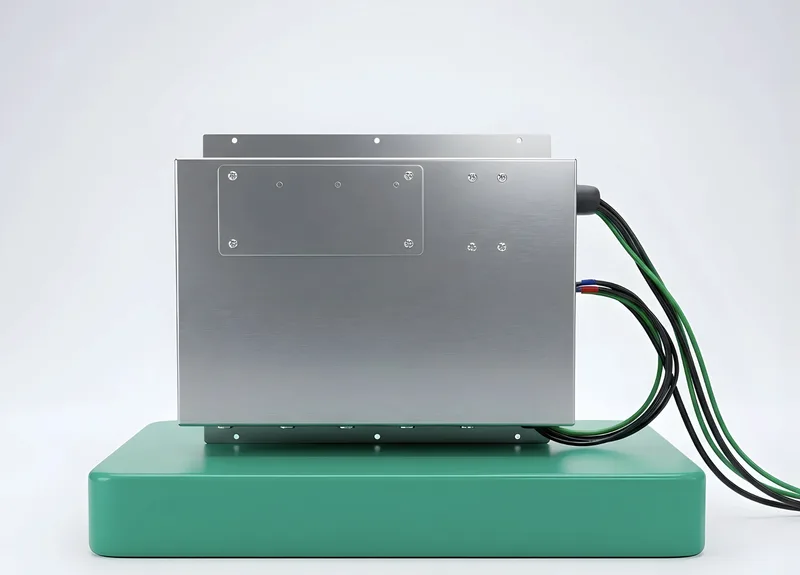
Unifies correction, filtering and voltage optimisation across multiple boards or sites — with the visibility to prove power factor, reactive power and billable demand at the meter, continuously, in the five-minute resolution the Código de Red now demands.
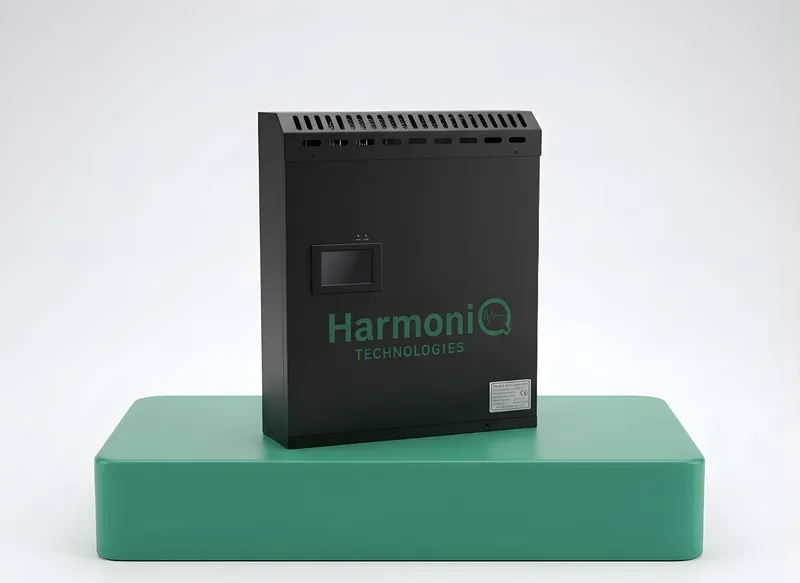
Active harmonic filtering that holds distortion within CFE L0000-45 and IEEE 519 limits — the component that matters most in Mexico’s nearshoring plants, where drives, rectifiers, non-linear UPS and on-site solar all push harmonic levels up and the duty to filter sits with the user.
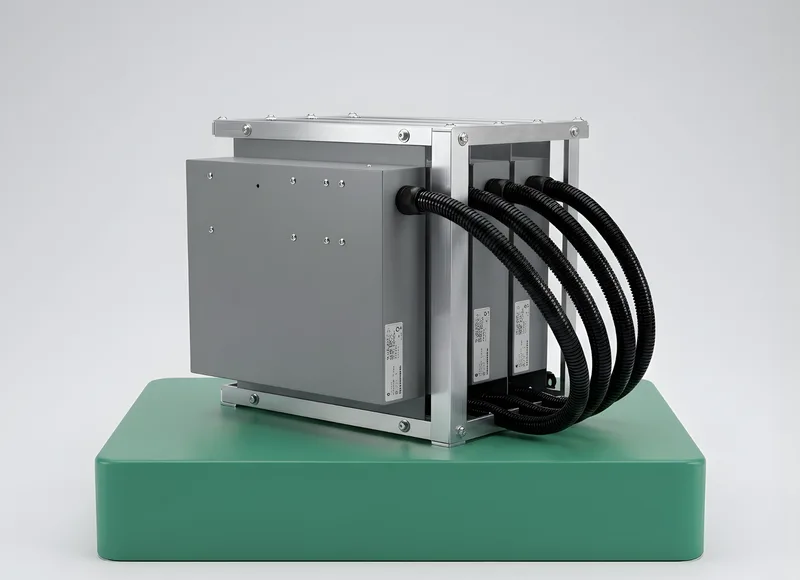
Real-time true power factor correction to 0.98+ across the whole network — clearing the CFE penalty below 0.90, earning the bonus, and meeting the Código de Red’s 0.97 requirement held in five-minute intervals, while cutting the billable-demand (kW) charge and freeing transformer headroom on a strained grid.
Why not just install capacitor banks? + Read more− Close
Switched-capacitor banks correct power factor in fixed steps at the incoming feed — enough, in theory, to lift you over the 0.90 threshold on a monthly average. But they respond in steps and seconds, so they lag fast-changing loads; they sit only at the boundary, so reactive current still flows through your internal network; and on a system carrying harmonics — as nearly every modern Mexican plant does, with its drives, rectifiers and inverters — a capacitor bank can form a resonant circuit with the supply, amplifying those harmonics. Against the Código de Red’s five-minute, 0.97 standard, a stepped bank that holds a monthly average will routinely fall short.
HarmoniQ is solid-state and dynamic: it corrects continuously rather than in steps, works across the network rather than at one point, and carries no resonance risk. Paired with active filtering, it is power factor correction and harmonic mitigation designed for a plant full of drives and inverters, not the switchgear of forty years ago.
What It’s Worth
Demand-Led Bill, a Real Penalty — the Savings Compound
| Lever | What changes | Effect on the bill |
|---|---|---|
| Power factor → 0.98+ | Clears the CFE penalty below 0.90, earns the bonus, lowers billed kW | Power-factor penalty removed; demand & capacity charges cut |
| Código de Red compliance | Holds 0.97 in five-minute intervals as required from April 2026 | Avoids non-compliance findings and CRE exposure |
| Harmonic filtering to L0000-45 | Lower distortion, cooler transformers & cables | Lower losses, longer asset life |
| Indicative annual saving | A material recurring sum on a site of this size — plus the capacity released on a strained grid | |
Every site’s loads, tariff and reactive profile are different, and the figures above are illustrative of the mechanism — not a quote. Our engineers will model the exact power factor improvement, penalty avoided, demand and capacity charges cut, losses reduced and capacity released for your specific connection, in Mexican pesos — get in touch for a site assessment, or see the method on our power factor correction and demand-charge pages.