The Cost of Power
Among the Most Heavily Subsidised Electricity in the World
Kuwait is the mirror image of a high-tariff market. Electricity and water run through a single state provider, the Ministry of Electricity, Water & Renewable Energy (MEW), supplied largely by gas- and oil-fired plants, and the tariff is held far below cost by long-standing subsidies. Business electricity costs roughly KWD 0.025 per kWh (about US$0.08), and households a fraction of that. For a factory, cooling plant, mall or hotel, that changes the entire question. The reason to fix power quality here is not to stop wasting an expensive kilowatt-hour — it is the capacity you reserve on a strained grid, the code you must meet, and the heat your equipment fights.
Because the tariff is so low, the usual energy-efficiency pitch genuinely does not carry the case in Kuwait — and we will not pretend otherwise. A few percent of avoided losses on power this cheap is a rounding error on the bill. What does carry the case is structural: every kVA of capacity you have to reserve is capacity the grid struggles to give you, MEW’s wiring regulations require power-factor correction on the equipment you install, and Kuwait’s heat punishes any current you draw and do not need.
| Who pays | Typical price | Notes |
|---|---|---|
| Business (all-in retail) | ~KWD 0.025/kWh (~$0.081) | About 53% of the world average — the energy-savings case is structurally weak |
| Commercial, industrial & agricultural (MEW statutory tariff) | ~5 fils/kWh (~$0.017) | 1.65 US¢/kWh on the published MEW schedule — among the lowest published rates anywhere; the band most malls, offices and factories fall under |
| Government (MEW statutory tariff) | ~25 fils/kWh (~$0.081) | 8.25 US¢/kWh — the highest statutory band, raised from 2 fils in the 2017 subsidy reform |
| Households (all-in retail) | ~KWD 0.014/kWh (~$0.045) | About 29% of the world average; statutory rates are 2 fils for citizens, 5 fils for expatriates — so industry has little to gain from the unit rate alone |
The all-in retail business and household rates are from GlobalPetrolPrices (September 2025); the statutory tariffs by sector are from the MEW (MEWR) schedule as tabulated in the Kuwait University Journal of Engineering Research — commercial, industrial and agricultural 1.65 US¢/kWh (~5 fils), industrial/agricultural production 0.99 US¢/kWh, government 8.25 US¢/kWh (~25 fils) and residential 0.66 US¢/kWh (~2 fils for citizens, with expatriate residential charged about 5 fils). USD equivalents use an approximate market rate of about KWD 0.31 to the US dollar (1 KWD ≈ $3.25, mid-2026); the Kuwaiti dinar is pegged to an undisclosed weighted currency basket rather than to the dollar, so the conversion moves slightly over time. Figures are current as of mid-2026 and are revised periodically — verify the rates and bands that apply to your connection against the Ministry of Electricity, Water & Renewable Energy (MEW) tariff schedule at the time of reading. Prices are unit rates and exclude connection and capacity fees.
How You’re Billed
In Kuwait, the Bill Is Not the Point — the Capacity Is
On power this cheap, the kilowatt-hours on an MEW bill are a small line for a large building. What matters far more is what sits behind the bill: the capacity (kVA) you reserve at your connection, the connection and transformer it ties up, and — on a grid that has run short of headroom — whether the network can give you more at all. A site running at poor power factor reserves more kVA than it needs to do the same work, and in Kuwait that reserved capacity, not the energy price, is the cost worth attacking.
| Component | What it is | Cut by power quality? |
|---|---|---|
| Energy (kWh) | The units you consume, at a heavily subsidised tariff | Indirectly — but the unit price is so low the saving is small |
| Reserved capacity (kVA) | The apparent-power capacity your connection and transformer must carry | Yes — correcting power factor lowers the kVA you draw for the same kW |
| Transformer & switchgear headroom | The spare capacity you need to add load — new chillers, lines, EV charging | Yes — correction frees ~15–20% of headroom on the asset you already have |
| Heat-driven losses | Resistive losses in cables and transformers, worsened above 50 °C ambient | Partly — less reactive and distorted current means less heating |
| Reactive-energy charge (kVArh) | A metered penalty on reactive energy, as some Gulf utilities apply | Not confirmed — we have not sourced a published MEW kVArh penalty (verify with MEW) |
So the honest answer to the question Kuwait operators ask — “will this cut my bill?” — is that the energy line barely moves, because the kilowatt-hour is almost free. What moves is the capacity you reserve and the headroom you free: correcting power factor lets the connection and transformer you already have carry more useful load, which matters all the more where the grid itself is short of spare capacity. We have not found a published MEW reactive-energy (kVArh) penalty, so — unlike some Gulf and European grids — we do not claim there is a metered reactive line to save against; the value here is capacity and compliance, not a kVArh credit. Confirm your own tariff and any reactive terms with MEW.
Power Factor & Regulation
Power Factor Is Written into the MEW Wiring Regulations
Where Kuwait is clear is the code. Electrical installations are governed by the MEW Regulations for Electrical Installations (MEW/R-1–R-8) and the accompanying general specifications, which include power-factor requirements and a Power Factor Improvement specification. In practice these set power-factor minimums on the equipment you install: under the MEW rules, motors and central air-conditioning plant are required to be corrected to high power factor — cooling-tower fan motors, for example, must carry variable-frequency drives and/or power-factor-optimisation devices to hold above 0.95 — and discharge and LED lighting must incorporate correction to at least 0.9 lagging. The thrust of the code is unambiguous: a Kuwaiti installation is expected to present a corrected, high power factor to the network, not a poor one.
On harmonics, MEW’s specifications and the design codes used in Kuwait draw on the international IEC 61000 and IEEE 519 frameworks for distortion limits, and MEW guidance itself warns that capacitor correction must be preceded by a harmonic study because capacitors can resonate with existing harmonics. As variable-speed-driven chillers, rectifier loads and non-linear UPS multiply across Kuwait’s cooling, data-centre and commercial sites — and as MEW works towards its renewable-energy targets with inverter-based solar — holding distortion inside accepted limits increasingly requires active harmonic filtering, not a one-off survey.
The power-factor requirements on motors, central air-conditioning and lighting (correction to above 0.95 for cooling-tower fans and motors, and to at least 0.9 lagging for discharge/LED lighting) are set in the MEW Regulations for Electrical Installations (MEW/R-1–R-8) and the associated general specifications and Power Factor Improvement specification; harmonic limits follow the IEC 61000 series and IEEE 519 as applied in Kuwaiti design codes. We have not independently confirmed a single nationwide metered power-factor penalty or a fixed condition-of-connection power-factor threshold of the kind some other Gulf utilities publish, and we have not audited every clause here. Confirm the exact power-factor and harmonic requirements, and any tariff penalties, that apply to your connection directly with the Ministry of Electricity, Water & Renewable Energy (MEW) — the regulations are updated periodically.
Why Power Quality Matters Here
Cheap Power, a Strained Grid, and Punishing Heat
With the tariff effectively off the table, three other forces make power quality a real issue in Kuwait. First, capacity — and here it bites harder than in most Gulf states. Kuwait’s summer peak demand reached a record of roughly 17.6 GW in 2024 against an installed capacity of around 20.3 GW, the ageing generation fleet has been losing availability, and in August 2024 MEW was forced into rolling power cuts for the first time since 2006, even while importing electricity from neighbouring states. Correcting power factor from around 0.80 to 0.98 frees roughly 15–20% of transformer and switchgear headroom — and on a grid this tight, released headroom on the connection you already hold is often the only way a growing site adds chillers, lines or EV charging at all. Second, ambient heat: at summer temperatures above 50 °C, every amp of reactive or distorted current you draw and do not need turns into extra heat in cables, motors and transformers — accelerating ageing and stealing capacity precisely when cooling load peaks. Third, harmonics: the VFD-driven chillers, rectifiers and non-linear UPS that dominate Kuwait’s buildings push distortion up, and a growing inverter-based solar fleet adds to it.
And unlike the most reliable Gulf grids, in Kuwait resilience is not entirely off the table either. With air-conditioning alone driving about 70% of summer peak demand and the reserve margin thin at the top of the day, the cooling and process loads we serve sit on a network that has genuinely run short — so freeing capacity and reducing the heat and distortion your own site adds is not only a cost question but, at the margin, a continuity one. The honest case in Kuwait is capacity, compliance and heat — with grid strain as a real backdrop rather than an afterthought.
The Solution
Solid-State Correction and Filtering, Network-Wide
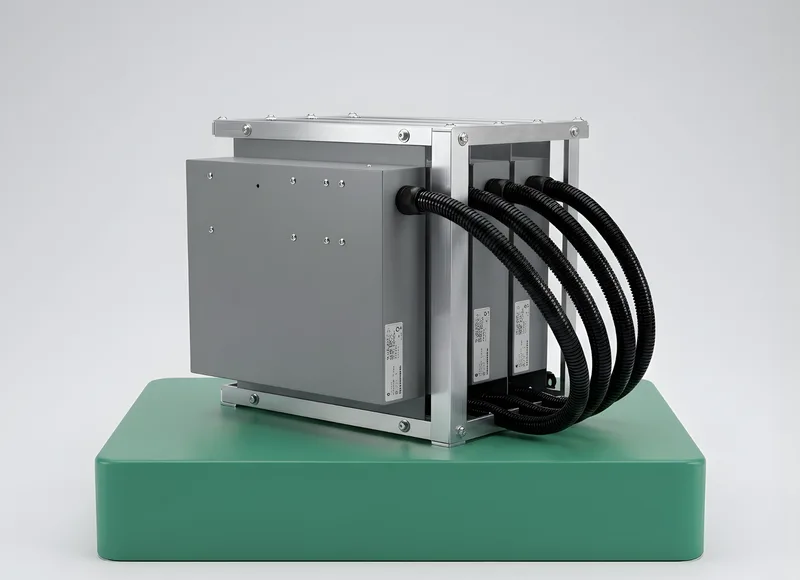
HarmoniQ installs a coordinated, solid-state system at the low-voltage switchboard — exactly where the MEW power-factor requirements are evaluated, where the capacity is reserved, and where Kuwait’s cooling and IT loads inject distortion. We deploy three products as the site requires: HarmoniQ Alpha for voltage stability at the point of use, the HarmoniQ Delta for harmonic mitigation, and the HarmoniQ Sigma for real-time power factor correction. No switched-capacitor steps, no contactors, and no resonance risk with the harmonics already on your system.
Real-time impedance matching for voltage stability at the point of use — the selective add-on for the criticality-led tail of hospitals, data halls and sensitive process plant, with the visibility to prove power factor, harmonics and demand at the meter, continuously.
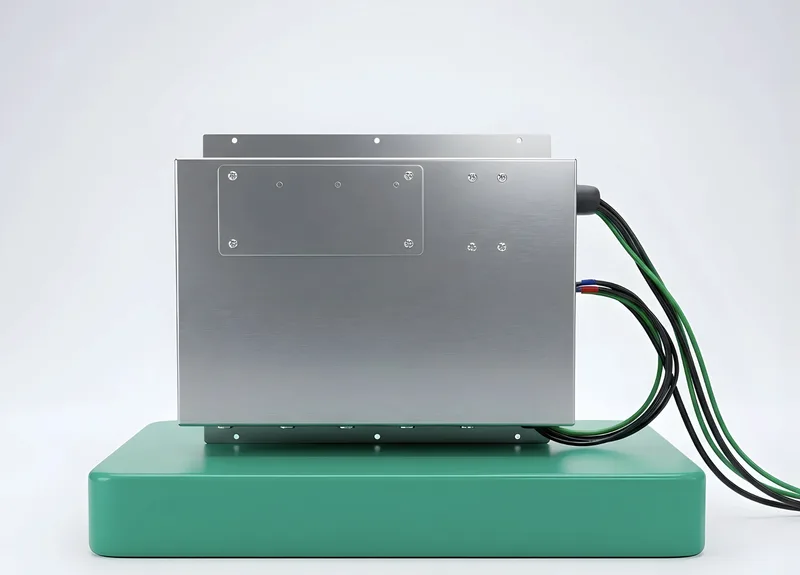
Active harmonic filtering that holds distortion within the IEC 61000 and IEEE 519 limits used in Kuwaiti design codes — the natural companion in Kuwait’s VFD-driven cooling, data-centre and commercial sites, where chillers, rectifiers and non-linear UPS all push harmonic levels up.
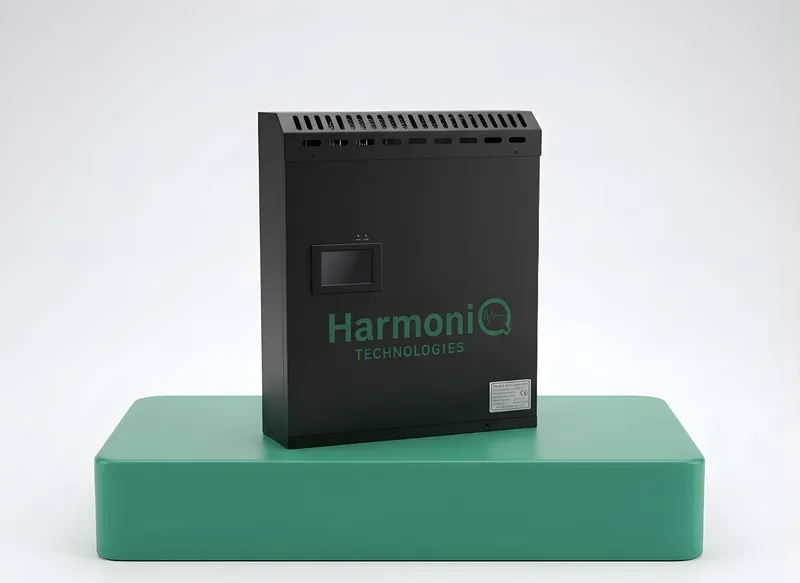
Real-time true power factor correction to 0.98+ across the whole network — meeting the MEW wiring-regulation power-factor requirements and freeing ~15–20% of transformer and switchgear capacity, so a growing site can connect more load on a grid that is short of spare headroom.
Why not just install capacitor banks? + Read more− Close
Switched-capacitor banks correct power factor in fixed steps at the incoming feed — enough, in theory, to lift you over a power-factor threshold at the meter, and they are cheap and locally available. But they respond in steps and seconds, so they lag the fast-changing loads of a chiller plant; they sit only at the boundary, so reactive current still flows through your internal network and still heats it above 50 °C; and on a system carrying harmonics — as nearly every modern Kuwaiti cooling, data-centre or commercial site does — a capacitor bank can form a resonant circuit with the supply, amplifying those harmonics rather than removing them. MEW’s own guidance warns to run a harmonic study before adding capacitors for exactly this reason.
HarmoniQ is solid-state and dynamic: it corrects continuously rather than in steps, works across the network rather than at one point, and carries no resonance risk. Paired with active filtering, it is power factor correction and harmonic mitigation designed for a plant full of drives and inverters, not the switchgear of forty years ago — and it meets the code while freeing the capacity a capacitor bank alone leaves locked up.
What It’s Worth
Capacity and Compliance, Not a Cheap Kilowatt-Hour
| Lever | What changes | Effect for the site |
|---|---|---|
| Power factor → 0.98+ | Reactive current falls; the installation meets the MEW power-factor requirements | Code requirements met; lower apparent-power demand on the connection |
| Capacity release | ~15–20% of transformer / switchgear headroom freed | Add chillers, lines or EV charging without a larger connection the grid may struggle to give |
| Harmonic filtering | Lower distortion, cooler transformers, motors & cables above 50 °C | Less thermal stress, longer asset life |
| Loss reduction | A Kuwait distribution case study correcting 0.75→0.95 cut apparent-power demand ~26% and cable losses ~36% | Real loss and heat reduction — but modest in money on power this cheap |
| Where the value sits | Released capacity and met code — not the energy line, which barely moves on a subsidised tariff | |
Every site’s loads, tariff band and reactive profile are different, and the figures above are illustrative of the mechanism — the kVA and loss reductions are drawn from a published Kuwait distribution case study, not a quote for your site. In Kuwait the honest picture is that the energy saving is small and the value is in the capacity released and the code met; our engineers will model the exact power factor improvement, capacity freed, harmonic headroom and losses reduced for your specific connection — get in touch for a site assessment, or see the method on our power factor correction and demand-charge pages.