The Cost of Power
Among the Most Expensive Electricity in the World
Hong Kong pairs a dense, high-value commercial economy with some of the highest electricity tariffs anywhere. Commercial users pay on the order of US$0.16–0.20/kWh, and the territory’s two privately-owned utilities post 2026 average net tariffs of roughly 140.6 and 163.3 HK cents per kWh — trimmed only about 2–3% on lower fuel costs, and still high in absolute terms. For a Grade-A office tower, a shopping mall, a data hall or a hotel, the price of a kilowatt-hour is the single biggest reason to stop wasting any of it.
Because power is this expensive, every percentage point of wasted current — reactive draw, harmonic loss, distribution loss inside the building — is charged at one of the highest unit rates on earth. The familiar argument that “efficiency doesn’t move the needle” simply does not hold in Hong Kong: here, energy cost is a lead driver, and it travels alongside the demand and power-factor charges and the harmonic compliance limits that a metered commercial site also carries.
| Who pays | Typical price | Notes |
|---|---|---|
| Commercial (office towers, malls, data halls) | ~US$0.16–0.20/kWh | Among the highest commercial tariffs in the world; the rate most Grade-A and mid-tier towers actually pay |
| Average net tariff — one utility (2026) | ~140.6 HK cents/kWh | Trimmed ~2–3% on lower fuel costs, still high in absolute terms |
| Average net tariff — the other utility (2026) | ~163.3 HK cents/kWh | The two utilities each serve their own franchise area |
| Large commercial & institutional (blended) | ~US$0.16–0.20/kWh | Demand and power-factor charges apply on top — both move when power factor rises |
Tariff figures are current as of 2025–2026 and are revised periodically — the 2026 average net tariffs of roughly 140.6 and 163.3 HK cents/kWh are the two utilities’ published rates, and the commercial US$0.16–0.20/kWh band is the rate most large commercial sites pay. Verify against the Electrical & Mechanical Services Department (EMSD) and your electricity utility at the time of reading. All prices are per kWh and exclude site-specific demand and reactive charges.
How You’re Billed
A Hong Kong Commercial Bill Is More Than the Energy You Use
The headline cents-per-kWh is only part of the story. A metered Hong Kong commercial site pays for the energy itself, for fuel-cost adjustments — and, critically for power quality, for the maximum demand it places on the network and, where the tariff carries it, for low power factor. Those last two move directly when you correct power factor at the switchboard.
| Component | What it is | Cut by power quality? |
|---|---|---|
| Energy charge (per kWh) | The energy you consume, at one of the world’s highest unit rates | Indirectly — lower in-building losses |
| Fuel-cost adjustment | A periodic adjustment tracking the utility’s fuel costs | No |
| Maximum-demand charge (kVA) | A charge on the peak apparent power you draw — central to large commercial tariffs | Yes — lower apparent power means a lower demand charge |
| Power-factor adjustment / charge | Where the tariff applies it, a penalty for running below the utility’s power-factor guidance (around 0.85–0.9) | Yes — power factor correction clears it directly |
So the answer to two questions Hong Kong operators often ask: yes, you are billed for demand and capacity — through the maximum-demand (kVA) charge — and yes, low power factor costs you, through the demand charge it inflates and, where the tariff carries one, a power-factor adjustment. Both fall as power factor rises towards unity, which is exactly what correction delivers.
Power Factor & Regulation
Demand-Charge Headroom on HVAC and Lift Loads
Hong Kong has no single mandatory national power-factor code. Instead, electrical work is governed through the EMSD’s Code of Practice for the Electricity (Wiring) Regulations, alongside the IEC family of standards. The two utilities apply power-factor guidance of around 0.85–0.9 together with maximum-demand charges — so a low power factor on chiller, HVAC and lift loads is correctable demand-charge headroom rather than an abstract penalty. Hotels, for instance, typically run at 0.80–0.87 power factor; correcting towards 0.98+ lifts apparent power off the demand charge across every floor.
On harmonics and supply quality, Hong Kong follows the IEC 61000 family via the EMSD Code of Practice, with IEC 61439 for low-voltage assemblies. As VFD-driven chillers, lift drives, rectifier loads and non-linear UPS multiply — and as rooftop-solar feed-in grows under the territory’s 2050 carbon-neutrality plan — holding distortion inside those IEC limits increasingly requires active harmonic filtering, not just a one-off survey.
There is no single mandatory power-factor code in Hong Kong; power-factor guidance (around 0.85–0.9) and demand charges are set by each of the two utilities, and electrical work follows the EMSD Code of Practice for the Electricity (Wiring) Regulations. Harmonic and equipment limits follow the IEC 61000 family and IEC 61439 for LV assemblies. Confirm the power-factor terms and limits that apply to your connection with your electricity utility, and check requirements with the EMSD — they are updated periodically.
Why Power Quality Matters Here
One of the Most Commercial Grids on Earth — Where Capacity Is the Constraint
Three structural forces make power quality a Hong Kong boardroom issue, not just an engineering one. First, the tariff — already covered, and among the highest in the world — so loss reduction and demand-charge reduction carry real money. Second, the loads and the buildings: Hong Kong is one of the most commercial electricity grids on earth, with building-related activity roughly 90% of all electricity and the commercial sector alone about 65%. That demand is concentrated in packed high-rise towers full of VFD chillers, lift drives, rectifier and data-hall load — where the binding constraint is switchboard and transformer capacity, not the supply. Power factor correction frees roughly 15–20% of capacity, which defers or avoids an upgrade in a building that has no room to add switchgear. Third, the generation mix: growing rooftop-solar feed-in under the 2050 carbon-neutrality plan adds inverter-based, harmonic-rich injection at exactly the low-voltage sites we serve.
What matters less in Hong Kong is resilience. The grid is among the most reliable in the world — better than 99.999% since 1997, under one outage-minute per customer a year — so “avoid the outage” is not the pitch. Heavy industry is essentially absent here, around 7% of consumption; the case is built on cost, capacity and compliance across office towers, malls, data centres, hotels, the metro (MTR), the airport and the ports — not on keeping the lights on.
The Solution
Solid-State Correction and Filtering, Network-Wide
HarmoniQ installs a coordinated, solid-state system at the low-voltage switchboard — where Hong Kong towers carry their cost, where the demand charge bites, where capacity runs out, and where rising inverter feed-in injects distortion. We deploy three products as the site requires: HarmoniQ Alpha as the integrated platform tying correction, filtering and voltage stabilisation together, the HarmoniQ Delta for harmonic mitigation, and the HarmoniQ Sigma for real-time power factor correction. No switched-capacitor steps, no contactors, and no resonance risk with the harmonics already on your system.
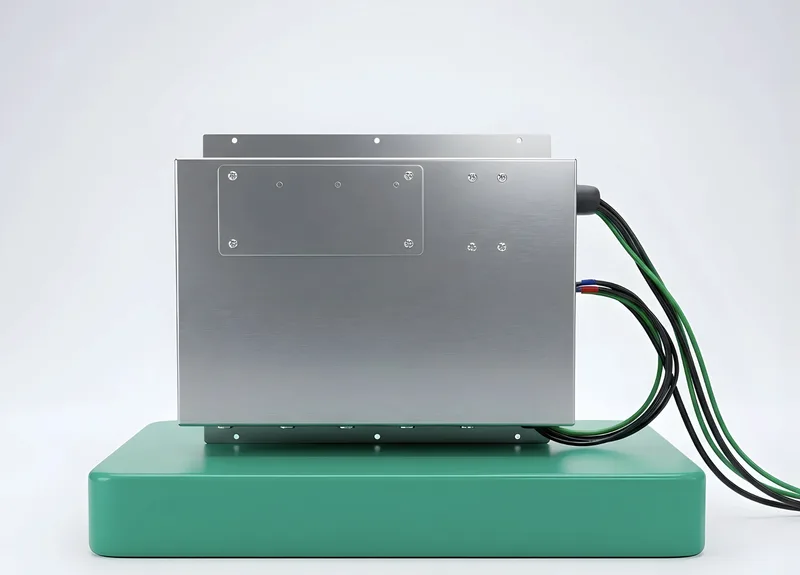
Unifies correction, filtering and voltage stabilisation across multiple boards, risers or sites — stabilising voltage at the point of use to protect IT, lift and chiller controls, with the visibility to prove power factor, harmonics and maximum demand at the meter, continuously.
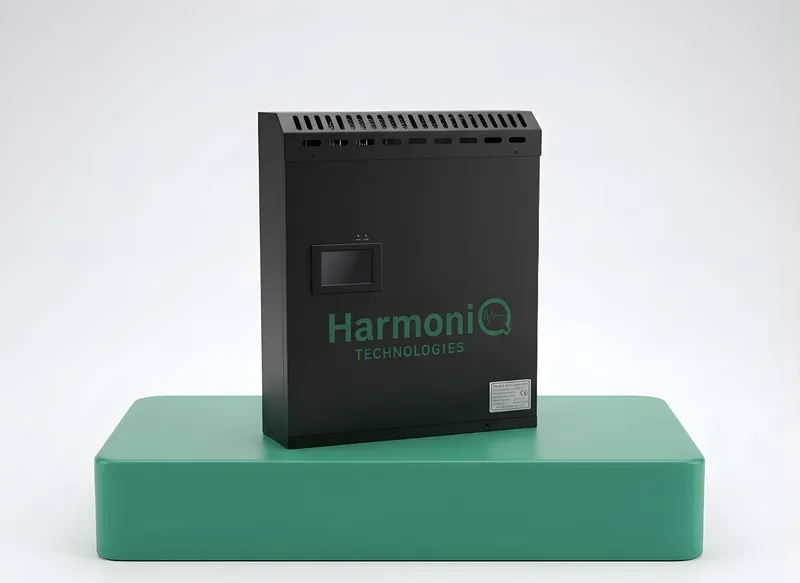
Active harmonic filtering that holds distortion within the IEC 61000 limits applied through the EMSD Code of Practice — the component that matters most as VFD chillers, lift drives, non-linear UPS and rooftop-solar feed-in multiply, protecting data-hall and lift-control loads in dense towers.
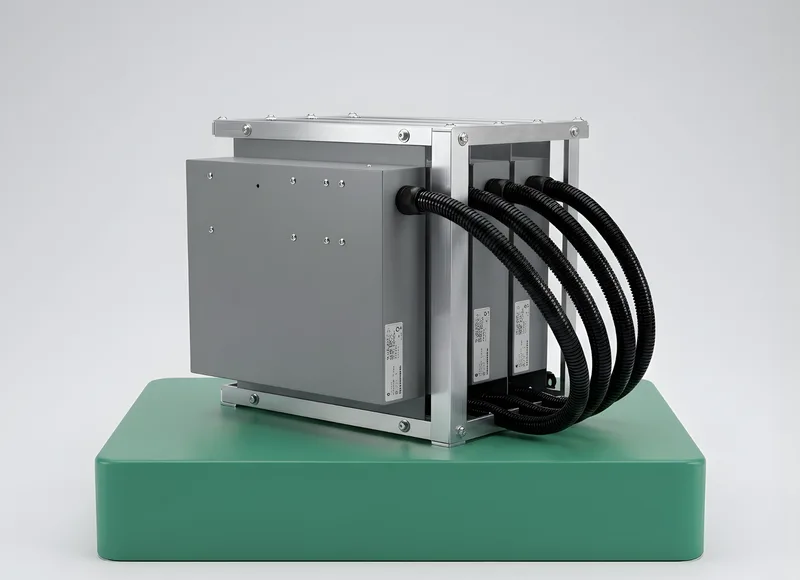
Real-time true power factor correction to 0.98+ across the whole network — lifting apparent power off the maximum-demand charge and clearing the utilities’ 0.85–0.9 power-factor guidance, and freeing roughly 15–20% of switchboard and transformer capacity so a packed tower can add chiller, lift or data load without waiting on an upgrade it has no room for.
Why not just install capacitor banks? + Read more− Close
Switched-capacitor banks correct power factor in fixed steps at the incoming feed — enough, in theory, to lift you over the utilities’ 0.85–0.9 power-factor guidance at the meter. But they respond in steps and seconds, so they lag the fast-changing chiller, lift and IT loads of a commercial tower; they sit only at the boundary, so reactive current still flows through the building’s risers and internal network; and on a system carrying harmonics — as nearly every modern Hong Kong tower does, with its VFD drives, rectifiers and inverters — a capacitor bank can form a resonant circuit with the supply, amplifying those harmonics.
HarmoniQ is solid-state and dynamic: it corrects continuously rather than in steps, works across the network rather than at one point, and carries no resonance risk. Paired with active filtering, it is power factor correction and harmonic mitigation designed for a tower full of drives and inverters, not the switchgear of forty years ago.
What It’s Worth
High Tariff, Demand Charges, Tight Capacity — the Savings Compound
| Lever | What changes | Effect on the bill |
|---|---|---|
| Power factor → 0.98+ | Apparent power falls; site clears the 0.85–0.9 power-factor guidance | Maximum-demand charge cut; any power-factor adjustment removed |
| Harmonic filtering to IEC limits | Lower distortion, cooler transformers, cables and risers; protected IT and lift loads | Lower in-building losses, longer asset life, IEC compliance held |
| Capacity release | Roughly 15–20% of switchboard / transformer headroom freed | Defer or avoid an upgrade in a tower with no room to add switchgear |
| Illustrative energy reduction | A meaningful cut on a bill priced at among the world’s highest tariffs — loss reduction plus a lower demand charge — with the capacity released often worth as much as the energy saved | |
Every site’s loads, tariff and reactive profile are different, and the figures above are illustrative of the mechanism — not a quote. Our engineers will model the exact power factor improvement, maximum-demand charge avoided, losses reduced and capacity released for your specific connection — get in touch for a site assessment, or see the method on our power factor correction and demand-charge pages.