The Cost of Power
Among the Higher Industrial Electricity Prices in the EU
Greece pairs a tourism- and services-heavy economy with electricity priced well above the European norm. Business electricity reached ~€0.159 per kWh in September 2025 — roughly 136% of the European average and around 174% of the world average — even after retreating from a 2022 crisis peak near €0.28/kWh for industry. For a hotel, factory, shopping centre or commercial estate, the price of a kilowatt-hour is the single biggest reason to stop wasting any.
Greek power is expensive enough that energy savings are genuinely bankable — this is a market driven by price, not by keeping the lights on. So the usual argument that “industrial power is cheap, efficiency doesn’t move the needle” simply does not hold here. Every percentage point of wasted current is charged at one of the EU’s higher unit rates.
| Who pays | Typical price | Notes |
|---|---|---|
| Business / commercial (all-in) | ~€0.159/kWh (Sep 2025) | ~136% of the EU average; ~174% of the world average |
| Industry (medium band) | ~€0.13/kWh (Dec 2024) | Down from a 2022 peak near €0.28/kWh; still among the pricier EU markets |
| 2022 crisis peak (industry) | ~€0.28/kWh | Shows how far prices can swing — the structural premium is the durable lever |
| Households (incl. taxes & levies) | ~€0.22/kWh (Dec 2024) | Among the higher residential prices in the EU |
Business and industrial prices are from GlobalPetrolPrices (commercial ~€0.159/kWh, September 2025) and Eurostat via TradingEconomics (non-household medium band ~€0.13/kWh, December 2024). The household figure is the Eurostat medium-consumer band (~€0.22/kWh, December 2024, including taxes and levies), web-sourced here because it falls outside our internal pricing work. Figures are current as of 2024–2025 and are revised regularly — verify against Eurostat electricity prices and the Greek regulator RAE at the time of reading. Prices are per kWh and exclude site-specific demand and capacity charges.
How You’re Billed
A Greek Industrial Bill Is More Than the Energy You Use
The headline cent-per-kWh is only part of the story. A metered Greek site pays for the energy itself, for the networks that deliver it, for taxes and levies — and, critically for power quality, for the apparent-power capacity it agrees with the network (in kVA) and for the reactive energy it draws. Those last two move directly when you correct power factor.
| Component | What it is | Cut by power quality? |
|---|---|---|
| Energy (wholesale / commodity) | The kWh you consume, at the traded price | Indirectly — lower network losses |
| Network charges | Distribution and transmission fees for delivering power over the grid | Partly |
| Taxes & levies | Public-service and regulatory charges added to the bill | No |
| Agreed power / capacity charge (kVA) | A charge on the apparent-power capacity you agree at your connection | Yes — lower apparent power means a lower charge |
| Reactive-power (cos φ) charge | A charge on reactive energy, billed on sites with agreed power above 55 kVA running a poor power factor | Yes — power factor correction cuts it directly |
So the answer to two questions Greek operators often ask: yes, you are billed for the capacity you agree — through the apparent-power (kVA) charge — and yes, you are billed for poor power factor, through the reactive-power (cos φ) charge once your agreed power passes 55 kVA. Both fall as power factor rises towards unity, which is exactly what correction delivers.
Power Factor & Regulation
A Reactive Charge Aimed Squarely at Larger Sites
Unlike countries with no nationwide reactive penalty, Greece operates a formal reactive-power (cos φ) billing regime. It applies to customers with agreed power above 55 kVA — essentially every substantial commercial or industrial site — while below that threshold cos φ is taken as 1 and no penalty applies. A motor- and drive-heavy site running a poor power factor therefore pays a recurring reactive charge that disappears the moment it is corrected to 0.98+, alongside lower apparent-power capacity fees.
On harmonics and supply quality, Greek connections must hold voltage quality within EN 50160, whose planning limit for total harmonic distortion is THD 8%, and the national grid code has integrated the EU connection rules (Regulation 2016/631, RfG). With around 11.5 GW of inverter-based solar now on the system — and rooftop self-consumption at commercial and industrial sites nearly doubling year on year — distortion at the low-voltage connection is rising fast, and staying inside the limit increasingly requires active harmonic filtering, not just a one-off survey.
The reactive-power (cos φ) charge above 55 kVA is applied by suppliers under the Greek regulated framework; voltage-quality limits follow EN 50160 (THD planning level 8%), and grid connection follows the national grid code, which integrates EU Regulation 2016/631 (RfG). The distribution network is operated by HEDNO (DEDDIE) and the transmission system by IPTO (ADMIE), under the regulator RAE. Confirm the charge, threshold and limits that apply to your connection with your supplier and network operator — they are set within the regulated framework and updated periodically. The figures here are drawn from public sources and should be verified with RAE.
Why Power Quality Matters Here
A High-Cost, High-Solar, Summer-Peaking Grid
Three structural forces make power quality a Greek boardroom issue, not just an engineering one. First, the tariff — already covered, and among the higher in the EU. Second, the generation mix: clean energy covered 50.5% of Greek demand in 2024 (wind and solar 44.4%, large hydro 6.1%), with lignite down to just 5.7% from around 60% in 2005 — and that inverter-heavy supply, with roughly 11.5 GW of solar installed by the end of 2025, raises harmonic distortion at exactly the commercial and industrial sites we serve. Third, a stressed summer peak: demand is summer-peaking on air-conditioning and tourism, reaching around 10,778 MW in July 2025 — close to the roughly 11,000 MW critical threshold — so trimming wasted consumption and freeing transformer headroom on the connection you already have is unusually valuable.
What matters less on the Greek mainland is resilience. The transmission grid is reasonably reliable — around 1.6 to 1.9 hours lost per customer per year — so unlike sites in parts of Africa or the Gulf, mainland operators are driven by cost, the reactive charge and compliance rather than by keeping the lights on. The genuine exceptions are the non-interconnected islands, where resilience carries more weight.
The Solution
Solid-State Correction and Filtering, Network-Wide
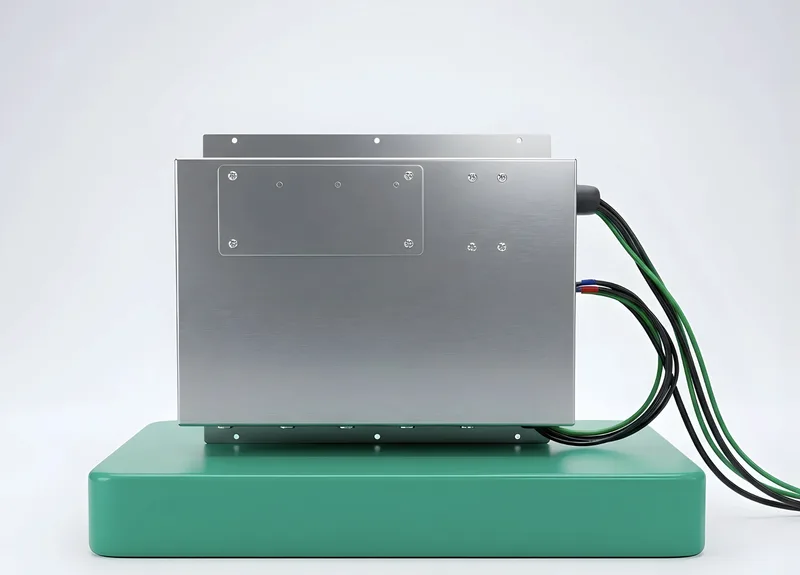
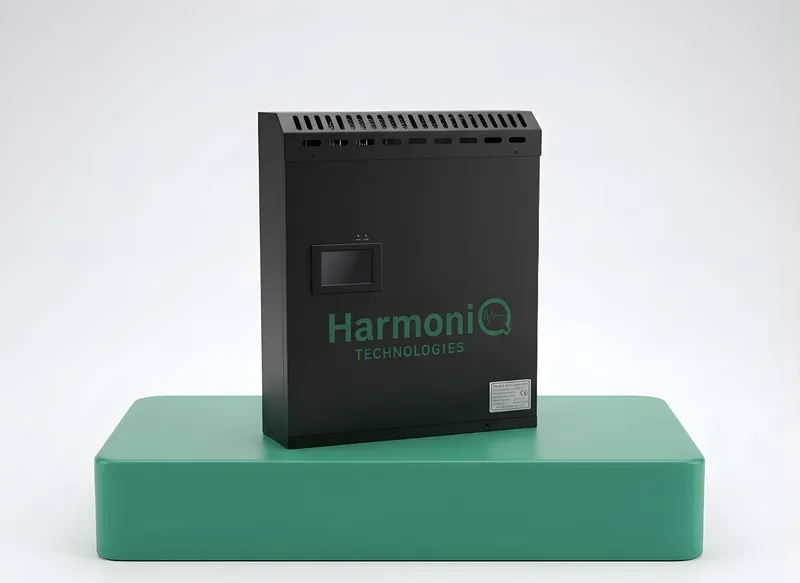
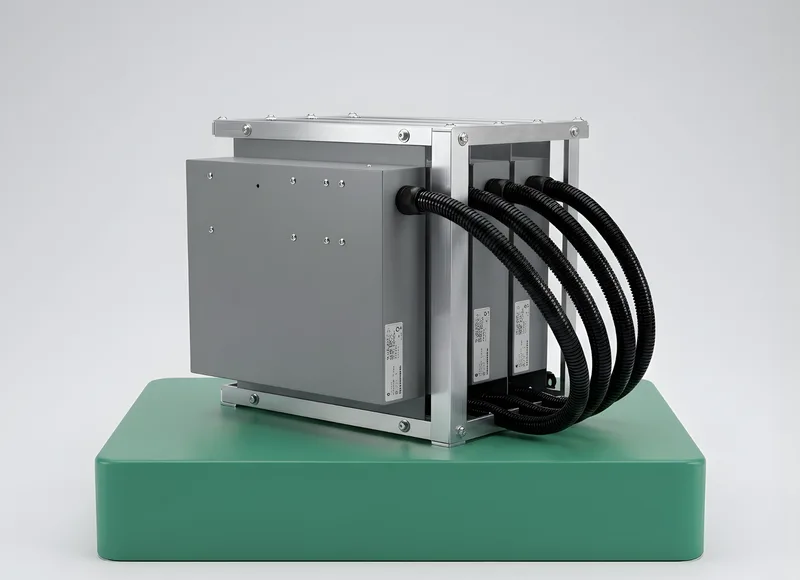
HarmoniQ installs a coordinated, solid-state system at the low-voltage switchboard — where Greek sites carry their cost, where the cos φ reactive charge bites, and where the surging behind-the-meter solar injects distortion. We deploy three products as the site requires: HarmoniQ Alpha as the integrated platform tying correction, filtering and voltage optimisation together, the HarmoniQ Delta for harmonic mitigation, and the HarmoniQ Sigma for real-time power factor correction. No switched-capacitor steps, no contactors, and no resonance risk with the harmonics already on your system.
Unifies correction, filtering and voltage optimisation across multiple boards or sites — stabilising voltage on a stressed, summer-peaking grid and trimming wasted consumption, with the visibility to prove power factor, reactive energy and apparent-power demand at the meter, continuously.
Active harmonic filtering that holds distortion below the EN 50160 planning limit (THD 8%) — the component that matters most in Greece’s high-solar environment, where rooftop self-consumption, drives, rectifiers and on-site inverters all push harmonic levels up at the point of connection.
Real-time true power factor correction to 0.98+ across the whole network — addressing the reactive-power charge that Greek suppliers levy on sites above 55 kVA, cutting apparent-power capacity fees, and freeing transformer headroom so you can add load without waiting for a grid upgrade. Because it corrects dynamically, it avoids the over-compensation that fixed capacitor banks cause as load varies through a hotel’s daily and seasonal cycle.
Why not just install capacitor banks? + Read more− Close
Switched-capacitor banks correct power factor in fixed steps at the incoming feed — enough, in theory, to lift you over the cos φ threshold at the meter. But they respond in steps and seconds, so they lag fast-changing loads — and on a resort or factory whose load swings through the day and the season, fixed banks readily over-compensate; they sit only at the boundary, so reactive current still flows through your internal network; and on a system carrying harmonics — as nearly every modern Greek site does, with its drives, rectifiers and rooftop inverters — a capacitor bank can form a resonant circuit with the supply, amplifying those harmonics.
HarmoniQ is solid-state and dynamic: it corrects continuously rather than in steps, works across the network rather than at one point, and carries no resonance risk. Paired with active filtering, it is power factor correction and harmonic mitigation designed for a plant full of drives and inverters, not the switchgear of forty years ago.
What It’s Worth
High Tariff, a Real Reactive Charge — the Savings Compound
| Lever | What changes | Effect on the bill |
|---|---|---|
| Power factor → 0.98+ | Reactive energy and apparent-power demand fall | Reactive (cos φ) charge cleared; capacity fees cut |
| Voltage optimisation | Around 3–6% less consumption — e.g. a 4% cut on a 5 GWh/yr hotel is roughly €32,000 a year at €0.159/kWh | Lower energy spend at a high tariff |
| Harmonic filtering to EN 50160 | Lower distortion, cooler transformers & cables as on-site solar grows | Lower losses, longer asset life |
| Capacity release | Transformer / switchgear headroom freed | Defer or avoid a grid upgrade on a stressed summer peak |
| Indicative annual saving | A material recurring sum on a site of this size — plus the capacity released | |
Every site’s loads, tariff and reactive profile are different, and the figures above are illustrative of the mechanism — not a quote. Our engineers will model the exact power factor improvement, reactive and capacity charges avoided, consumption and losses reduced and capacity released for your specific connection — get in touch for a site assessment, or see the method on our power factor correction and demand-charge pages.