The Cost of Power
Imported Power, Rising Far Faster Than Inflation
Electricity in Eswatini is not cheap, and it is climbing fast. The Eswatini Energy Regulatory Authority (ESERA) approved an average tariff increase of 14.67% for 2025/26 — effective 1 April 2025 — followed by a further 11.74% for 2026/27 (revised down from an approved 13.61% after government special funding, effective 1 April 2026), after the Eswatini Electricity Company (EEC) had applied for rises of more than 25%. For a sugar mill, factory or commercial estate, the trajectory matters as much as the level: every percentage point of wasted current costs more this year than last, and more again next year.
The level itself sits in the mid-range for the region. The all-in business rate is about SZL 1.77 per kWh (~USD 0.11), while EEC’s published small-commercial energy charge is E3.3920 per kWh before demand and access charges. Households pay more per unit, at around SZL 2.49/kWh (~USD 0.15). On a tariff rising around 15% a year, eliminating wasted energy and trimming demand charges is a material, repeating saving.
| Who pays | Typical price | Notes |
|---|---|---|
| Business / commercial (all-in) | ~SZL 1.77/kWh (~USD 0.11, Sep 2025) | Includes power, network and taxes; before site-specific demand charges |
| Small commercial (EEC S3 energy charge) | E3.3920/kWh | Plus a monthly facility charge of E208–416; max demand ≤20 kVA |
| Corporate time-of-use (EEC T1–T4) | energy ~E1.2–7.1/kWh + kVA charges | Energy varies by peak / standard / off-peak; demand & access billed in kVA |
| Households (residential, all-in) | ~SZL 2.49/kWh (~USD 0.15, Sep 2025) | Web-sourced for context — varies by tariff and usage; see note |
The approved tariff increases are from ESERA decisions and EEC’s tariff-adjustment communications; the EEC S3 small-commercial and T1–T4 time-of-use rates are from EEC and the ESERA tariff structure (effective 1 April; prices are inclusive of the 2.5% Rural Electrification Access Fund levy and exclusive of VAT for non-domestic customers). The all-in business and household figures are from GlobalPetrolPrices (September 2025); USD conversions are indicative and the lilangeni (SZL/E), pegged to the South African rand, can move. The 2026/27 increase was revised from an approved 13.61% to 11.74% after government special funding (ESERA, 26 March 2026). Figures are current as of June 2026 and are revised annually — verify against EEC’s tariff schedules and ESERA at the time of reading.
How You’re Billed
An Eswatini Industrial Bill Is Dominated by Demand, Not Just Energy
The headline cents-per-kWh is only part of the story. A larger Eswatini site on one of EEC’s corporate time-of-use tariffs (T1–T4) pays for the energy itself, for the network that delivers it, for the Rural Electrification levy — and, critically for power quality, for the maximum demand it draws, billed in kVA, plus an access charge tied to that demand. On these tariffs the kVA charges are among the largest line items on the bill, and they move directly when you correct power factor.
| Component | What it is | Cut by power quality? |
|---|---|---|
| Energy (active, c/kWh) | The kWh you consume, differentiated by time of day (peak / standard / off-peak) | Indirectly — lower network losses |
| Facility charge | A fixed monthly charge per connection | No |
| Maximum-demand charge (kVA) | Charged on the highest apparent-power demand recorded over any 30-minute period (~E220–259/kVA) | Yes — correcting power factor lowers kVA, so the charge falls |
| Access charge (kVA) | Based on the highest maximum demand of the previous 12 months (~E65–73/kVA) | Yes — a lower peak kVA lowers the access charge too |
| Rural Electrification levy | 2.5% of the energy charge, for the Rural Electrification Access Fund | No |
EEC defines maximum demand as “the power recorded over any thirty minutes period by a kVA demand indicator,” and bases the access charge on “the highest of the previous 12 month maximum demand.” So the answer to the question Eswatini operators most often ask: yes, you are billed for kVA — through both the maximum-demand charge and the 12-month access charge — and because kVA rises as power factor falls, a poorly corrected site registers a higher demand, and pays more, for the same real work. Correcting power factor towards unity lowers both charges at once.
Power Factor & Regulation
kVA Charges That Reward Correction — and Regional Power-Quality Limits
EEC’s published tariffs do not set out a separate power-factor penalty or reactive-energy charge in the way some utilities do. Instead, the cost of poor power factor is carried entirely through the kVA maximum-demand and access charges: because kVA is the vector sum of real and reactive power, a site running at 0.85 power factor draws a higher apparent demand — and therefore pays more in demand and access charges — than the same site corrected to 0.98+. The practical effect is the same as an explicit penalty: correction reads straight through to a lower bill.
On harmonics and supply quality, Eswatini sits within the Southern African framework, where networks are designed and assessed against NRS 048-2 — the regional power-quality standard that sets compatibility levels including total harmonic distortion of ≤8% on low- and medium-voltage networks — alongside the IEC 61000 series. As variable-speed drives, rectifiers, non-linear UPS and behind-the-meter solar multiply on industrial sites, staying inside those limits increasingly requires active harmonic filtering, not just a one-off survey.
EEC tariffs are approved by ESERA and published in the tariff schedule; the kVA maximum-demand and access charges and the maximum-demand definition are taken directly from EEC’s commercial tariff documentation. We did not find a separately published power-factor penalty or reactive-energy charge in those tariffs — the cost of poor power factor is carried through the kVA charges. Harmonic and voltage-quality limits referenced here follow the regional NRS 048-2 standard (THD ≤8% on LV/MV) and the IEC 61000 series; the precise standards, thresholds and any power-factor requirement that apply to your connection should be confirmed with ESERA and EEC, as they are set per connection and updated periodically.
Why Power Quality Matters Here
An Import-Dependent, Demand-Charged, Constrained Grid
Three structural forces make power quality an Eswatini boardroom issue, not just an engineering one. First, the tariff — already covered: rising around 15% a year, so the savings case strengthens annually, and dominated by kVA demand charges that reward correction directly. Second, import dependence: Eswatini generates only about 76.5 MW domestically against a peak demand above 230 MW, importing roughly 70% of its electricity — the bulk of it from South Africa’s grid, with the balance from Mozambique and the Southern African Power Pool. Power purchases and wheeling charges have made up around 70% of EEC’s cost of sales, so every kVA and every unit a site can avoid eases a bill that is largely set across the border. Third, reliability: that same dependence exposes Eswatini to South Africa’s supply strains, and EEC has had to implement winter load management and load-shedding when regional supply tightens — so freeing capacity and protecting sensitive loads carries real value.
Eswatini’s industrial demand is concentrated in energy-intensive processing — above all the sugar sector, where producers such as Royal Eswatini Sugar Corporation and Illovo-owned Ubombo Sugar run large mills (Ubombo was the country’s first independent power producer, exporting biomass power to the grid), alongside textiles, agro-processing and beverages. These are exactly the motor- and drive-heavy, kVA-billed loads where power factor correction and harmonic filtering pay back. On an import-dependent grid with rising tariffs, the question is not whether to manage power quality, but how soon.
The Solution
Solid-State Correction and Filtering, Network-Wide
HarmoniQ installs a coordinated, solid-state system at the low-voltage switchboard — where Eswatini sites carry their cost, where the kVA maximum-demand and access charges bite, and where drives, rectifiers and on-site solar inject distortion. We deploy three products as the site requires: HarmoniQ Alpha as the integrated platform tying correction, filtering and voltage stabilisation together, the HarmoniQ Delta for harmonic mitigation, and the HarmoniQ Sigma for real-time power factor correction. No switched-capacitor steps, no contactors, and no resonance risk with the harmonics already on your system.
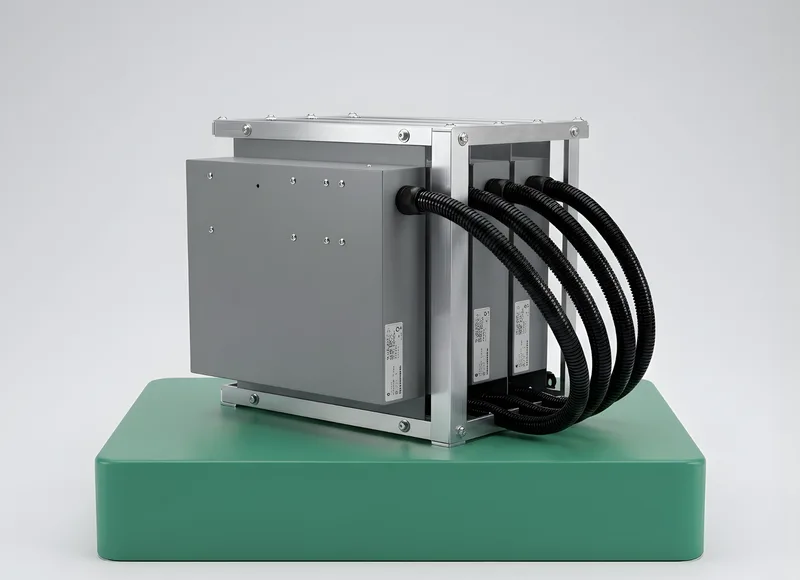
Unifies correction, filtering and voltage stabilisation across multiple boards or sites — valuable for sensitive loads in process plants, hospitals and data halls on an import-dependent grid, with the visibility to prove power factor and kVA demand at the meter, continuously.
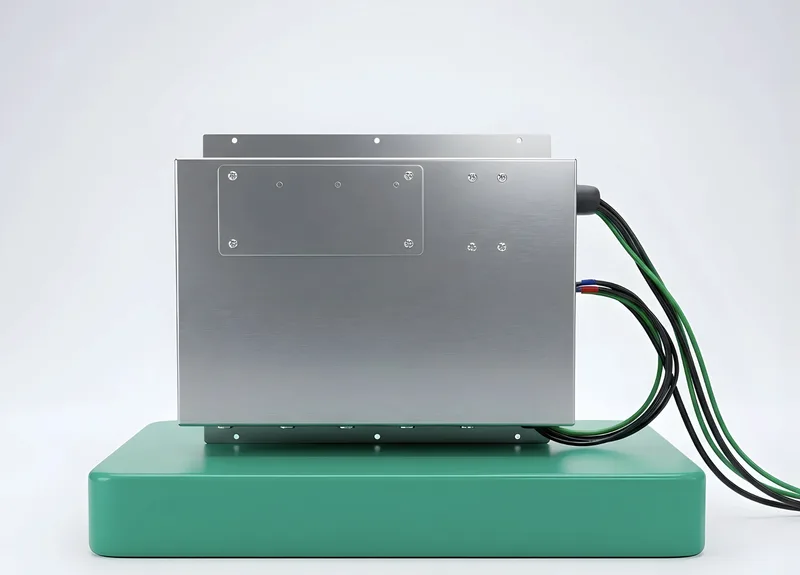
Active harmonic filtering that holds distortion within the regional NRS 048-2 limit (THD ≤8% on LV/MV) — the component that matters most as sugar-mill drives, rectifiers, non-linear UPS and on-site solar push harmonic levels up.
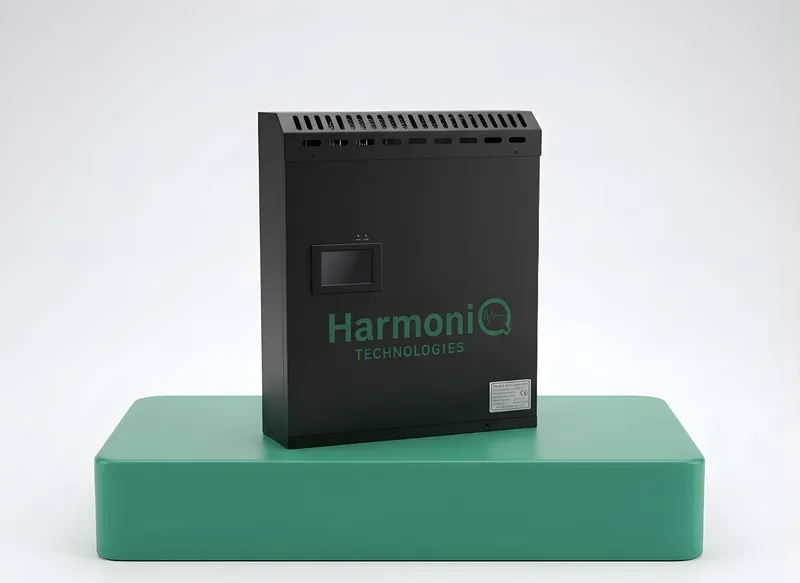
Real-time true power factor correction to 0.98+ across the whole network — lowering the kVA maximum demand and the 12-month access charge that dominate an EEC time-of-use bill, and freeing transformer headroom so you can add load without a costly connection upgrade on an import-constrained grid.
Why not just install capacitor banks? + Read more− Close
Switched-capacitor banks correct power factor in fixed steps at the incoming feed — enough, in theory, to trim the kVA demand registered at the meter. But they respond in steps and seconds, so they lag fast-changing loads; they sit only at the boundary, so reactive current still flows through your internal network; and on a system carrying harmonics — as nearly every modern industrial site does, with its drives, rectifiers and inverters — a capacitor bank can form a resonant circuit with the supply, amplifying those harmonics rather than removing them.
HarmoniQ is solid-state and dynamic: it corrects continuously rather than in steps, works across the network rather than at one point, and carries no resonance risk. Paired with active filtering, it is power factor correction and harmonic mitigation designed for a plant full of drives and inverters, not the switchgear of forty years ago.
What It’s Worth
Heavy kVA Charges on a Rising Tariff — the Savings Compound
| Lever | What changes | Effect on the bill |
|---|---|---|
| Power factor → 0.98+ | Apparent demand (kVA) and peak fall for the same real load | Lower kVA maximum-demand and 12-month access charges |
| Harmonic filtering to NRS 048-2 | Lower distortion, cleaner solar coupling, cooler transformers & cables | Lower losses, longer asset life, compliant supply |
| Capacity release | ~15–20% of transformer / switchgear headroom freed | Defer or avoid a costly connection upgrade on a constrained grid |
| Indicative annual saving | A meaningful recurring saving in lilangeni on a site of this size — growing with every annual tariff increase — plus the capacity released | |
Every site’s loads, tariff and reactive profile are different, and the figures above are illustrative of the mechanism — not a quote. Our engineers will model the exact power factor improvement, the kVA maximum-demand and access charges avoided, the losses reduced and the capacity released for your specific connection, in lilangeni — get in touch for a site assessment, or see the method on our power factor correction and demand-charge pages.