The Cost of Power
Cheap Today, Rising Fast Towards Cost-Reflective Tariffs
Egypt has long run on some of the cheapest electricity in the region — commercial power sat at roughly EGP 1.94 per kWh (~USD 0.039/kWh) in September 2025. But that is changing deliberately. Under an IMF-anchored subsidy-reform programme, industrial and commercial tariffs are being lifted towards cost-reflective levels, year on year: the reduced industrial rate granted since 2020 ended on 1 July 2025, and a further round lifted commercial brackets by around 20% in April 2026, with more increases expected. For a factory, hotel, mall, or data centre, the price of a kilowatt-hour is no longer a rounding error — and every wasted unit costs more than it did a year ago.
The economics have shifted because the direction of travel is fixed. The Egyptian pound has also devalued sharply since 2022, so headline EGP tariffs overstate the dollar move — but the real cost of power for industrial and commercial sites is climbing each year. The old argument that “Egyptian power is so cheap that efficiency does not move the needle” is being undone tariff round by tariff round, and a correction that struggles to pay on today’s bill clears the hurdle comfortably after two or three more.
| Who pays | Typical all-in price | Notes |
|---|---|---|
| Industry (reduced rate ended Jul 2025) | ~EGP 2.33 /kWh (~USD 0.047) | Subsidy support withdrawn; the trajectory is firmly up |
| Commercial / business (all-in) | ~EGP 1.94 /kWh (~USD 0.039) | Sep 2025; rose a further ~20% in the April 2026 round |
| Households (incl. taxes) | ~EGP 1.07 /kWh (~USD 0.021) | Sep 2025; lowest tier ~68 piastres/kWh; held for low-use homes into 2026 |
Commercial and household unit prices are from GlobalPetrolPrices (collected September 2025, all costs and taxes included); the industrial rate and the reform timeline (reduced industrial rate ended 1 July 2025; commercial brackets up ~20% in April 2026; further hikes expected) follow EgyptERA tariff rounds and Egyptian press reporting. Figures are current as of 2025–2026 and are revised regularly — and the pound has devalued in steps since 2022, so USD equivalents move with the exchange rate. Verify against EgyptERA and your distribution company at the time of reading. All prices are unit rates and exclude demand and capacity charges.
How You’re Billed
An Egyptian Industrial Bill Is More Than the Energy You Use
The headline pound-per-kWh is only part of the story. A larger metered Egyptian site pays for the energy itself, for the networks that deliver it, for taxes — and, critically for power quality, for the apparent-power capacity it places on the connection (in kVA) and for the reactive energy it draws once power factor falls below the EgyptERA threshold. Those last two move directly when you correct power factor.
| Component | What it is | Cut by power quality? |
|---|---|---|
| Energy (consumption) | The kWh you consume, at the regulated tariff for your category | Indirectly — lower network losses |
| Network & distribution | Delivering power over the local distribution company’s network | Partly |
| Taxes & levies | VAT and other charges applied to the supply | No |
| Demand / capacity charge (kVA) | A charge on the apparent-power capacity you reserve at your connection | Yes — lower kVA means a lower charge |
| Reactive-energy charge (kVArh) | A charge levied on excess reactive energy drawn once power factor falls below the EgyptERA threshold | Yes — power factor correction cuts it directly |
So the answer to two questions Egyptian operators often ask: yes, you are billed for kVA — through the demand and capacity charge — and yes, you are billed for poor power factor, through the reactive-energy charge and the EgyptERA penalty applied below the reference power factor. Both fall as power factor rises towards unity, which is exactly what correction delivers.
Power Factor & Regulation
The EgyptERA Power-Factor Obligation
Egypt’s electricity sector is regulated by the Egyptian Electric Utility and Consumer Protection Regulatory Agency (EgyptERA), and how a plant draws its current is governed by the Egyptian Electricity Distribution Code, administered through the regional distribution companies. The Code sets an explicit power-factor obligation for industrial and larger commercial customers:
- Customers must maintain an average power factor of at least 0.90 lagging.
- The tariff is struck at a reference power factor of 0.92 — operate above it and you earn a reduction on your bill; fall below it and you incur a penalty, with reactive energy charged on low-power-factor connections.
- Loads above 500 kW are assessed on their average annual power factor, so a few good months cannot rescue a poor full-year figure.
On harmonics and connection, non-linear loads must hold distortion within the limits of the IEC 61000 family that the Distribution Code applies. As variable-speed-driven chillers, rectifiers, induction furnaces, non-linear UPS and behind-the-meter solar multiply on Egyptian sites — the country is targeting 42% of electricity from renewables by 2030 — staying inside those limits increasingly requires active harmonic filtering, not just a one-off survey.
The power-factor obligation (minimum ~0.90, reference ~0.92, full-year assessment above 500 kW) and the reactive-energy charge on low-power-factor connections are set in the Egyptian Electricity Distribution Code and administered by the regional distribution companies; harmonic limits follow the IEC 61000 family. The exact threshold, reactive-charge formula and tariff parameters are reviewed periodically — confirm the rules that apply to your connection with EgyptERA and your distribution company at the time of reading.
Why Power Quality Matters Here
A Rising-Tariff, High-Heat, Capacity-Hungry Grid
Three structural forces make power quality an Egyptian boardroom issue, not just an engineering one. First, the tariff trajectory — already covered: prices are low today but rising deliberately towards cost-reflective levels, so the savings case strengthens with every reform round. Second, capacity: an aggressive build-out of new cities, economic zones and industrial estates is competing for connection capacity, so freeing transformer and switchgear headroom on the connection you already have lets a growing site add load without a costly utility upgrade. Third, the operating environment: 40°C+ summer cooling peaks still strain the grid and the equipment on it, and a fast-growing fleet of inverter-based solar and VFD-driven cooling is raising harmonic distortion at exactly the industrial and commercial sites we serve.
What matters less in Egypt than it once did is resilience. After the 2014–15 shortage crisis, a wave of new generation turned the deficit into a sizeable surplus, and the grid is now broadly reliable — so unlike a decade ago, most Egyptian operators are driven by cost, charges, capacity and compliance rather than by keeping the lights on, even if summer peaks still bite.
The Solution
Solid-State Correction and Filtering, Network-Wide
HarmoniQ installs a coordinated, solid-state system at the low-voltage switchboard — where Egyptian sites carry their cost, where the distribution companies assess power factor, and where the inverter-heavy, cooling-heavy load injects distortion. We deploy three products as the site requires: HarmoniQ Alpha as the integrated platform tying correction, filtering and voltage optimisation together, the HarmoniQ Delta for harmonic mitigation, and the HarmoniQ Sigma for real-time power factor correction. No switched-capacitor steps, no contactors, and no resonance risk with the harmonics already on your system.
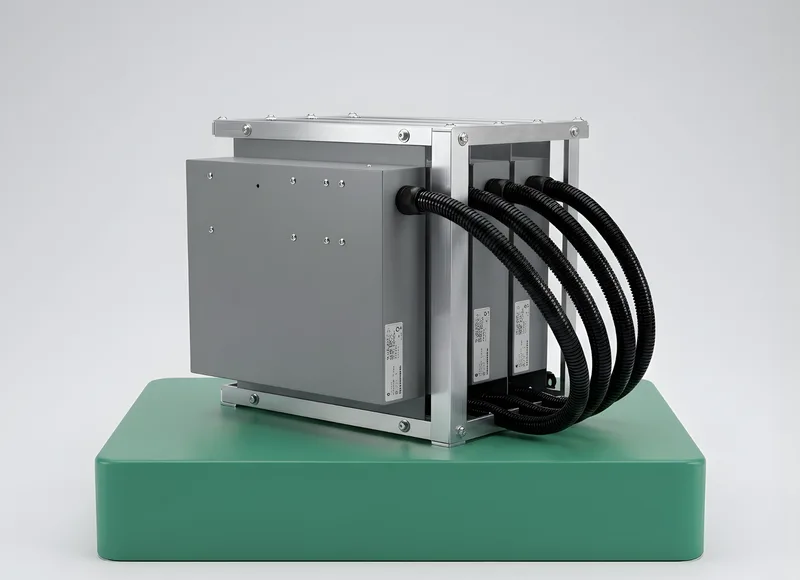
Unifies correction, filtering and voltage optimisation across multiple boards or sites — stabilising voltage for sensitive loads through summer-peak sag, with the visibility to prove power factor, reactive energy and kVA demand at the meter, continuously.
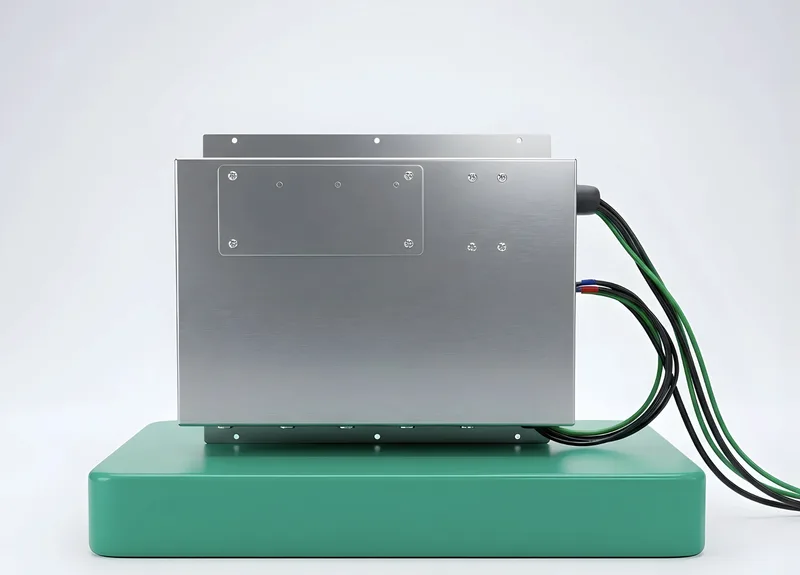
Active harmonic filtering that holds distortion within the IEC 61000 limits the Distribution Code requires — the component that matters most for the VFD-driven chillers, rectifiers, induction furnaces and non-linear UPS that dominate Egypt’s cooling, manufacturing and data-centre sites.
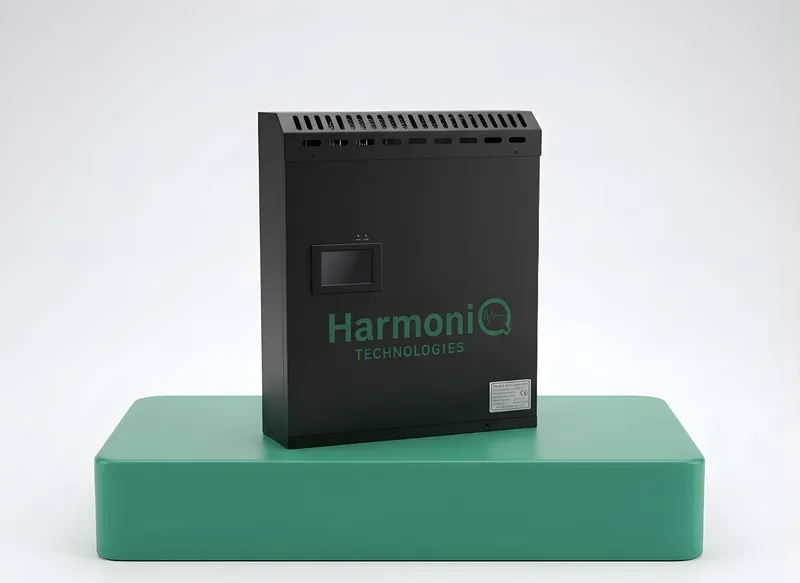
Real-time true power factor correction to 0.98+ across the whole network — comfortably clear of the EgyptERA 0.92 reference, removing the reactive-energy charge and cutting kVA demand, and freeing transformer headroom so a growing site or new-city development can add load without a costly connection upgrade.
Why not just install capacitor banks? + Read more− Close
Switched-capacitor banks correct power factor in fixed steps at the incoming feed — enough, in theory, to clear the EgyptERA threshold at the meter in a clean network, which is why they are common in Egypt. But Egyptian industrial loads expose every one of their limits. They respond in steps and seconds, so they lag fast-changing furnace and motor loads and can leave you over- or under-corrected; they sit only at the boundary, so reactive current still flows through your internal network; and on a system carrying harmonics — as nearly every modern steel, cement, fertiliser or cooling-heavy plant does — a capacitor bank can form a resonant circuit with the supply, amplifying those harmonics and, in the worst case, failing the capacitors themselves.
HarmoniQ is solid-state and dynamic: it corrects continuously rather than in steps, works across the network rather than at one point, filters harmonics rather than resonating with them, and carries no resonance risk. Paired with active filtering, it is power factor correction and harmonic mitigation designed for a plant full of drives and inverters, not the switchgear of forty years ago.
What It’s Worth
Rising Tariff, a Real Penalty — the Savings Compound
| Metric | Before | After HarmoniQ | Improvement |
|---|---|---|---|
| Average power factor | 0.82 | 0.98 | +19.5% |
| EgyptERA power-factor penalty | Charged monthly (below 0.92) | Eliminated — into the rebate band | −100% |
| Peak demand (kVA) | 3,200 | 2,678 | −16.3% |
| Spare connection capacity | Near limit | ~500 kVA freed | Capacity released |
| Indicative annual saving | USD 120,000–220,000 | penalty + demand + losses | |
Worked logic: a site averaging 0.82 sits below the 0.92 reference and pays the penalty every month; corrected to 0.98 it crosses 0.92 into the rebate band, so the penalty is removed and a tariff reduction applies, while the lower kVA cuts demand charges and internal losses on top. Every site’s loads, tariff and reactive profile are different, and the figures above are illustrative of the mechanism — not a quote, and your saving rises with each tariff round. Our engineers will model the exact power factor improvement, EgyptERA penalty and reactive charge avoided, losses reduced and capacity released for your specific connection — get in touch for a site assessment, or see the method on our power factor correction and demand-charge pages.