The Cost of Power
A High Underlying Tariff — and Very High Taxes
Denmark pairs one of the cleanest grids on earth with a genuinely high underlying electricity tariff. The energy-plus-network cost sits at around €0.10–0.13 per kWh on a process, recoverable-tax-excluded basis — the highest in the Nordics — and rises to roughly €0.22 per kWh all-in for the commercial and data-centre loads that cannot reclaim the full electricity tax. For a factory, data centre, or commercial estate, the price of a kilowatt-hour is real money, and a strong reason to stop wasting any.
There is an important nuance Danish operators know well. VAT-registered firms can reclaim the electricity tax (elafgift) on process electricity — it is refunded to DKK 0.004/kWh — so the largest manufacturers’ effective process rate is far below the headline. But that refund does not reach non-process loads: offices, retail, cold chain, hotels and the cooling and mechanical side of a data centre pay close to the full all-in rate. For them, the “Denmark is expensive” story holds in full, and every percentage point of wasted current is charged at one of the higher unit rates in Europe.
| Who pays | Typical price | Notes |
|---|---|---|
| Industry — process, ex recoverable tax | ~€0.10–0.13/kWh | The effective rate where the elafgift refund applies; highest in the Nordics |
| Business / commercial (all-in, non-process) | ~€0.22/kWh | Offices, retail, cold chain and data-centre cooling feel the tariff in full |
| Electricity tax (elafgift) on process use | Refunded to DKK 0.004/kWh | Blunts the cost story for the largest manufacturers — not for commercial loads |
| Households (incl. taxes & levies) | ~€0.3312/kWh (H2 2025) | Among the highest residential prices in the EU; taxes and levies are ~49% of the bill |
Industrial, all-in business and electricity-tax figures are from HarmoniQ’s Denmark market research; the household figure is from Eurostat for the second half of 2025. Figures are current as of 2025 and are revised regularly — verify against Eurostat electricity prices and Forsyningstilsynet (the Danish Utility Regulator) at the time of reading. Prices are per kWh and exclude site-specific demand and capacity charges; EUR/DKK is converted at the fixed ERM II peg of €1 ≈ DKK 7.46.
How You’re Billed
A Danish Industrial Bill Is More Than the Energy You Use
The headline price per kWh is only part of the story. A metered Danish site pays for the energy itself, for the networks that deliver it, and for taxes and levies — and, critically for power quality, for the capacity it reserves at its connection and for the reactive power it draws. Two of those line items move directly when you correct power factor — and in Denmark, where new grid capacity is effectively unavailable, the connection capacity you free up is worth far more than the charge alone.
| Component | What it is | Cut by power quality? |
|---|---|---|
| Energy (wholesale / commodity) | The kWh you consume, at the traded price | Indirectly — lower network losses |
| Network charges (tariffer) | Distribution and transmission fees for delivering power over the grid | Partly |
| Taxes & levies (incl. elafgift) | The electricity tax and other levies — refunded to DKK 0.004/kWh on process use for VAT-registered firms | No |
| Demand / capacity charge (kW / kVA) | A charge on the apparent-power demand and capacity you reserve at your connection | Yes — lower apparent power means a lower charge, and freed capacity |
| Reactive-power charge (kvarh) | A charge on excess reactive energy drawn from the network (modest in Denmark, and set per operator) | Yes — power factor correction cuts it directly |
So the answer to two questions Danish operators often ask: yes, you are billed for demand and capacity — through the apparent-power charge — and yes, poor power factor costs you, both through the reactive-power charge and, far more importantly here, through the connection capacity it wastes. Both fall as power factor rises towards unity, which is exactly what correction delivers.
Power Factor & Regulation
A cos φ 0.95 Connection Rule — and Strict Harmonic Limits
Danish distribution operators require a power factor above cos φ 0.95 at the point of connection. The explicit reactive-power charge is modest by European standards — this is not a market where a punitive reactive penalty drives the case — but a site running below cos φ 0.95 is both out of step with the connection requirement and reserving apparent-power capacity it does not need to. Correcting to 0.98+ clears the requirement and releases that capacity, which on a frozen connection queue is the single most valuable thing power factor correction can do in Denmark.
On harmonics and supply quality, Danish connections must hold voltage quality within EN 50160 — total harmonic distortion at or below 8% up to the 40th harmonic — and equipment must be CE-marked under the Low Voltage (2014/35/EU) and EMC (2014/30/EU) directives, complying with the Danish connection codes set by Energinet and the distribution operators. Installation work is carried out under the Danish authorised-electrician regime (Sikkerhedsstyrelsen). As variable-speed drives, refrigeration, rectifiers, non-linear UPS and behind-the-meter solar multiply on Danish sites — on top of a grid that is already ~60% wind — staying inside those limits increasingly requires active harmonic filtering, not just a one-off survey.
The cos φ 0.95 connection requirement and the reactive-power charge are set per distribution operator and published in their terms of connection; voltage-quality limits follow EN 50160 (THD ≤8% to the 40th harmonic), and equipment compliance follows the LVD (2014/35/EU) and EMC (2014/30/EU) directives plus the Danish connection codes administered by Energinet. Confirm the power-factor requirement, charges and limits that apply to your connection with your distribution operator (netselskab) and with Energinet — they vary by region and are updated periodically.
Why Power Quality Matters Here
The Most Wind-Heavy Grid in Europe — and a Frozen Connection Queue
Three structural forces make power quality a Danish boardroom issue, not just an engineering one. First, the generation mix: in 2025 wind supplied roughly 60% of Danish generation — with solar around 14%, biomass around 19% and fossil around 8%, some 92% low-carbon — making it the most inverter-saturated grid in Europe. That inverter-heavy supply raises harmonic distortion and voltage volatility at exactly the commercial and industrial sites we serve, and it is the single most important reason power quality matters here. Second, capacity: Energinet, the transmission operator, is holding roughly 60 GW of grid-connection requests against a national peak of only about 7 GW, and in March 2026 it imposed a moratorium on new connections — so freeing transformer and switchgear headroom on the connection you already have, rather than waiting years for a new one, has become a board-level priority. Third, the tariff — already covered: a high underlying rate, paid in full by the commercial and data-centre loads that cannot reclaim the electricity tax.
What matters less in Denmark is resilience. The grid is among the most reliable on earth — around 30 customer-minutes lost per customer per year, with both the low- and medium-voltage networks fully underground — so unlike sites in parts of Africa or the Gulf, Danish operators are driven by capacity, harmonics and cost rather than by keeping the lights on.
The Solution
Solid-State Correction and Filtering, Network-Wide
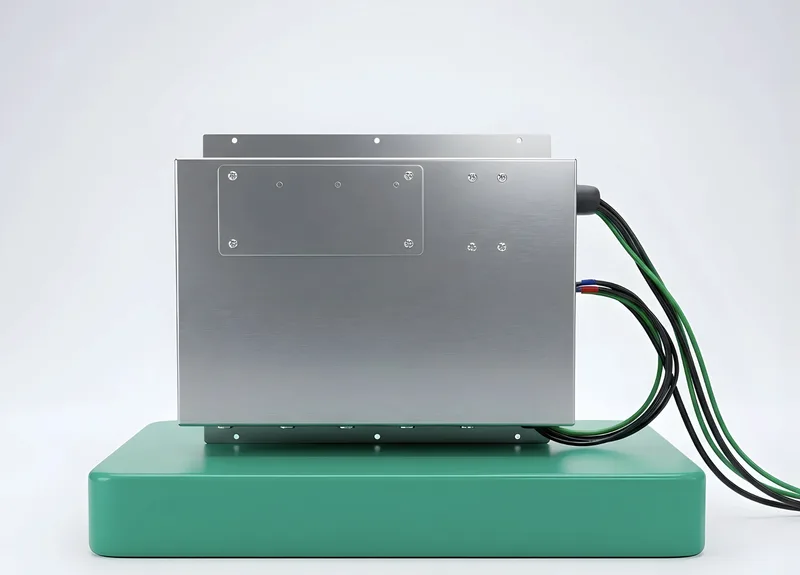
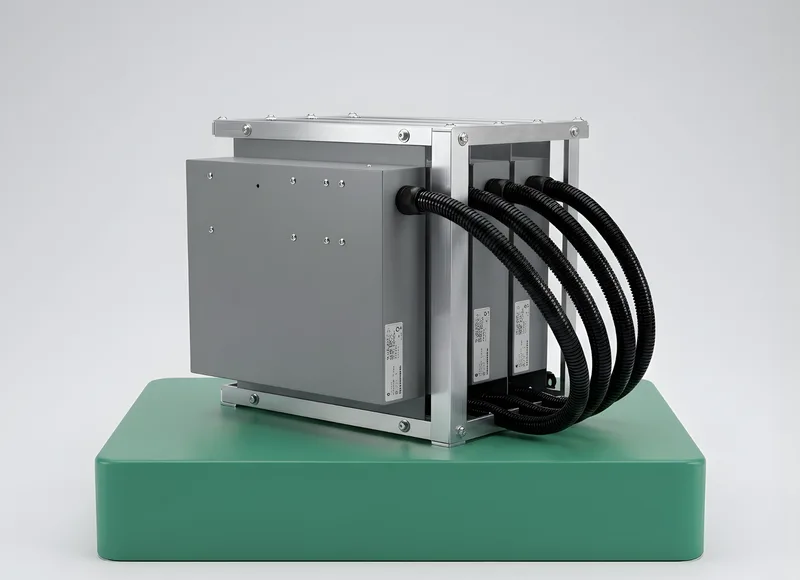
HarmoniQ installs a coordinated, solid-state system at the low-voltage switchboard — where Danish sites carry their VFD-dense, inverter-fed load, where capacity is unlocked, and where the ~60%-wind grid injects distortion. We deploy three products as the site requires: HarmoniQ Alpha as the integrated platform tying correction, filtering and voltage optimisation together, the HarmoniQ Delta for harmonic mitigation, and the HarmoniQ Sigma for real-time power factor correction. No switched-capacitor steps, no contactors, and no resonance risk with the harmonics already on your system.
Dynamically matches source impedance to load impedance up to 20,000 times a second, stabilising voltage at the point of use — especially valuable under the weak-grid, high-renewable conditions a ~60%-wind system produces, and for sensitive data-hall, cleanroom and process loads.
Active harmonic filtering that holds distortion within EN 50160 limits (THD ≤8% to the 40th harmonic) — the component that matters most on Denmark’s ~60%-wind grid, where VFD-driven chillers and pumps, rectifiers, non-linear UPS and on-site solar all push harmonic levels up.
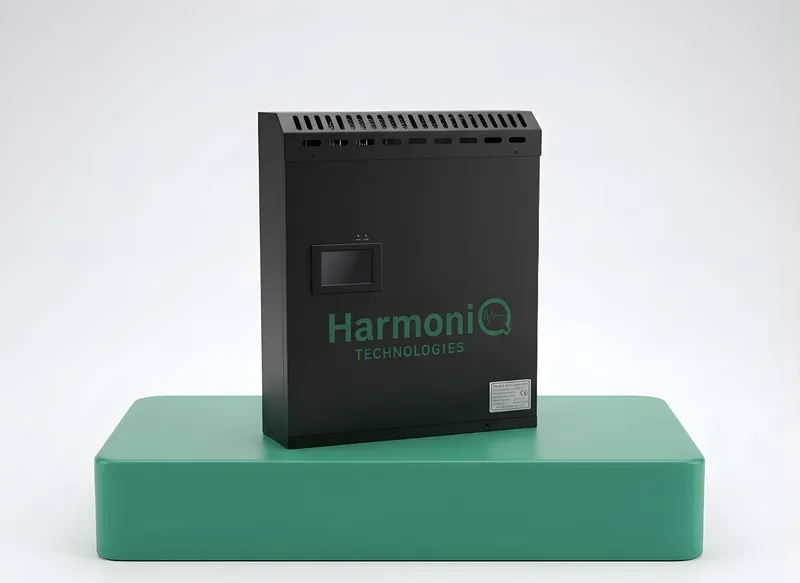
Real-time true power factor correction to 0.98+ across the whole network — clearing the cos φ 0.95 connection requirement, cutting apparent-power demand, and freeing 5–10% of transformer and switchgear capacity so a growing site can add load without waiting years for a grid connection that is currently frozen.
Why not just install capacitor banks? + Read more− Close
Switched-capacitor banks correct power factor in fixed steps at the incoming feed — enough, in theory, to lift you over the cos φ 0.95 requirement at the meter. But they respond in steps and seconds, so they lag fast-changing loads; they sit only at the boundary, so reactive current still flows through your internal network; and on a system carrying harmonics — as nearly every modern Danish site does, with its drives, refrigeration, rectifiers and inverters, on a grid that is already ~60% wind — a capacitor bank can form a resonant circuit with the supply, amplifying those harmonics.
HarmoniQ is solid-state and dynamic: it corrects continuously rather than in steps, works across the network rather than at one point, and carries no resonance risk. Paired with active filtering, it is power factor correction and harmonic mitigation designed for a plant full of drives and inverters on an inverter-heavy grid, not the switchgear of forty years ago.
What It’s Worth
Capacity First, Then Harmonics and Energy
| Lever | What changes | Effect on the site |
|---|---|---|
| Capacity release (5–10%) | Reactive and distorted current cut; transformer / switchgear headroom freed | Add load without waiting years for a frozen grid connection |
| Harmonic filtering to EN 50160 | Lower distortion, cooler transformers & cables on a ~60%-wind grid | Lower losses, longer asset life, protected processes |
| Power factor → 0.98+ | Clears cos φ 0.95; apparent-power demand and reactive charges fall | Lower demand fees; modest reactive charge removed |
| Active-energy reduction (3–8%) | On ~€0.12/kWh, across ~7 GWh a year | Roughly DKK 185,000–500,000 a year — plus the capacity released |
Every site’s loads, tariff and reactive profile are different, and the figures above are illustrative of the mechanism — not a quote. The energy saving is genuine but, for process loads that reclaim the electricity tax, capped by the refund — which is why in Denmark the headline value is the capacity unlocked behind your meter and the harmonics held inside EN 50160. Our engineers will model the exact capacity released, distortion reduced, power factor improvement and losses reduced for your specific connection — get in touch for a site assessment, or see the method on our power factor correction and demand-charge pages.