The Cost of Power
Among the More Expensive Industrial Electricity in the EU
Austria pairs a high-value manufacturing base with among the EU’s more expensive electricity. Non-household prices for a medium-sized consumer reached 20.29 cents per kWh in the first half of 2025 (excluding VAT and recoverable taxes), up from around €0.20/kWh at the end of 2024 — towards the upper half of the EU range. For a factory, data centre, or commercial estate, the price of a kilowatt-hour is the single biggest reason to stop wasting any.
Larger energy-intensive plants drawing 20,000–70,000 MWh a year pay less — around 15.84 ct/kWh (H1 2025) — but that relief does not reach the bulk of Austrian demand: the offices, mid-sized factories, logistics depots and data halls that sit in the smaller consumption bands. They pay closer to the full ~20 ct/kWh non-household rate, so the argument that “industrial power is cheap, efficiency doesn’t move the needle” simply does not hold for them. Every percentage point of wasted current is charged at one of the EU’s higher unit rates.
| Who pays | Typical price | Notes |
|---|---|---|
| Non-household — medium consumer (500–2,000 MWh) | 20.29 ct/kWh (H1 2025) | ~€0.20/kWh (Dec 2024); the band most mid-sized C&I sites fall into; excl. VAT |
| Non-household — large industrial (20,000–70,000 MWh) | 15.84 ct/kWh (H1 2025) | Even the relieved rate is high by international standards |
| Business / SME (all-in, incl. taxes) | ~€0.247/kWh (Sep 2025) | Commercial estates feel the tariff as acutely as industry |
| Households — medium consumer (incl. taxes & levies) | ~€0.27/kWh (Dec 2024) | Among the higher residential prices in the EU |
Non-household prices by consumption band are from Eurostat (online data code nrg_pc_205) via Statista; the household figure is the Eurostat medium-consumer band; the business/SME figure is from GlobalPetrolPrices. Figures are current as of the H1 2025 Eurostat release (reviewed June 2026) and are revised regularly — verify against Eurostat electricity prices and the national regulator E-Control at the time of reading. Non-household prices exclude VAT and recoverable taxes; all figures are per kWh and exclude site-specific demand and capacity charges.
How You’re Billed
An Austrian Industrial Bill Is More Than the Energy You Use
The headline cent-per-kWh is only part of the story. A metered Austrian site pays for the energy itself, for the networks that deliver it (the Systemnutzungsentgelte, or network-use charges), for taxes and decarbonisation levies — and, critically for power quality, for the apparent-power demand it places on the grid and for the reactive energy it draws. Those last two move directly when you correct power factor.
| Component | What it is | Cut by power quality? |
|---|---|---|
| Energy (wholesale / commodity) | The kWh you consume, at the traded price | Indirectly — lower network losses |
| Network charges (Netzentgelte / Systemnutzungsentgelt) | Grid fees for delivering power; electricity network charges rose ~23.1% on average from 1 Jan 2025 | Partly |
| Taxes & levies | Electricity tax (Elektrizitätsabgabe) and decarbonisation costs | No |
| Demand / capacity charge (kW / kVA) | A charge on the apparent-power demand and capacity you place on the network | Yes — lower apparent power means a lower charge |
| Reactive-energy charge (Blindarbeit, kvarh) | A charge on reactive energy drawn once it exceeds the cos φ 0.9 threshold (the free allowance is 0.5 kvarh per kWh) | Yes — power factor correction cuts it directly |
So the answer to two questions Austrian operators often ask: yes, you are billed for demand and capacity — through the apparent-power demand charge — and yes, you are billed for poor power factor, through the reactive-energy charge (Blindarbeit) once you slip below cos φ 0.9. Both fall as power factor rises towards unity, which is exactly what correction delivers.
Power Factor & Regulation
A Reactive Charge That Rewards Correction — on Every Bill
Unlike countries with no nationwide reactive penalty, Austrian distribution operators bill reactive energy on a clear, common rule. Each kWh of active energy comes with an allowance of 0.5 kvarh of reactive energy free of charge — equivalent to a power factor of cos φ 0.9 — and any reactive energy drawn beyond that is metered and charged (the exact rate and arrangements vary by operator). A site running at 0.85–0.92 power factor — typical for motor- and drive-heavy plants — therefore pays a recurring charge that disappears the moment it is corrected to 0.98+, alongside lower apparent-power demand fees.
On harmonics and supply quality, Austrian connections must hold voltage quality within EN 50160 and manage harmonic emissions under the IEC 61000 series, while connection to the network follows the national TOR (Technische und Organisatorische Regeln) issued by E-Control — which, for generation, require a displacement factor capability of cos φ 0.9 under- to over-excited. As variable-speed drives, rectifiers, non-linear UPS and behind-the-meter solar multiply on Austrian sites, staying inside those limits increasingly requires active harmonic filtering — not just a one-off survey.
The reactive-energy (Blindarbeit) allowance of 0.5 kvarh per kWh — equivalent to cos φ 0.9 — and the charge on the excess are set per distribution operator and published in their connection rules (for example Netz OÖ); voltage-quality limits follow EN 50160, harmonic emissions follow the IEC 61000 series, and network connection follows the TOR issued by E-Control. The exact threshold, rate and arrangements vary by operator and are updated periodically — verify the figures and rules that apply to your connection with your distribution operator (Netzbetreiber) and with E-Control before relying on them.
Why Power Quality Matters Here
A High-Cost, High-Inverter, Capacity-Constrained Grid
Three structural forces make power quality an Austrian boardroom issue, not just an engineering one. First, the tariff — already covered, and among the higher in the EU, with network charges that jumped ~23.1% on average in 2025. Second, the generation mix: renewables supplied roughly 87.5% of Austrian generation in 2024 — led by hydropower at around 54–67%, with wind and a fast-growing solar fleet behind it — and that inverter-heavy, hydro-dominated supply raises harmonic distortion and voltage volatility at exactly the commercial and industrial sites we serve. Third, capacity: as network charges rise and connection capacity tightens, freeing transformer and switchgear headroom on the connection you already have lets a growing or electrifying site add heat pumps, EV charging or new lines without waiting for the grid.
What matters less in Austria is resilience. The grid is among the most reliable in Europe — unplanned outages averaged around 23.4 customer-minutes per customer in 2024 — so unlike sites in parts of Africa or the Gulf, Austrian operators are driven by cost, charges, capacity and compliance rather than by keeping the lights on.
The Solution
Solid-State Correction and Filtering, Network-Wide
HarmoniQ installs a coordinated, solid-state system at the low-voltage switchboard — where Austrian sites carry their cost, where the cos φ 0.9 reactive charge bites, and where the inverter-heavy grid injects distortion. We deploy three products as the site requires: HarmoniQ Alpha as the integrated platform tying correction, filtering and voltage optimisation together, the HarmoniQ Delta for harmonic mitigation, and the HarmoniQ Sigma for real-time power factor correction. No switched-capacitor steps, no contactors, and no resonance risk with the harmonics already on your system.
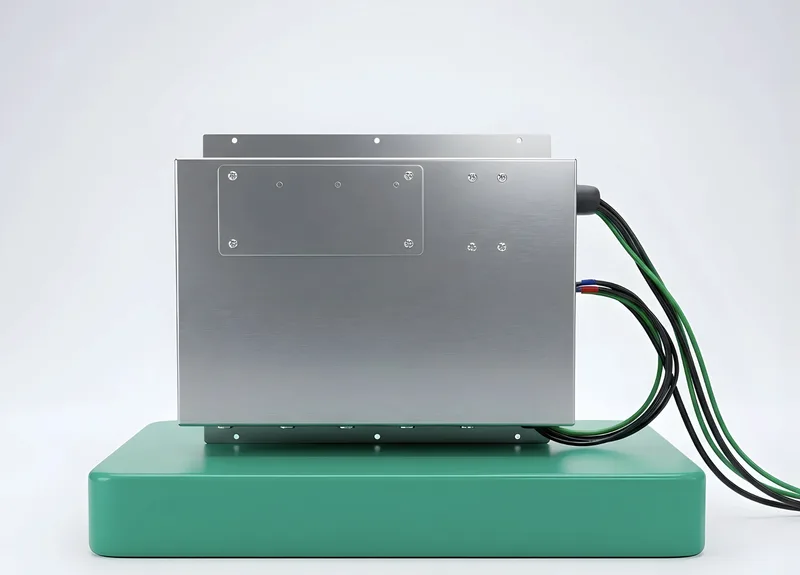
Unifies correction, filtering and voltage optimisation across multiple boards or sites — with the visibility to prove power factor, reactive energy and apparent-power demand at the meter, continuously.
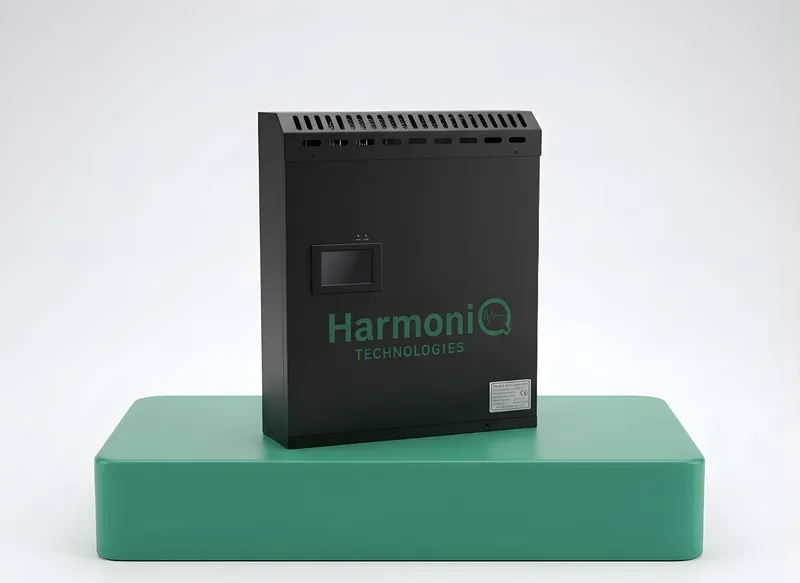
Active harmonic filtering that holds distortion within EN 50160 and IEC 61000 limits — the component that matters most in Austria’s high-inverter environment, where drives, rectifiers, non-linear UPS and on-site solar all push harmonic levels up.
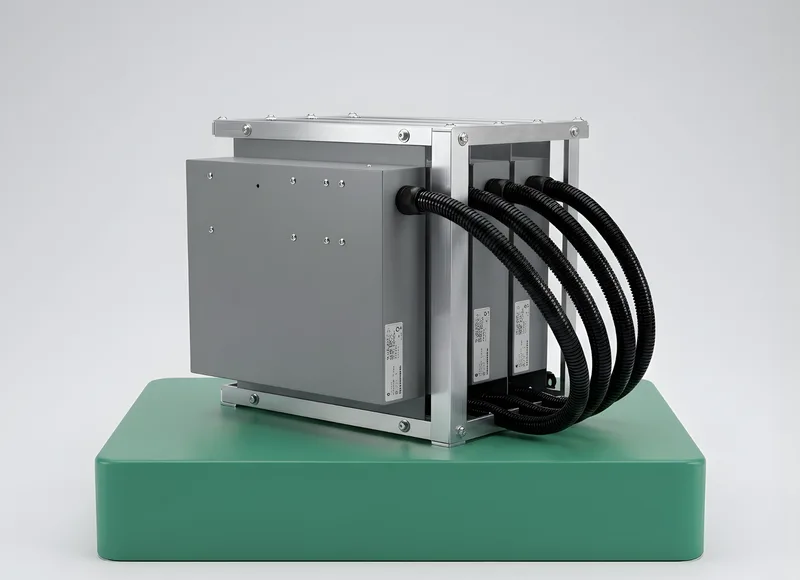
Real-time true power factor correction to 0.98+ across the whole network — clearing the cos φ 0.9 threshold to remove the reactive-energy charge and cut apparent-power demand fees, and freeing transformer headroom so you can add load without a slow grid-connection upgrade.
Why not just install capacitor banks? + Read more− Close
Switched-capacitor banks correct power factor in fixed steps at the incoming feed — enough, in theory, to lift you over the cos φ 0.9 threshold at the meter. But they respond in steps and seconds, so they lag fast-changing loads; they sit only at the boundary, so reactive current still flows through your internal network; and on a system carrying harmonics — as nearly every modern Austrian site does, with its drives, rectifiers and inverters — a capacitor bank can form a resonant circuit with the supply, amplifying those harmonics.
HarmoniQ is solid-state and dynamic: it corrects continuously rather than in steps, works across the network rather than at one point, and carries no resonance risk. Paired with active filtering, it is power factor correction and harmonic mitigation designed for a plant full of drives and inverters, not the switchgear of forty years ago.
What It’s Worth
High Tariff, a Real Reactive Charge — the Savings Compound
| Lever | What changes | Effect on the bill |
|---|---|---|
| Power factor → 0.98+ | Reactive energy clears the cos φ 0.9 threshold; apparent-power demand falls | Reactive-energy charge removed; demand fees cut |
| Harmonic filtering to EN 50160 | Lower distortion, cooler transformers & cables | Lower losses, longer asset life |
| Capacity release | Transformer / switchgear headroom freed | Add heat pumps, EV charging or new lines without a grid-connection upgrade |
| Indicative annual saving | A material recurring sum on a site of this size — plus the capacity released | |
Every site’s loads, tariff and reactive profile are different, and the figures above are illustrative of the mechanism — not a quote. Our engineers will model the exact power factor improvement, reactive-energy and demand charges avoided, losses reduced and capacity released for your specific connection — get in touch for a site assessment, or see the method on our power factor correction and demand-charge pages.