The Cost of Power
Tariffs Rising Fast as the Subsidies Come Off
For two decades Argentine electricity was held down by deep, near-universal subsidies. That era is ending. Commercial and industrial users now pay tariffs close to the real cost of supply, and the government’s reforms pass the full wholesale (MEM) generation cost straight through to the bill. An industrial or commercial site of moderate size paid roughly US$0.21 per kWh all-in around Buenos Aires (AMBA) and about US$0.26 per kWh in the rest of the country in April 2025. For a factory, data centre, or commercial estate, the price of a kilowatt-hour is rising — and that is the single biggest reason to stop wasting any.
Crucially, the relief that still cushions the bill reaches only lower-income residential users — it does not apply to commercial and industrial sites, which pay tariffs similar to the actual cost of supply. With residential rates having risen on the order of 500% through 2024 and adjusted again month by month since, the direction of travel is clear, and the argument that “Argentine power is cheap, efficiency doesn’t move the needle” no longer holds. Every percentage point of wasted current is charged at a rate that is no longer subsidised — and that keeps rising.
| Who pays | Typical all-in price | Notes |
|---|---|---|
| Industry / commercial — AMBA (Buenos Aires) | ~US$0.21/kWh (Apr 2025) | 500 kWh-month user, all-in incl. taxes; no subsidy for C&I sites |
| Industry / commercial — rest of country | ~US$0.26/kWh (Apr 2025) | Tariffs vary widely by province and distributor |
| Business (market average, all-in) | ~US$0.100/kWh (~ARS 143/kWh, Sep 2025) | Includes power, distribution, transmission and all taxes |
| Households (residential, all-in) | ~US$0.105/kWh (~ARS 150/kWh, Sep 2025) | Subsidies being cut; many users now pay close to full cost |
The April 2025 industrial/commercial figures are from the GIZ / German Energy Solutions Initiative guide to industrial electricity in Argentina; the business and household figures are a web-sourced market average from GlobalPetrolPrices (September 2025). Argentina is in a high-inflation environment with a moving exchange rate, so peso figures date quickly — prices here are stated in US dollars and date-stamped for that reason. A central reform is the withdrawal of energy subsidies (quita de subsidios), which is pushing tariffs up; verify the current numbers against the Secretaría de Energía, ENRE, CAMMESA and your distributor’s published tariff at the time of reading. All prices are unit rates and exclude site-specific potencia (demand) charges. Figures reviewed June 2026.
How You’re Billed
An Argentine Industrial Bill Is More Than the Energy You Use
The headline price per kWh is only part of the story. A commercial or industrial site pays for the energy itself (the wholesale MEM cost, now passed through in full), for the transmission and distribution networks that deliver it, for national, provincial and municipal taxes — and, critically for power quality, for the capacity it contracts (in kW) and, on inefficient sites, an explicit low-power-factor surcharge. Those last two move directly when you correct power factor.
| Component | What it is | Cut by power quality? |
|---|---|---|
| Energy & power (MEM) | The wholesale cost of energy consumed (kWh) and capacity, now passed through in full to the bill | Indirectly — lower network losses |
| Transmission & distribution (Transporte, VAD / Peaje) | Network charges for delivering power over the transmission and distribution grid | Partly |
| Taxes & regulatory charges | VAT (IVA), provincial (ingresos brutos) and municipal taxes, plus the FNEE | No |
| Demand charge (Potencia Contratada / Adquirida, $/kW) | A monthly charge on the kW of capacity you contract and on the maximum demand you actually draw | Yes — lower apparent power means a lower charge |
| Low-power-factor surcharge (recargo por factor de potencia) | A surcharge applied to inefficient users whose cos φ falls below the regulated minimum | Yes — power factor correction removes it directly |
So the answer to two questions Argentine operators often ask: yes, you are billed for potencia (demand) — through the Cargo por Potencia Contratada and Adquirida on the kW you reserve and draw — and yes, you are billed for poor power factor, through the recargo por factor de potencia once cos φ slips below the regulated minimum. Both fall as power factor rises towards unity, which is exactly what correction delivers.
Power Factor & Regulation
A cos φ 0.95 Minimum — and a Surcharge Below It
Argentina penalises low power factor explicitly. The national regulator ENRE, in Resolución 628/2024, raised the minimum power factor for the federally-regulated distributors (Edenor and Edesur) from 0.85 — a level unchanged for more than 60 years — to 0.95, and authorised them to apply a surcharge for excess reactive energy (recargo por factor de potencia) below it. For large-demand users (Tarifa 3), the surcharge bites once reactive energy exceeds 33% of active energy in a billing period (tangente φ > 0.33), at roughly 1.5% added to the energy charge for each 0.01 of variation in tangente φ beyond that point. The surcharge is being phased in — 30% from October 2024, 60% from May 2025 and 100% from December 2025 — and at very low power factor (below cos φ 0.60) the distributor may, after notice, suspend supply. A site running at 0.85–0.92 — typical for motor- and drive-heavy plants — therefore pays a recurring surcharge that disappears the moment it is corrected to 0.98+, alongside lower potencia charges.
On harmonics and supply quality, ENRE controls voltage perturbations — harmonics and flicker — under its Base Metodológica para el Control de la Emisión de Perturbaciones (Resolución ENRE 99/97), the methodology that holds distortion at the connection point to defined compatibility levels, drawing on the IEC 61000 series (adopted in Argentina as the IRAM 2491 standards). As variable-speed drives, rectifiers, non-linear UPS and behind-the-meter solar multiply on Argentine sites, staying inside those limits increasingly requires active harmonic filtering — not just a one-off survey.
The cos φ 0.95 minimum and the surcharge for excess reactive energy are set for the federally-regulated distributors (Edenor, Edesur) under ENRE Resolución 628/2024; perturbation and harmonic limits follow the Base Metodológica of ENRE Resolución 99/97 and the IEC 61000 / IRAM 2491 series. The exact threshold, formula, phase-in and measurement window should be verified with ENRE — and note that provincial distributors outside the federal area set their own power-factor rules, so confirm the figures and thresholds that apply to your connection with your distributor and with ENRE at the time of reading.
Why Power Quality Matters Here
Rising Tariffs, a High-Inverter Mix, and a Strained Grid
Three structural forces make power quality an Argentine boardroom issue, not just an engineering one. First, the tariff — already covered, and rising sharply as subsidies are withdrawn and the full MEM cost is passed through, so every wasted unit costs more this year than last. Second, the generation mix: gas-fired thermal supplies roughly 49% of generation and fossil fuels around 61% overall, with hydro near 24% and a fast-growing inverter-based segment — wind around 12% and solar climbing — and that rising inverter share raises harmonic distortion and reactive-power volatility at exactly the commercial and industrial sites we serve. Third, a strained grid: years of frozen tariffs and under-investment have left transmission and distribution stretched, with summer-peak outages a recurring feature around Buenos Aires — so freeing transformer and switchgear headroom on the connection you already have, while cutting the current you draw, is unusually valuable.
Unlike the highly reliable grids of Western Europe, Argentina’s network carries real resilience pressure during summer heatwaves — but for most commercial and industrial operators the day-to-day driver is cost: rising tariffs, the explicit reactive surcharge, and the demand charge, rather than keeping the lights on alone.
The Solution
Solid-State Correction and Filtering, Network-Wide
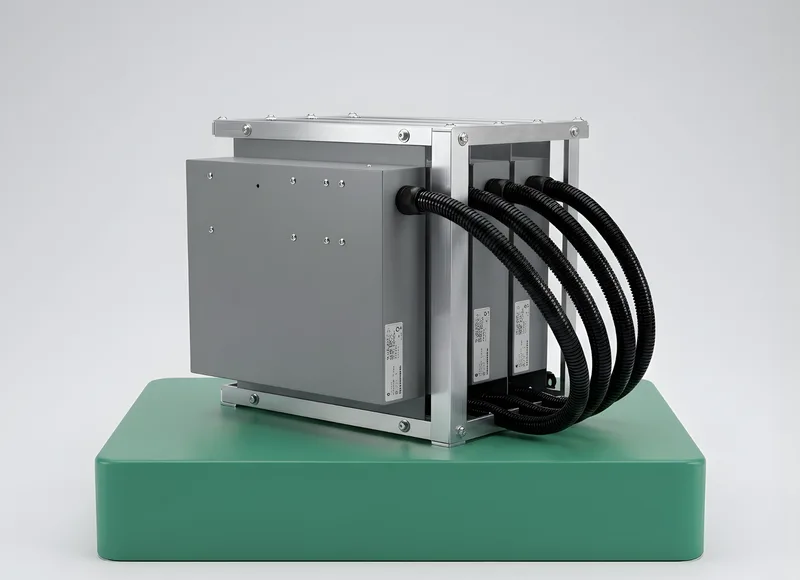
HarmoniQ installs a coordinated, solid-state system at the low-voltage switchboard — where Argentine sites carry their cost, where the cos φ 0.95 surcharge and the potencia charge bite, and where the inverter-heavy grid injects distortion. We deploy three products as the site requires: HarmoniQ Alpha as the integrated platform tying correction, filtering and voltage optimisation together, the HarmoniQ Delta for harmonic mitigation, and the HarmoniQ Sigma for real-time power factor correction. No switched-capacitor steps, no contactors, and no resonance risk with the harmonics already on your system.
Unifies correction, filtering and voltage optimisation across multiple boards or sites — with the visibility to prove power factor, reactive energy and potencia demand at the meter, continuously.
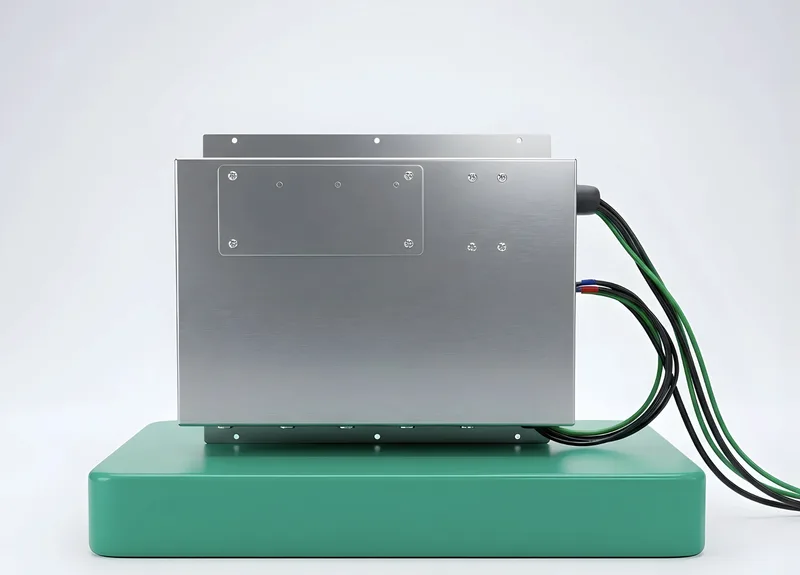
Active harmonic filtering that holds distortion within ENRE’s perturbation limits and the IEC 61000 / IRAM 2491 series — the component that matters most in Argentina’s high-inverter environment, where drives, rectifiers, non-linear UPS and on-site solar all push harmonic levels up.
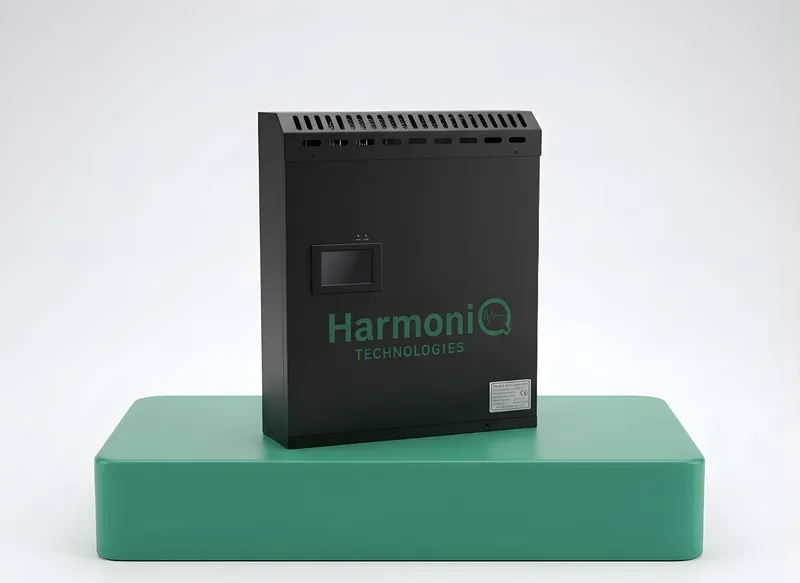
Real-time true power factor correction to 0.98+ across the whole network — clearing ENRE’s cos φ 0.95 threshold to remove the recargo por factor de potencia and cut potencia demand charges, and freeing transformer headroom so you can add load without waiting on a strained grid.
Why not just install capacitor banks? + Read more− Close
Switched-capacitor banks correct power factor in fixed steps at the incoming feed — enough, in theory, to lift you over the cos φ 0.95 threshold at the meter. But they respond in steps and seconds, so they lag fast-changing loads; they sit only at the boundary, so reactive current still flows through your internal network; and on a system carrying harmonics — as nearly every modern Argentine site does, with its drives, rectifiers and inverters — a capacitor bank can form a resonant circuit with the supply, amplifying those harmonics.
HarmoniQ is solid-state and dynamic: it corrects continuously rather than in steps, works across the network rather than at one point, and carries no resonance risk. Paired with active filtering, it is power factor correction and harmonic mitigation designed for a plant full of drives and inverters, not the switchgear of forty years ago.
What It’s Worth
Rising Tariffs and a Real Surcharge — the Savings Compound
| Lever | What changes | Effect on the bill |
|---|---|---|
| Power factor → 0.98+ | Reactive energy clears the cos φ 0.95 threshold; potencia demand falls | Recargo por factor de potencia removed; demand charges cut |
| Harmonic filtering to ENRE / IEC 61000 limits | Lower distortion, cooler transformers & cables | Lower losses, longer asset life |
| Capacity release | ~15–20% of transformer / switchgear headroom freed | Add load without waiting on a strained grid |
| Indicative annual saving | A material recurring sum, in US dollars, on a site of this size — plus the capacity released | |
Every site’s loads, tariff and reactive profile are different, and the figures above are illustrative of the mechanism — not a quote. Amounts are stated in US dollars because Argentina’s peso figures and exchange rate move quickly with inflation. Our engineers will model the exact power factor improvement, the recargo and potencia charges avoided, losses reduced and capacity released for your specific connection — get in touch for a site assessment, or see the method on our power factor correction and demand-charge pages.