The Cost of Power
The Grid Tariff Is Cheap — the Power Is Not
Angola has one of the lowest electricity tariffs in the world. Years of subsidy hold the business grid rate near $0.011 per kWh (about 9.6 AOA) in dollar terms. But that headline figure dramatically understates what power actually costs an Angolan business, because the grid is unreliable and a large share of every site’s load is met not by the grid at all, but by its own diesel generator. For a brewery, a telecom-tower fleet, a bank’s branch estate or a commercial building, the price that matters is the blended cost of grid and generator together — and that is a different number entirely.
Self-generated diesel power costs on the order of $0.30–0.45+/kWh effective once fuel, maintenance and the generator itself are counted — roughly thirty to forty times the subsidised grid rate. And that cost is moving the wrong way: the IMF-aligned removal of fuel subsidies pushed diesel from 200 to 400 AOA per litre across 2025, a tripling in a single year, which raises the effective cost of self-generation, not lowers it. So the usual argument that “Angolan power is cheap, efficiency doesn’t move the needle” gets it exactly backwards: the cheap grid rate is largely theoretical, and the kilowatt-hours that actually run the business are among the most expensive a company can buy.
| Who pays / how | Typical cost | Notes |
|---|---|---|
| Subsidised grid tariff (business) | ~$0.011/kWh (≈9.6 AOA) | Among the lowest on earth — but not what most sites pay for most kWh |
| Diesel self-generation (effective) | ~$0.30–0.45+/kWh | What much of the load actually costs on an unreliable grid; rising as subsidies are cut |
| Blended grid-plus-generator cost | ~$0.24/kWh (illustrative) | The true cost a typical self-generating site bears across the year |
| Diesel price (2025) | ~400 AOA/L (~$0.44) | Tripled from 200 AOA/L across 2025 under fuel-subsidy reform |
| Households (grid, all-in) | ~15 AOA/kWh (~$0.02–0.03) | Subsidised, but running ~20% above the business grid rate |
The subsidised business grid tariff (~$0.011/kWh) and diesel pricing (~400 AOA/L, tripled across 2025) are drawn from GlobalPetrolPrices and Bloomberg/Polity; the effective diesel self-generation cost of ~$0.30–0.45/kWh is from Works in Progress and published African diesel-LCOE models. The household figure (~15 AOA/kWh, roughly $0.02–0.03) is the GlobalPetrolPrices residential rate collected September 2025 and moves with the kwanza. Figures are current as of 2025 and the kwanza has been volatile, so dollar equivalents shift — verify against the regulator IRSE (Instituto Regulador do Sector Eléctrico) and the distributor ENDE at the time of reading. Self-generation costs are site-specific and depend on the diesel price, generator and load profile.
How You’re Billed
An Angolan Site Pays Twice — for the Grid and for the Generator
The headline grid tariff is only part of the story, and on most Angolan sites it is the smaller part. A typical commercial or industrial site pays for the subsidised energy it draws from the grid — and then, because the grid cannot be relied on, it pays again to run its own diesel generator: the fuel, the maintenance, the spare capacity it has to keep spinning, and the replacement of equipment worn out by an unstable supply. Critically for power quality, both the grid feeder and the on-site generator are sized on the apparent power the site draws and both are degraded by poor power factor and harmonics — and those move directly when you correct them.
| Component | What it is | Cut by power quality? |
|---|---|---|
| Grid energy (subsidised) | The kWh you draw from the grid, at the subsidised tariff | Indirectly — lower losses |
| Diesel fuel for self-generation | The fuel burned to make power when the grid is unavailable — the largest cost line on most sites | Yes — better power factor and stability mean less fuel per real kW |
| Generator capacity & maintenance | The generator you must own, run and service to ride through outages | Yes — lower apparent power frees generator capacity |
| Equipment wear & lost production | Motors, drives and refrigeration damaged, and output lost, when an unstable supply sags or trips | Yes — stabilisation and filtering cut both |
| Apparent-power demand on the feeder | The kVA the grid feeder and transformer must carry | Yes — correction lowers it |
So the answer to the question Angolan operators really ask — where does the money actually go? — is: mostly into the generator, not the grid. The diesel fuel, the generator capacity and the equipment worn out by an unstable supply dwarf the subsidised grid bill. Every one of those lines falls as power factor rises towards unity and as the supply is stabilised and cleaned, which is exactly what correction, stabilisation and filtering deliver.
Power Factor & Regulation
No Connection Penalty — the Case Is Made on Economics
Unlike the Gulf states or many European grids, Angola does not impose a mandatory power-factor connection regime or a nationwide reactive-power penalty that a site must clear. There is no threshold to beat at the meter. That changes why a site corrects power factor, but not whether it should: rather than avoiding a charge, the value comes from the physics of self-generation. A lagging power factor forces the diesel generator to produce more apparent power — and so burn more fuel and tie up more capacity — to deliver the same real kilowatts. Correcting to 0.98+ cuts that waste directly, on the most expensive power the site buys.
On harmonics and supply quality there is no local connection-approval gate to satisfy either, but the engineering reality is unforgiving: a diesel generator is a weak, high-impedance source, easily distorted by the variable-speed drives, rectifier loads and non-linear UPS systems common in Angolan breweries, telecom sites, data centres and commercial buildings. Harmonic distortion that a strong grid would absorb instead overheats the generator and the downstream equipment. International practice follows the IEC 61000 series for harmonic emissions and EN 50160 for voltage quality — sensible engineering targets to design to, even where they are not locally mandated.
Angola’s electricity sector is overseen by the regulator IRSE (Instituto Regulador do Sector Eléctrico), with distribution by ENDE; there is no mandatory power-factor or harmonic connection penalty of the kind seen in the Gulf, so the case is made on economics and reliability and proven at the meter on the customer’s own site. Where harmonic and voltage-quality targets are referenced, international standards (the IEC 61000 series and EN 50160) are the usual basis. Confirm the connection terms, tariff and any conformity requirements that apply to your site with IRSE, ENDE and your supplier — they are updated periodically.
Why Power Quality Matters Here
A Weak, Fragmented Grid and an Expensive Diesel Habit
Two structural forces make power quality an Angolan boardroom issue, not just an engineering one — and the first is reliability. Angola runs three unconnected regional grids — northern (serving Luanda), central and southern — plus isolated systems, so generation in one region cannot back another, and its transmission is among the least efficient in Africa. Electrification reaches only about 43–51% of the population (around 67% urban, under 23% rural), and outages and brown-outs are routine outside the central Luanda core, worsening in the humid months as air-conditioning load climbs. The practical consequence is that public supply simply cannot be relied on, so almost every serious commercial and industrial site backs itself with a diesel generator — and runs a large share of its load on it.
The second force is the cost of that self-generation, already covered: diesel at $0.30–0.45+/kWh effective and rising. A weak grid feeder that sags and an islanded generator that steps with load are both exactly the conditions in which poor power factor and harmonics do the most damage — tripping sensitive loads, overheating motors and refrigeration, and forcing the generator to burn more fuel than the real work requires. Stabilising the supply, correcting power factor and filtering harmonics therefore attack the two things that actually cost an Angolan business money: the reliability of its power and the fuel its generator burns. National generation is roughly 16.7 TWh a year and around 68–80% hydropower, but it is concentrated on the northern grid and has not yet fixed reliability for the country as a whole — so the problem is structural, not temporary.
The Solution
Solid-State Stabilisation, Correction and Filtering, Network-Wide
HarmoniQ installs a coordinated, solid-state system at the low-voltage switchboard — exactly where Angola’s sites take supply from a weak grid feeder and from their own diesel generators, and exactly where unstable voltage, poor power factor and harmonics do their damage. We deploy three products as the site requires: HarmoniQ Alpha as the integrated platform that stabilises voltage and ties correction, filtering and optimisation together, the HarmoniQ Delta for harmonic mitigation, and the HarmoniQ Sigma for real-time power factor correction. No switched-capacitor steps, no contactors, and no resonance risk with the harmonics already on your system or your generator.
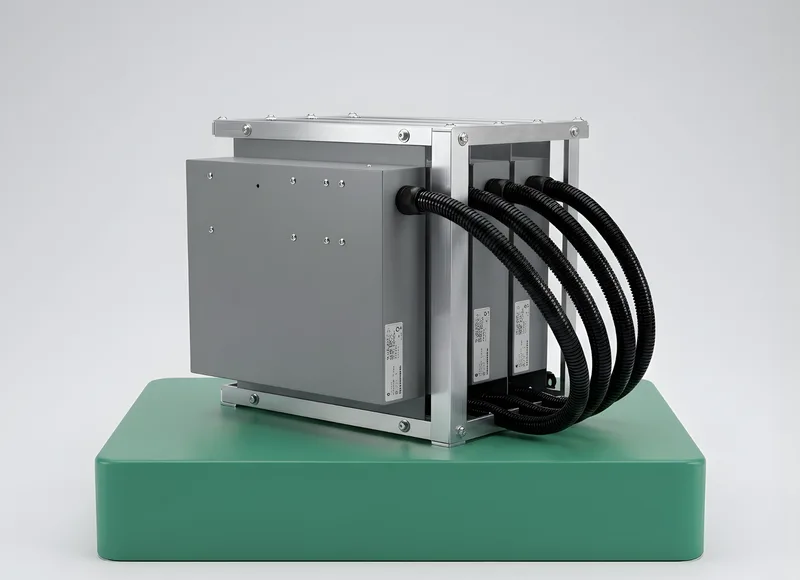
The lead component in Angola: it matches source impedance to load impedance thousands of times a second, holding voltage steady through the sags, swells and brown-outs of a weak feeder and the load steps of an islanded generator — protecting motors, drives, IT and refrigeration that would otherwise trip, overheat or fail early.
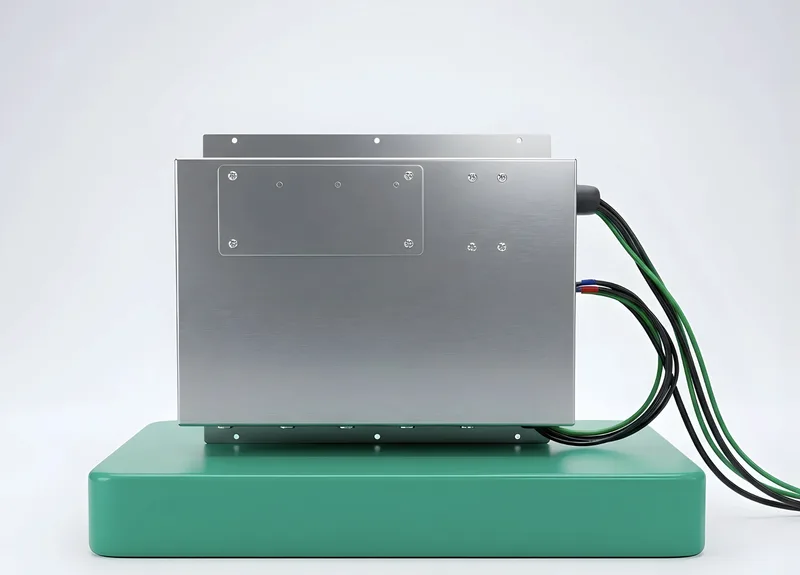
Active harmonic filtering that eliminates distortion in real time — the component that matters most on a self-generating site, where a diesel generator is a weak source easily distorted by the drives, rectifiers and non-linear UPS common in Angolan plants. The Delta keeps that distortion off the generator and the equipment.
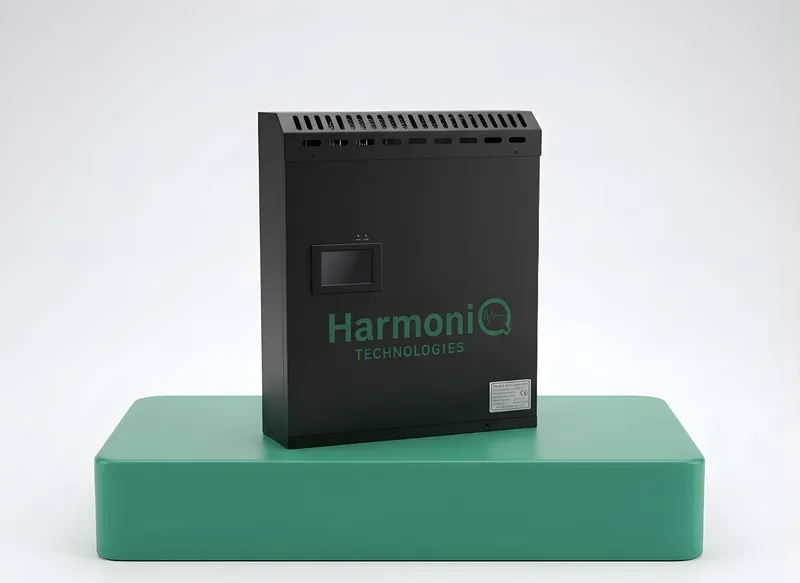
Real-time true power factor correction to 0.98+ across the whole network — reducing the apparent power drawn from both the grid feeder and the on-site generator, so the diesel delivers the same real kilowatts with less fuel burned and less capacity tied up, and freeing transformer and generator headroom.
Why not just install capacitor banks? + Read more− Close
Switched-capacitor banks correct power factor in fixed steps at the incoming feed. But they respond in steps and seconds, so they lag fast-changing loads; they sit only at the boundary, so reactive current still flows through your internal network; and on a system carrying harmonics — as nearly every modern Angolan site does, with its drives, rectifiers and inverters — a capacitor bank can form a resonant circuit with the supply, amplifying those harmonics. On a weak diesel generator, that resonance risk is sharper still, because the generator is a high-impedance source.
HarmoniQ is solid-state and dynamic: it corrects continuously rather than in steps, works across the network rather than at one point, stabilises voltage as well as correcting power factor, and carries no resonance risk. Paired with active filtering, it is power factor correction and harmonic mitigation designed for a plant running on a weak feeder and its own generator, not the switchgear of forty years ago.
What It’s Worth
Expensive Diesel, an Unreliable Grid — the Savings Compound
| Lever | What changes | Effect on the cost |
|---|---|---|
| Fuel / self-gen cost reduction | Better power factor and stability mean the generator delivers the same real kW with less fuel and less spinning capacity | The headline saving — on the most expensive power the site buys |
| Reliability & uptime | Voltage held through feeder sags and generator load steps | Fewer nuisance trips, less lost production |
| Power factor → 0.98+ | PF 0.80→0.98 frees ~15–20% of transformer / generator capacity | Add load or downsize a generator; longer asset life |
| Indicative annual saving | A six-figure sum on a site of this size — growing as fuel subsidies are withdrawn | |
Every site’s loads, generator, fuel cost and reliability profile are different, and the figures above are illustrative of the mechanism — not a quote. Our engineers will model the exact power factor improvement, fuel burn avoided, capacity released and reliability gained for your specific site, with a minimum performance guarantee proven at the meter — get in touch for a site assessment, or see the method on our power factor correction and voltage optimisation pages.