In brief
- Most Scope 2 plans change where electricity comes from, through certificates, power purchase agreements or on-site solar. Few start by using less of it.
- Efficiency needs no certificate and raises no question of additionality: a kilowatt-hour never drawn is never generated, and it comes off Scope 2 under both reporting methods.
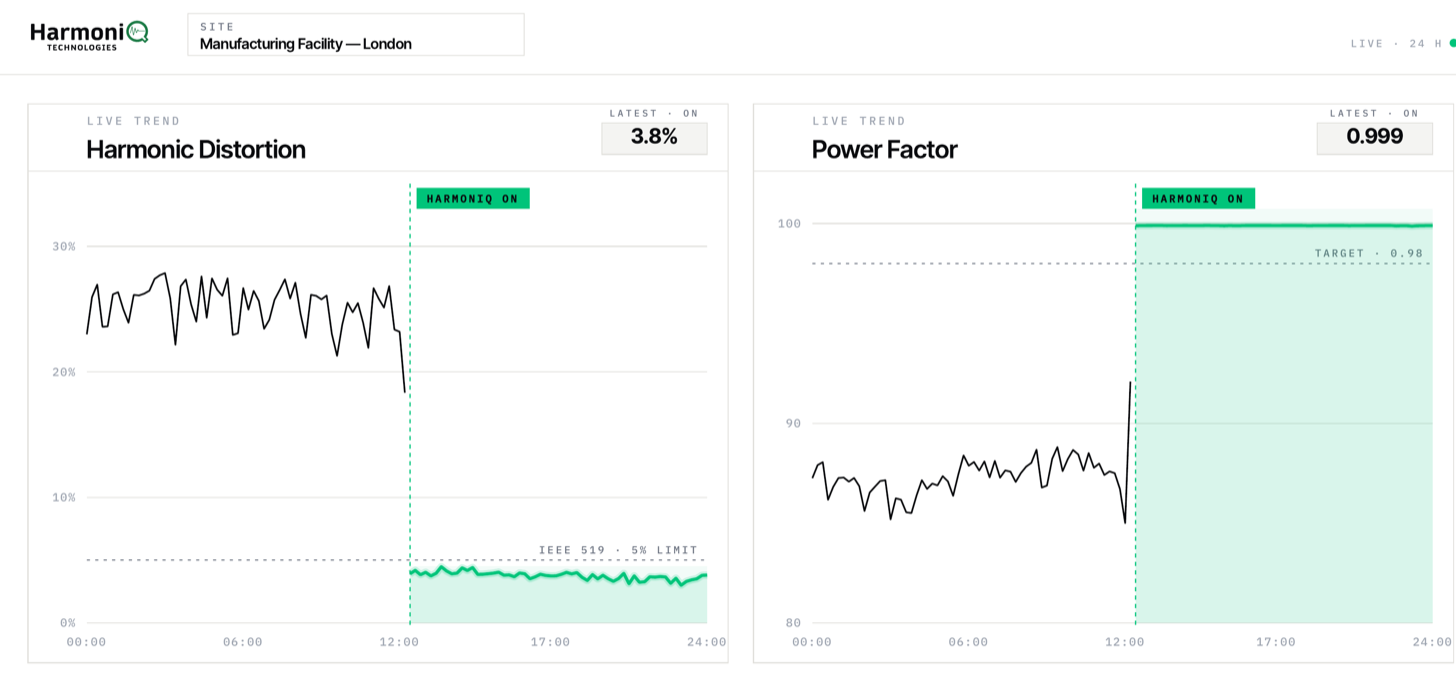
- Poor power quality wastes electricity as heat inside a site’s own network, through reactive current, harmonics and phase imbalance. Every wasted kilowatt-hour carries its grid’s carbon intensity.
- HarmoniQ typically cuts consumption by 10–20% for the same output, proven at the site’s own meter, and the carbon avoided follows from the grid’s published emission factor.
Most major companies now have a decarbonisation target, and many have a Scope 2 reduction plan. Almost every one of those plans begins in the same place: procure renewable energy, buy certificates, sign a power purchase agreement.
These are valid strategies, but they share a blind spot. They all change the source of the electricity, and overlook the most direct lever available: using less of it.
The International Energy Agency calls energy efficiency “the first fuel”. It cuts emissions and costs at the same time, and makes operations more resilient. Yet on most corporate sustainability roadmaps, efficiency is the last item addressed, if it appears at all.
This article makes the case that power-quality correction, the systematic prevention of electrical waste inside a facility’s own network, should be the first line item on every Scope 2 reduction plan. Not because renewables and PPAs are wrong, but because efficiency is faster, cheaper and more credible, and the money it saves helps fund everything else.
01The Scope 2 problem
Scope 2 emissions are those from the electricity, steam, heat and cooling a company buys. For many commercial and industrial organisations, purchased electricity is among the largest sources of the emissions they report from their own operations.
The pressure to reduce them is no longer aspirational. The EU’s Corporate Sustainability Reporting Directive asks the companies within its scope to report their transition plans, their targets and the actions behind them. The ISSB’s climate standard, IFRS S2, asks for much the same in the jurisdictions that adopt it. And CDP scores the companies that answer its questionnaire on whether their targets are credible and backed by concrete action.
The standard corporate playbook for Scope 2 looks much the same across industries:
- Renewable energy certificates or guarantees of origin. Buy certificates that match electricity consumption with renewable generation somewhere on the grid.
- Power purchase agreements. Contract directly with a renewable generator for a fixed volume of green electricity, over a long term.
- On-site generation. Install rooftop solar, battery storage or other renewable assets behind the meter.
These strategies address the supply side: where the electricity comes from. Almost none address the demand side: how much electricity is consumed in the first place.
The pointThe cheapest, fastest and most credible megawatt-hour is the one you never consume.
02Why efficiency beats procurement
To see why energy efficiency deserves priority over renewable procurement, compare the three main Scope 2 strategies on what matters most to decision-makers: cost, speed, certainty and financial return.
| Dimension | Renewable procurement: certificates and PPAs | On-site generation: solar | Energy efficiency |
|---|---|---|---|
| Upfront cost | Low for certificates, moderate for PPAs | High: a capital project | Low to moderate |
| Time to implement | Weeks for certificates; many months to agree a PPA | Months of design, consents and installation | Weeks to months, with no shutdown for power-quality correction |
| Certainty of reduction | Moderate: depends on certificate quality | High, but limited to what the panels generate | High: measured at the meter |
| Additionality | Weak for unbundled certificates, strong for new-build PPAs | Strong | Not in question: every kWh saved is a kWh not generated |
| Financial return | Certificates are a cost; a PPA may save or cost, depending on the market | Positive over the system’s life | Positive: the bill falls with the kWh |
| Net effect | Changes the reported source of the emissions | Displaces part of the grid supply | Removes the demand, and the emissions of every kWh saved |
Additionality is the distinction that matters more each year. Unbundled certificates, bought separately from the electricity they describe, face growing scrutiny from investors, rating agencies and the GHG Protocol itself, which is revising its Scope 2 Guidance. Its draft, put out for consultation in October 2025, proposes that the certificates behind a market-based figure be matched to consumption hour by hour, and come from the same grid.
Solar and PPAs fare better on additionality, but solar needs capital and a suitable site, and a PPA a long contract and enough demand to justify one. Many companies cannot meet those conditions.
Energy efficiency sidesteps these debates. A kilowatt-hour a site stops drawing comes off its Scope 2 total under both accounting methods: at the grid’s average factor under the location-based method, and at the factor of the supply it no longer buys under the market-based method. There is no question of additionality, no certificate expiry and no counterparty risk. The reduction is real because the energy is never consumed.
The most credible tonne of carbon avoided is the one that never needed a certificate to prove it. Efficiency reductions are measured at the meter, not in a registry.
03The power quality–emissions connection
If efficiency is the lever to pull first, the next question is where the efficiency opportunity sits. For most industrial and commercial facilities, part of it sits in the electrical network itself.
Poor power quality wastes energy through three mechanisms, each of which raises electricity consumption without producing any more useful output.
1. Reactive current and I²R losses
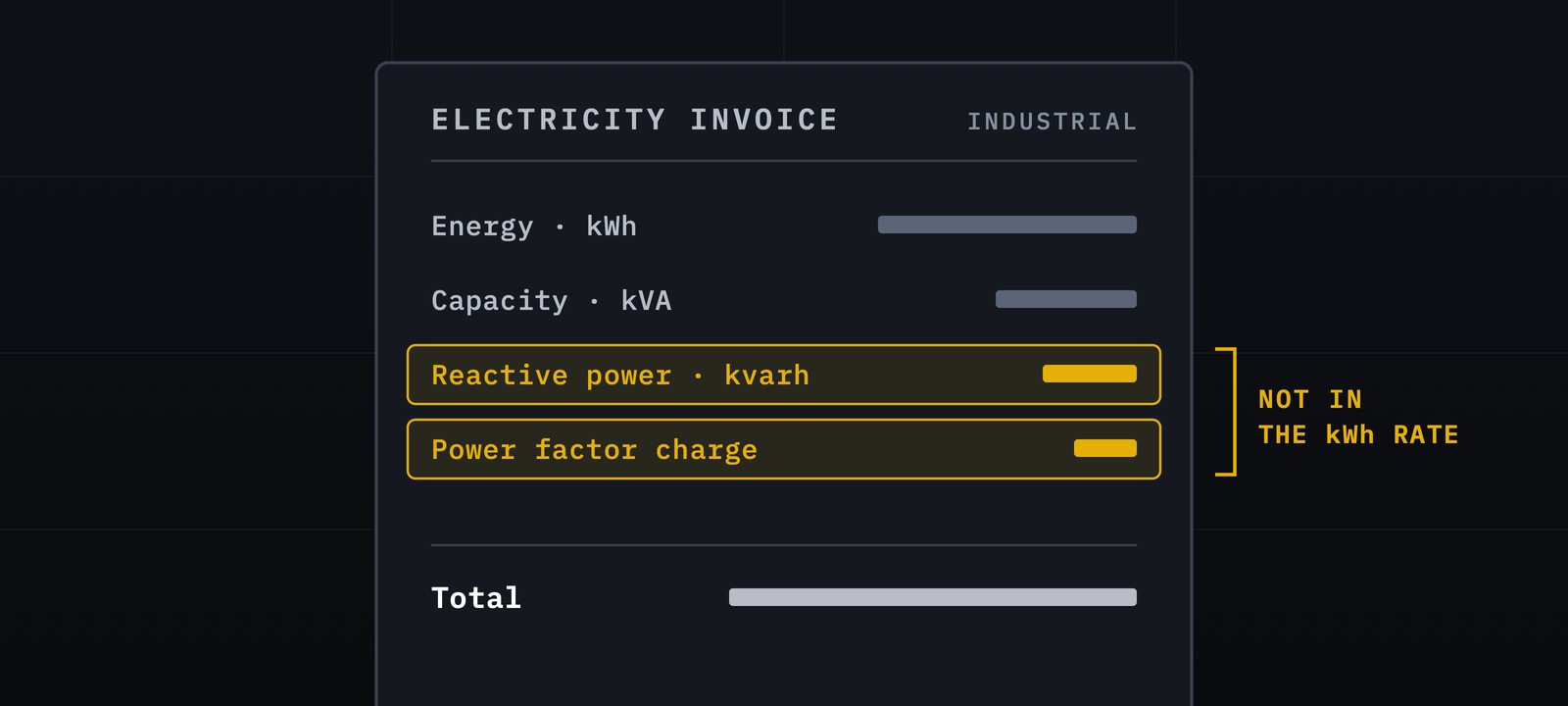
When a facility runs at a low power factor, it draws more current than the useful work needs. That excess current flows through every metre of cable, every busbar connection, every transformer winding and every switchgear contact in the distribution system, and at each point it makes heat through resistive losses, I²R. The heat is pure waste: energy turned into warmth that serves no productive purpose and, in many cases, has to be removed by air conditioning that uses more electricity still.
We put a number on the full financial cost of reactive current in The Hidden Cost on Every Industrial Electricity Bill, and on its cost in equipment life in The IEEE Arrhenius Rule: Why Every 10 °C Matters.
2. Harmonic distortion
Non-linear loads, variable-speed drives, LED lighting, UPS units and rectifiers, inject harmonic currents into the electrical system. Harmonics add eddy-current and stray losses in the windings of transformers and motors, raise skin-effect losses in cables and increase the total RMS current flowing through the system. A transformer in a high-harmonic environment may have to be derated, by the method IEEE C57.110 sets out, leaving capacity that was paid for at installation unused.
3. Phase imbalance
Unbalanced loading across the three phases puts current on the neutral that would not flow in a balanced system. That neutral current makes losses of its own, and can overheat neutral conductors sized on the assumption of balanced loads. In motors, imbalance also drives negative-sequence current, which makes heat without making torque.
The cost of the first mechanism is plain arithmetic. A facility at a power factor of 0.75 draws about 27% more current than the same facility at 0.95, for the same useful work: 0.95 ÷ 0.75 is 1.27. And since resistive heat rises with the square of the current, that is about 60% more heat in every cable and winding the current passes through: 1.27² is 1.60.
- More current at power factor 0.75 than at 0.95
- +27%
- More resistive heat in every cable and winding
- +60%
Every wasted kilowatt-hour carries the carbon intensity of the grid that supplied it.
04Quantifying the carbon impact
The arithmetic is the same for any site on any grid. Scope 2 emissions are the electricity a site consumes multiplied by an emission factor, so the emissions a saving avoids are the energy saved multiplied by the same factor.
The calculation
Emissions avoided, in tCO₂e = energy saved, in MWh × emission factor, in tCO₂e per MWh
The emission factor is the emissions per unit of electricity. Under the location-based method it is the average for the grid the site draws from, which governments and agencies publish by country or region. Under the market-based method it is the factor of the supply the site contracts for: its supplier’s rate, a certificate, or the residual mix where it holds neither. The GHG Protocol’s Scope 2 Guidance sets out the order in which they are chosen.
The energy saved is the measured figure: kilowatt-hours at the meter, before and after, normalised for production and weather. It is what HarmoniQ’s performance guarantee is written against, and it is what makes the carbon figure auditable. Weather normalisation and the on/off test are how a saving is proven.
Worked exampleTake a hypothetical facility running at an average of 1 MW, around the clock: 8,760 MWh a year. With 10–20% fewer kWh, HarmoniQ’s typical range, it draws 876 to 1,752 MWh less a year. On the UK grid, at the 2026 conversion factor from the Department for Energy Security and Net Zero, 0.131 kg CO₂e per kWh, each of those megawatt-hours takes 0.131 tonnes off location-based Scope 2. On a coal-heavy grid, it takes several times as much.
Grid factors fall as grids decarbonise. The UK’s fell by about a quarter between the Government’s 2025 and 2026 updates, so the carbon each saved kilowatt-hour avoids will shrink over time. The kilowatt-hours are still saved, and so is what they cost.
Now compare buying certificates instead. A company can buy enough certificates to cover all of its consumption and report a market-based Scope 2 close to zero, at a recurring cost, and with no change to its location-based figure or its operations. Efficiency cuts a share of the emissions under both methods, and saves money while it does.
| Measure | Energy efficiency | Certificate procurement |
|---|---|---|
| Scope 2 reduction | A share of consumption, under both methods | Up to all of it, under the market-based method only |
| Annual financial effect | A saving: the bill falls with the kWh | A recurring cost |
| Additionality | Not in question: the energy is never consumed | Contested, for unbundled certificates |
| GHG Protocol method | Reduces location-based and market-based | Reduces market-based only |
| Operational co-benefits | Lower capacity charges, longer equipment life, freed capacity | None |
05The reporting advantage
The GHG Protocol’s Scope 2 Guidance has companies report Scope 2 two ways wherever contractual instruments are available: the location-based method, which uses average grid emission factors, and the market-based method, which reflects the contracts and certificates a company holds.
That dual reporting draws a sharp line between strategies. Renewable energy certificates reduce emissions under the market-based method only. They have no effect on location-based emissions, because the electricity the site physically uses still comes from the grid, at its actual carbon intensity. Energy efficiency reduces emissions under both methods, because fewer kilowatt-hours are consumed.
This matters more than most sustainability teams realise. Investors, rating agencies and regulators increasingly look at both numbers. A wide gap between a company’s market-based and location-based figures, driven by heavy reliance on certificates, invites the question of whether its reductions happened on paper or in its operations.
The major disclosure frameworks reinforce the point:
- IFRS S2. The ISSB’s climate standard asks for location-based Scope 2, the figure certificates cannot move, with information about any contractual instruments alongside it.
- ESRS E1. The CSRD’s climate standard asks for both figures, and for the decarbonisation levers behind a company’s transition plan, energy efficiency among them.
- CDP. Its questionnaire asks for both Scope 2 figures, and applies quality criteria to the certificates and contracts behind a market-based one.
Energy efficiency reduces emissions, reduces cost and shows a genuine operational improvement, all at once. It is the difference between telling investors “we bought certificates” and telling them “we reduced the energy intensity of our operations”. Auditors, rating agencies and institutional investors are learning to tell the two apart, and the difference is becoming material.
06Building the business case that CFOs and CSOs both sign
Most decarbonisation investments carry a tension between financial performance and sustainability outcomes. Solar needs significant capital, and repays it slowly. PPAs carry price risk and contract complexity. Certificates are a pure cost with no operational return. In each case the CFO sees a cost centre, and the CSO a compliance necessity.
Power-quality correction is one of the rare interventions that removes that tension. It earns two returns at once: a financial one, in pounds, dollars, euros or rand, and a carbon one, in tonnes of CO₂e. The business case does not ask the CFO to believe in sustainability, or the CSO to defend a negative return.
What the CFO sees
Up to 25% off the total bill
- Energy: 10–20% fewer kWh for the same output, proven at the site’s own meter
- Power-factor penalties: eliminated, with power factor at 0.98+, where the utility levies them
- Capacity charges: reduced, as the apparent power freed lets the site lower its agreed capacity
- Equipment: 2–4× longer downstream equipment life
- Installation: zero operational disruption
The 25% needs all three lines; with no penalty and no capacity charge, the bill saving is close to the kWh saving alone.
What the CSO sees
A Scope 2 cut with no certificate
- Scope 2: falls under both the location-based and market-based methods, with every kWh saved
- Additionality: not in question, and no certificate to renew
- Reporting: measured at the meter, so auditable for CDP, IFRS S2 and the CSRD
- Targets: an absolute reduction, counted towards a science-based target
- Capital goods: fewer early replacements, so less embodied carbon in Scope 3
That dual return matters strategically. In most organisations, sustainability investments compete for capital against projects with clear financial returns. Power-quality correction does not need to compete: it makes its case on both counts.
It also simplifies governance. The project needs no separate sustainability budget, and no special board approval for ESG spending. It can go through the normal capital process on its financial case, with the carbon reduction as a benefit the sustainability team reports.
Most ESG investments are cost centres. Power-quality correction is one of the rare interventions that is an ESG win and a financial win at once. When the CFO’s case and the CSO’s case are the same case, approval stops being a negotiation.
07The bottom line
Scope 2 is the most actionable emission category for a simple reason: it is purchased electricity, a variable directly within management control. The fastest, cheapest and most credible lever for reducing it is not a procurement strategy or a certificate. It is efficiency: consuming fewer kilowatt-hours for the same output.
With HarmoniQ
A facility typically uses 10–20% fewer kWh for the same output, proven at its own meter, so its Scope 2 falls under both reporting methods.
At the load
HarmoniQ Alpha
Fitted at each machine, it cleans the current where it is drawn, so every cable upstream carries less of it and runs cooler.
At the drives
HarmoniQ Delta
Fitted at the drives panel, it cleans the current where the drives distort it, before it spreads to the feeder, busbar and transformer.
At the incomer
HarmoniQ Sigma
At the main switchgear, it corrects reactive current where the network meets the grid, so the supply and the meter see cleaner current.
All three are shunt-connected, outside the main power path, so they install with zero operational disruption. With power factor corrected to 0.98+, penalties fall away where the utility levies them and capacity charges come down: up to 25% off the total bill where all three lines apply. The same correction frees electrical capacity for growth, and its cooler running is the basis of a 2–4× extension in downstream equipment life.
Correction strengthens what a company can report under CDP, the CSRD and IFRS S2, and its carbon reductions are measured at the meter, need no certificate and stand up to investor scrutiny.
Renewable procurement and on-site generation have their place in a comprehensive Scope 2 strategy. But they should come second. The logical sequence is: first, stop wasting the electricity you already buy; then, green the remainder.
Power-quality correction should be the first item on every sustainability roadmap. Not the last.
Sources and further reading
- GHG Protocol (2015), GHG Protocol Scope 2 Guidance: An Amendment to the GHG Protocol Corporate Standard, World Resources Institute and World Business Council for Sustainable Development.
- GHG Protocol (2025), Public consultation on revisions to the Scope 2 Guidance, October 2025 to January 2026, World Resources Institute and World Business Council for Sustainable Development.
- International Energy Agency (2023), Energy Efficiency 2023, IEA, Paris.
- International Energy Agency (2022), “Energy efficiency is the ‘first fuel’, and demand for it needs to grow”, IEA Commentary, December 2022.
- Directive (EU) 2022/2464, Corporate Sustainability Reporting Directive (CSRD).
- Commission Delegated Regulation (EU) 2023/2772, European Sustainability Reporting Standards: ESRS E1, Climate change.
- IFRS Foundation (2023), IFRS S2 Climate-related Disclosures, International Sustainability Standards Board, paragraph 29(a)(v).
- CDP (2023), CDP Technical Note: Relevance of Scope 2 Quality Criteria, CDP Worldwide.
- Science Based Targets initiative (2023), SBTi Corporate Net-Zero Standard, Version 1.1.
- Department for Energy Security and Net Zero (2026), Greenhouse Gas Reporting: Conversion Factors 2026, published 11 June 2026, with its methodology paper.
- IEEE Std C57.110-2018, IEEE Recommended Practice for Establishing Liquid-Immersed and Dry-Type Power and Distribution Transformer Capability When Supplying Nonsinusoidal Load Currents.