In brief
- Reactive power does no work, yet the grid supplies it and cables carry it, and it reaches the bill three ways: as metered heat, as penalties and as capacity charges.
- It hides in four mechanisms: kVA demand charges, power factor adjustment formulas, reactive energy penalties and oversized capacity subscriptions.
- It persists because the bill is built for accountants, power factor falls between departments, and few sites have ever put a number on it.
- With HarmoniQ, three invoice lines move: 10–20% fewer kWh, power-factor penalties eliminated and capacity charges reduced. Together, up to 25% off the total electricity bill.
Ask any plant manager what they pay for electricity and you will get a fast answer: the rate per kilowatt-hour. That number is on the front page of every bill, tracked monthly, benchmarked against budget and negotiated at every procurement round.
But the kWh rate tells only part of the story. In most industrial markets the amount actually billed is shaped by a second variable that rarely reaches a budget review, a board pack or an energy audit. That variable is reactive power, and it quietly inflates the electricity cost of most industrial facilities that run motors.
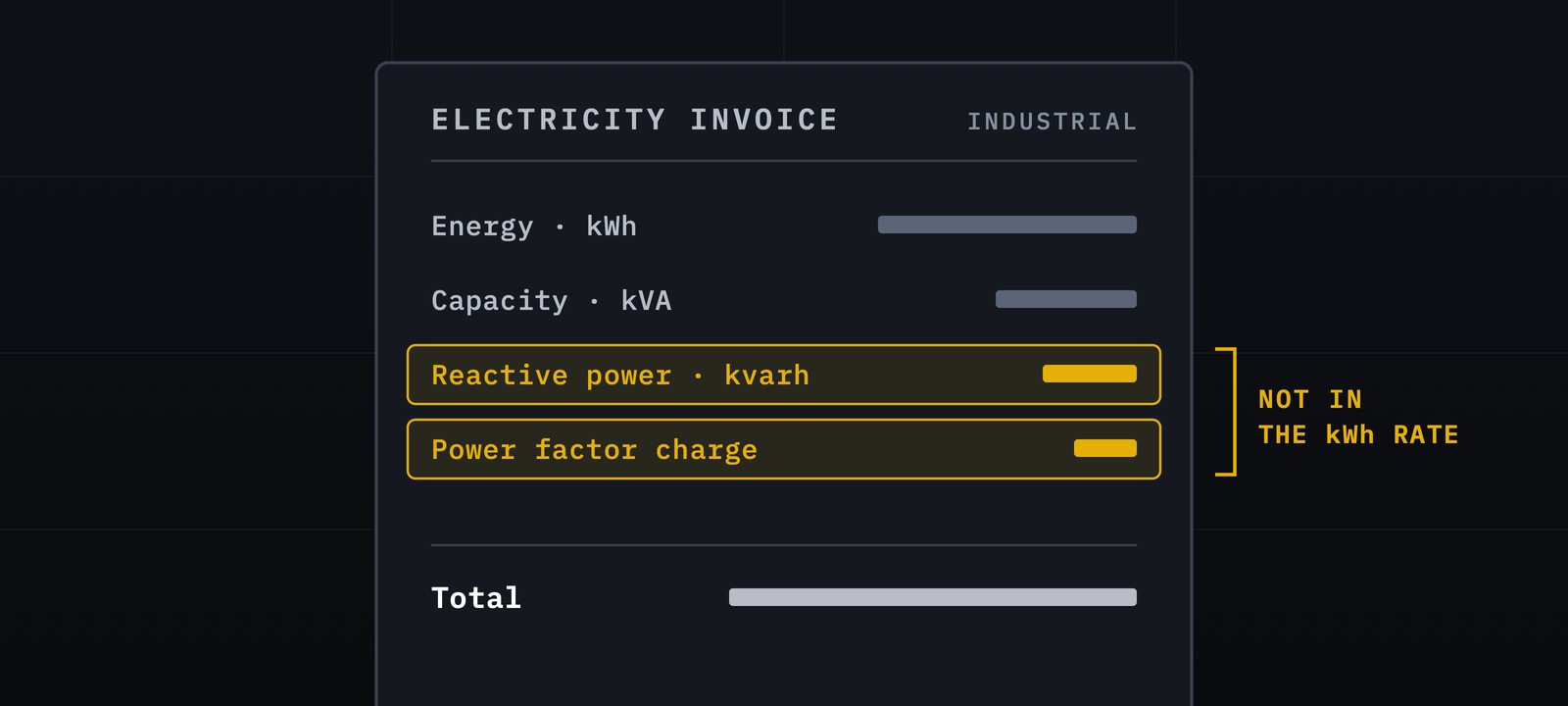
It is not a rounding error, and it reaches the invoice three ways. Current that does no work heats cables, transformers and motors, and the meter records that heat as kilowatt-hours. Tariffs penalise poor power factor directly. And capacity charges bill for apparent power, reactive power included. This article makes the invisible visible: how reactive power turns into cost, how billing structures around the world reveal or conceal it, and what can be done to stop paying for it.
01The electricity you pay for versus the electricity you use
Most electrical equipment in an industrial facility, motors, compressors, transformers, variable-speed drives and lighting, draws two kinds of power from the grid:
- Active power, in kW, does useful work. It turns shafts, heats furnaces and moves conveyors. It is what most people think of as electricity.
- Reactive power, in kvar, sustains the magnetic fields that make motors and transformers work. It does no useful work, but without it the equipment cannot run. It oscillates between supply and load, occupying grid capacity without producing output.
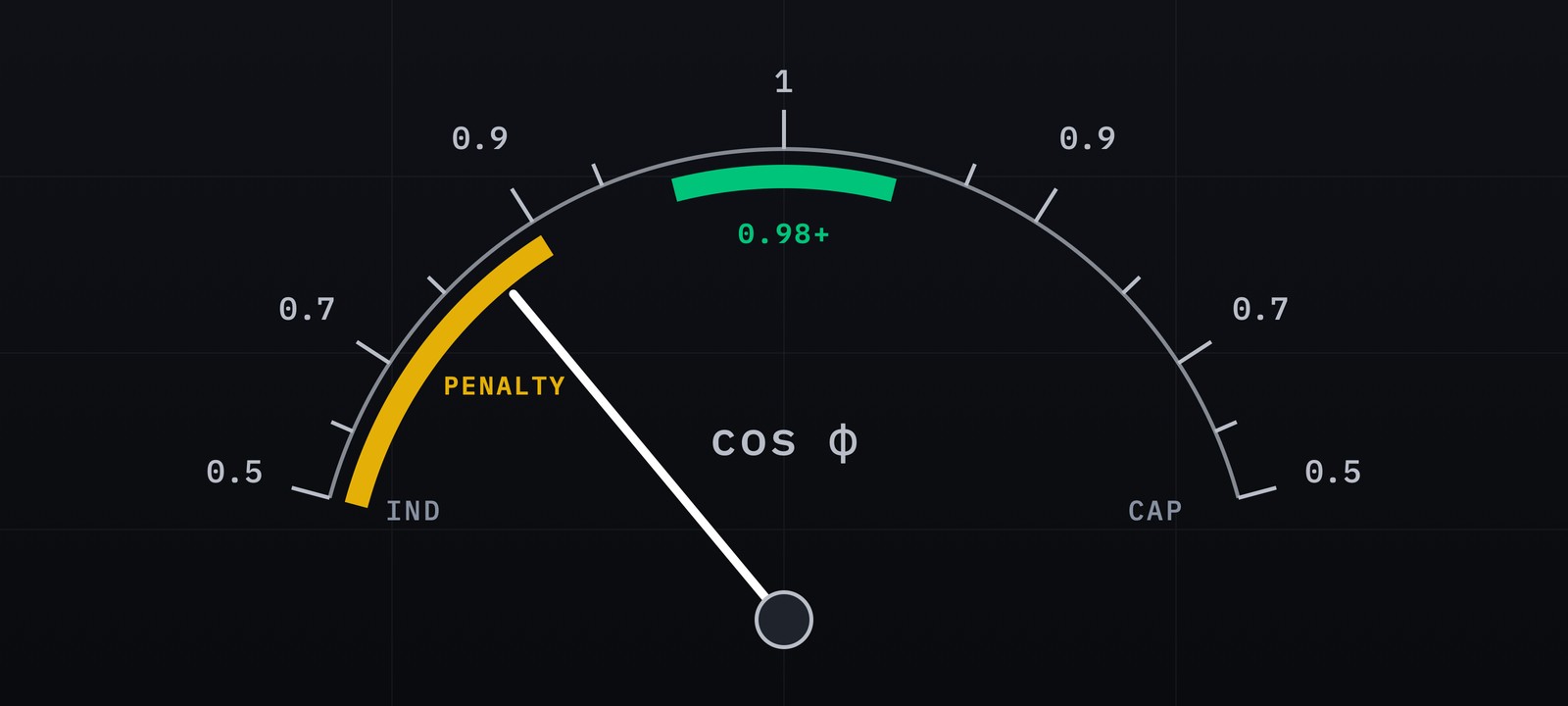
Together they make apparent power, in kVA: the total load the grid has to deliver. They combine at right angles rather than end to end, like the two shorter sides of a right-angled triangle, and the ratio of active to apparent power, kW ÷ kVA, is the power factor. The power triangle in our article on penalties lets you set a load and drag the power factor.
A power factor of 1.0 means every amp drawn from the grid does useful work. At 0.70, a site draws 1 ÷ 0.70, about 1.43 times, the current the work alone needs. The grid still has to supply all of it, the cables still have to carry all of it, and something still has to pay for all of it. The question is whether that something appears on your bill as a visible line, or is buried in charges you have never questioned.
02Where the cost hides: four mechanisms
Reactive power never shows up as a single charge labelled “waste”. It works its way into the bill through four mechanisms, each operating differently by country, utility and tariff. Most energy managers know one or two of them. It pays to know all four.
1. Direct kVA demand charges
In some markets the utility bills peak demand not in kilowatts, useful power, but in kilovolt-amperes, apparent power. Because kVA includes the reactive component, a facility with poor power factor registers a higher demand even though its productive load has not changed. Consider two identical factories, each using 800 kW of real power:
| Metric | Factory A, PF 0.95 | Factory B, PF 0.75 | Difference |
|---|---|---|---|
| Active power, useful work | 800 kW | 800 kW | — |
| Apparent power, billed | 842 kVA | 1,067 kVA | +225 kVA (+27%) |
| Reactive power drawn | 263 kvar | 706 kvar | +443 kvar |
| Line current, three-phase | 1,215 A | 1,540 A | +325 A |
| Relative I²R heating | 1.00× | 1.60× | +60% heat |
Factory B is billed for 225 kVA more demand, 27% more, every month, while producing exactly the same output. It is not labelled a penalty and it is not listed as a surcharge. It is simply a larger number in the demand column, and unless someone understands why it is larger, nobody will question it. The same reactive current raises the current in every cable by 27% and the heat in them by 60%, and that heat is metered too, in kilowatt-hours.
2. Power factor adjustment formulas
Where demand is billed in kW, utilities often apply an adjustment with much the same effect: billed demand = measured kW × (target PF ÷ actual PF).
Worked exampleWith a target of 0.90 and a facility running at 0.75, billed demand becomes 800 kW × (0.90 ÷ 0.75) = 960 kW: 160 kW of demand the plant never used productively.
Versions of this adjustment appear in US tariffs, FPL and Austin Energy among them, and in Japan, at TEPCO. Hydro-Québec and Hydro One reach a similar result by billing the higher of measured kW and 90% of measured kVA. The effect matches kVA billing, but it is far less transparent: the bill shows an inflated kW figure, with no note explaining why it differs from the meter reading. Many facility managers have never noticed the difference.
3. Reactive energy penalties
The third mechanism charges for every unit of reactive energy above a threshold. It is the most explicit form of the hidden cost, a line item of its own, and it is still often overlooked, because it is small next to the total and sits among dozens of other charges.
| Market | Threshold | How it is charged |
|---|---|---|
| Germany | cos φ 0.93 | Per kvarh above the threshold |
| Italy | cos φ 0.95 | Per kvarh above the threshold |
| Spain | cos φ 0.95 | Tiered, inductive and capacitive |
| Poland | cos φ 0.93 | Per kvarh above the threshold |
| Brazil | cos φ 0.92 | Tariff rate on the excess, measured hourly |
| Colombia | cos φ 0.90 | Escalating M factor, up to 12 times the base rate |
| Mexico | cos φ 0.90 | Formula surcharge on the bill, capped at 120% |
| Turkey | cos φ 0.98 | Per the EPDK tariff tables |
| South Africa | cos φ 0.96 | Per kvarh above the threshold |
The range is wide. In Colombia, a site that has run at poor power factor for more than twelve months faces a multiplier of 12 times the base rate, a mechanism designed to force corrective action. In Mexico, CFE’s formula puts a site at a power factor of 0.65 on a surcharge of about 23% of its entire electricity bill.
All five penalty models, with a worked example of each, are set out in Power Factor Penalties: What Your Utility Isn’t Telling You.
4. Oversized capacity subscriptions
The least visible cost of all. Where customers subscribe to a fixed capacity, as they do in France, Morocco and India, a subscription counted in kVA has to cover apparent power, reactive power included. Several Canadian utilities reach the same result in kW, billing demand on the greater of kW or 90% of kVA. Either way, a facility with poor power factor subscribes to more capacity than its productive load requires.
Worked exampleA site drawing 500 kW at a power factor of 0.80 needs 625 kVA of subscribed capacity. Corrected to 0.95, it would need 526 kVA: 16% less, recurring every month for the life of the connection.
- More billed kVA demand for the same 800 kW, at power factor 0.75
- +27%
- Billed for an 800 kW load under a 0.90 adjustment formula
- 960 kW
- The base rate: Colombia’s penalty multiplier after twelve months
- 12×
- Less subscribed capacity at power factor 0.95 than at 0.80
- 16%
03Why this cost persists
If the cost is real and recurring, why does it go unaddressed at so many industrial sites? The answer is a mix of structure, information and organisation.
The bill is designed for accountants, not engineers
An industrial electricity bill in a market such as the UK or Germany can run to pages of line items: commodity, DUoS, TNUoS, capacity, reactive power, climate levies, balancing and meter operator charges. The reactive power charge is one line among dozens, usually a small share of the total. It does not flag itself as a problem. It simply exists.
The demand charge, the larger hidden cost, is worse, because it does not appear as a separate surcharge at all. It is simply a number: “Maximum demand: 1,067 kVA”. Without knowing what that number should be, there is nothing to question.
Power factor falls between departments
Procurement negotiates the commodity rate. Maintenance looks after the equipment. Finance pays the bill. No single function owns power factor as a metric, and none has both the technical understanding and the commercial visibility to see the cost. It is an engineering problem that shows up as a finance problem, and neither side sees the whole picture.
The baseline is never established
Many facilities have never had a power quality audit that puts a financial value on their power factor. Without a baseline there is no business case, without a business case there is no budget, and without a budget the problem persists, year after year.
The most expensive kilowatt-hour is not the one with the highest rate. It is the one you pay for without realising it.
04The global landscape: who pays for what
How visible reactive power costs are on a bill varies widely by country, and the variation is itself part of the problem. A manufacturer operating in ten markets may face kVA demand charges in one, kvarh penalties in another, adjustment formulas in a third and no reactive power cost on the bill at all in a fourth. Broadly, there are three billing models:
| Model | How it works | Where it applies | How visible the cost is |
|---|---|---|---|
| kVA demand billing | Peak demand measured in apparent power, so reactive power inflates the billed figure directly | UK, India, South Africa, Nigeria, Kenya, Indonesia, Morocco, Ghana, Tanzania, parts of China | Low: the cost sits inside the demand figure |
| kW plus power factor penalties | Peak demand in kW, with reactive energy charges or adjustment formulas | Germany, France, Italy, Spain, US, Canada, Brazil, Mexico, Japan, South Korea, Poland, Turkey and others | Moderate: penalties appear as a line item, demand inflation stays hidden |
| kWh only | Flat or tiered energy billing, with no demand charge and no power factor penalty | UAE, Qatar, Kuwait, Bahrain | None on the bill, though Qatar sets power factor as a condition of connection instead |
The pointMost large industrial markets penalise reactive power, through kVA demand charges or kW-plus-penalty structures. kWh-only billing is the exception, not the rule. And even there, the heat from current that does no work still reaches the bill, in kilowatt-hours.
05Three lines on one invoice
Put the mechanisms together and poor power quality reaches a bill on three separate lines. They are worth keeping apart, because each moves for a different reason and each is measured differently. Adjustment formulas and reactive energy penalties land on the penalty line; kVA demand charges and capacity subscriptions land on the capacity line. The third is the energy line itself: the heat that current doing no work leaves in the site’s own cables, transformers and motors, which the meter records as kilowatt-hours.
| Invoice line | What it bills | This plant today | With HarmoniQ, power factor 0.98+ |
|---|---|---|---|
| Energy | kWh at the meter, heat included | The baseline, metered before installation | 10–20% fewer kWh, the typical range, proven at the site’s own meter |
| Power-factor penalties | Reactive power above the allowance: 657 kvar at a 0.95 threshold | 1,500 kvar drawn, 843 kvar over | At 0.98, 406 kvar: nothing over |
| Capacity charges | kVA of demand or subscribed capacity | 2,500 kVA | At 0.98, 2,041 kVA: 459 kVA freed |
Each line has its own figure. The energy line is the 10–20% fewer kWh, and it is what HarmoniQ’s performance guarantee is written against: kWh at the meter, never the bill, because the bill also moves with tariffs and charges outside anyone’s control. On the penalty line, power factor corrected to 0.98+ means reactive-power penalty charges fall away entirely, wherever the utility levies them. On the capacity line, the apparent power freed lets a site lower its agreed capacity instead of paying for headroom it never uses.
Added together, the three lines come to up to 25% off the total electricity bill, and that figure needs all three. At a site with no power factor penalty and no capacity charge, the bill saving is close to the kWh saving alone. The hypothetical plant above carries all three lines, which is exactly where the hidden cost is largest.
- Fewer kWh on the energy line: what the guarantee is written against
- 10–20%
- Power factor, so reactive-power penalty charges fall away
- 0.98+
- Off the total electricity bill, where all three lines apply
- Up to 25%
06What the bill does not show you
The three lines capture the costs that appear on the electricity bill. Reactive power imposes others, which surface elsewhere in the operating budget:
- Excess heat. Reactive current flowing through cables, switchgear and transformers makes heat through resistive losses, I²R. In heavily loaded circuits that heat raises operating temperatures across the installation.
- Premature equipment failure. Every 10 °C rise in operating temperature halves the life of electrical insulation, so a motor running 20 °C hotter than it needs to will fail in roughly a quarter of its expected life. Our article on the Arrhenius rule explains why.
- Oversized infrastructure. Cables, transformers and switchgear are rated for apparent power, kVA, not useful power. A facility at power factor 0.75 needs infrastructure rated a third higher than one at unity, a cost locked in at design and carried for the life of the assets.
- Reduced available capacity. A 2,000 kVA transformer at power factor 0.75 delivers only 1,500 kW of useful power. At 0.95 the same transformer delivers 1,900 kW: 27% more useful power from the same asset.
Correcting power factor does not only reduce the bill. It frees capacity in existing infrastructure, cables, transformers, switchgear and protection, without new assets, and for a facility approaching the limit of its electrical capacity that can defer an upgrade. Cooler running is also the basis of HarmoniQ’s 2–4× extension of downstream equipment life, under the same Arrhenius rule.
07A framework for action
Addressing reactive power costs takes a systematic approach, in four steps:
- Establish the baseline Commission a power quality audit that measures power factor, harmonic distortion, phase balance and load profile at the point of common coupling and at the major distribution boards. Then translate the electrical parameters into money: what reactive power is costing today, on each of the three lines, and what the minimum could be.
- Identify the sources Reactive power is not spread evenly across a facility. Particular loads, large induction motors at partial load, variable-speed drives and arc furnaces, contribute far more than their share. Targeting the largest sources first gives the best return on each intervention.
- Implement correction A capacitor bank at the incomer addresses reactive power at the meter, but it does nothing for harmonics or imbalance, and the reactive and distorted current still flows through every cable inside the site. Correcting where each problem arises treats more of it: HarmoniQ fits the Alpha at the loads, the Delta at the drives and the Sigma at the incomer, each working where it sits.
- Verify and sustain After installation, measurement should confirm that power factor has reached its target, demand charges have fallen, reactive penalties have gone and energy consumption has dropped. The on/off test proves the kWh saving directly, at the meter. Monitoring should then raise an alert if power factor degrades as equipment ages or the load profile changes.
08The bottom line
The hidden cost of reactive power is an efficiency opportunity in plain sight. It is not hidden because it is small. It is hidden because it is structural: built into the way demand is measured, the way capacity is subscribed and the way bills are designed.
It persists because it falls between departments, and because few facilities have ever put a number on it.
With HarmoniQ
A facility typically uses 10–20% fewer kWh for the same output, and saves up to 25% of its total bill where power-factor penalties fall away and capacity charges come down too.
At the load
HarmoniQ Alpha
Fitted at each machine, it cleans the current where it is drawn, so every cable upstream carries less of it and runs cooler.
At the drives
HarmoniQ Delta
Fitted at the drives panel, it cleans the current where the drives distort it, before it spreads to the feeder, busbar and transformer.
At the incomer
HarmoniQ Sigma
At the main switchgear, it corrects reactive current where the network meets the grid, so the supply and the meter see cleaner current.
Its equipment runs cooler and lasts longer, and capacity it thought was fully used is freed.
The cost is on every industrial electricity bill. The question is whether you can see it.
Sources and further reading
- IEEE Std 1-2021, IEEE Standard for General Principles for Temperature Limits in the Rating of Electrical Equipment, Institute of Electrical and Electronics Engineers.
- IEC 60085:2007, Electrical Insulation: Thermal Evaluation and Designation, International Electrotechnical Commission.
- Bollen, M.H.J. (2000), Understanding Power Quality Problems: Voltage Sags and Interruptions, IEEE Press, New York.
- Dugan, R.C. et al. (2012), Electrical Power Systems Quality, 3rd ed., McGraw-Hill Education.
- UK Power Networks, Distribution Use of System Charging Methodology, Schedule of Charges 2024/25.
- Florida Power & Light (FPL), General Service Demand Rate Schedule GSD-1, effective January 2024.
- Consolidated Edison, Service Classification No. 9, General Large, P.S.C. No. 10.
- Comisión Federal de Electricidad (CFE), Tarifa HM, Servicio en Media Tensión con Demanda, Mexico.
- Enedis, TURPE 6 HTA, Tarif d’Utilisation des Réseaux Publics d’Électricité, 2023.
- Eskom Holdings SOC Ltd, Tariff & Charges Booklet 2024/25, South Africa.
- International Energy Agency (2023), Energy Efficiency 2023, IEA, Paris.