In brief
- Utilities charge for poor power factor in five distinct ways, and most never appear on the bill as a labelled penalty.
- Thresholds run from 0.80 to 0.98 by market. A site at 0.90 sits below the threshold in most of the European markets listed.
- Demand inflation costs the most and shows the least: at 0.75, a 1,500 kW plant is billed for 2,000 kVA.
- Correcting to 0.98+ removes reactive-power penalties wherever they are levied, and frees capacity a site can stop paying for.
Somewhere on your electricity bill, buried in a demand column, built into a kVA figure or disguised as a one-line “reactive power adjustment”, there is a charge you have almost certainly never questioned.
The utility has no obligation to make it transparent, and no incentive to. Reactive power flows back and forth through the grid’s cables, transformers and switchgear without doing any work, and it occupies capacity the utility has to build and maintain all the same. The penalty is how the utility charges for that capacity. The obscurity is simply how bills have always been structured.
This article takes apart the five models utilities use to penalise poor power factor, sets out the thresholds that trigger them market by market, and lays out a clear path to removing them.
01The charge most facility managers have never noticed
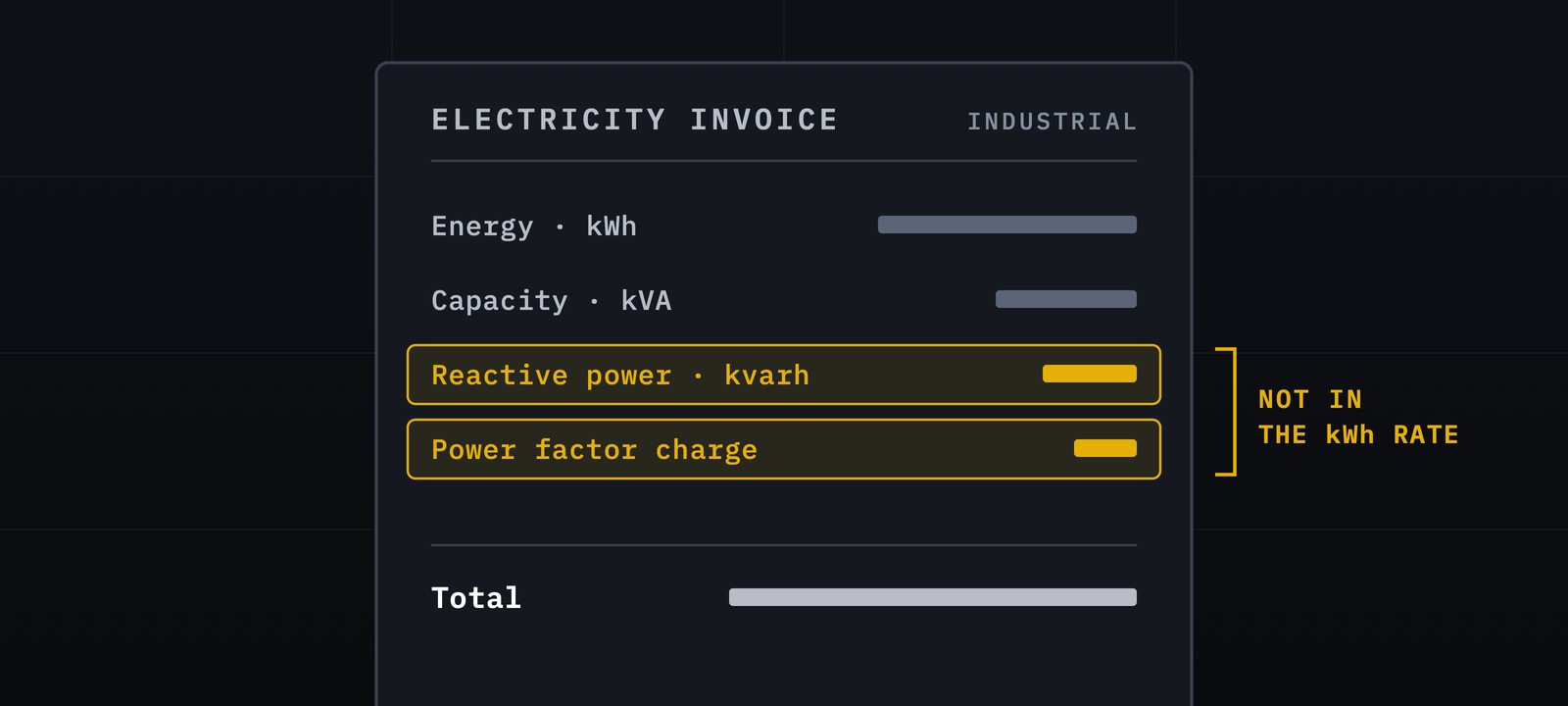
Power factor penalties appear on industrial electricity bills in dozens of markets worldwide, and have done for decades. Yet many facility managers, energy buyers and even finance directors have never found them on their own bills. The reason is not negligence. It is design.
Utilities do not label power factor penalties with a red flag and an explanation. They build them into the structure of the bill, in at least three ways:
- Inflated demand figures. Where demand is billed in kVA rather than kW, the reactive component is built straight into the demand figure. The bill shows a larger number, with no annotation and no comparison with what it would have been at unity power factor.
- kvarh line items. Some tariffs charge for every unit of reactive energy above a threshold. It appears as one line among twenty or thirty, usually a small share of the total: easy to overlook, and easy to accept as fixed.
- Adjustment formulas and surcharges. Other utilities apply a multiplier to the demand charge, or a percentage surcharge to the whole bill, based on the measured power factor. The formula is in the tariff schedule. It is almost never explained on the bill.
From the utility’s side the charge is justified: reactive power takes up grid capacity without generating billable energy. From yours, it is a cost that can be engineered away.
02How utilities calculate power factor penalties: the five models
Not all power factor penalties work the same way. Across the world’s electricity markets there are five distinct billing models, and knowing which one applies to your facility is the first step towards putting a number on the cost, and then removing it.
All five are arithmetic on one right-angled triangle. Real power, in kW, runs along the bottom: the power that does work. Reactive power, in kvar, rises up the side: the power that sustains the magnetic fields in motors and transformers, and does no work. Apparent power, in kVA, is the hypotenuse: what the supply has to carry. Power factor is the ratio of the first to the last, kW ÷ kVA, the cosine of the angle φ between them. Set a load and a power factor below, pick a threshold, and see what the models would bill.
Apparent power
1,500kVA
kW ÷ power factor: what the supply must carry
Reactive power
900kvar
Does no work, but loads every cable
Above the 0.90 allowance
319kvar
What a threshold-based penalty bills
kVA demand above kW
+25%
300 kVA billed beyond 1,200 kW of work
1,200 kW at power factor 0.80 draws 1,500 kVA and 900 kvar. A 0.90 threshold allows 581 kvar, so 319 kvar is billed as excess, and a kVA demand charge bills 300 kVA beyond the work.
The triangle is drawn for a clean, sinusoidal supply. Harmonic current adds apparent power that the triangle does not show, which the standards section below comes back to.
Model 1: kVA demand billing
The utility measures peak demand in kilovolt-amperes, apparent power, rather than kilowatts. Since kVA = kW ÷ PF, any fall in power factor inflates the billed demand directly. It is the most opaque model, because the penalty is invisible: it is simply a larger number in the demand column.
Worked exampleA factory drawing 1,000 kW at power factor 0.85 registers 1,176 kVA of demand. At 0.96, the same load registers 1,042 kVA. Its demand charge is about 13% higher at 0.85, with no line item to say why.
Model 2: kW × PF multiplier
The utility measures demand in kW but adjusts it with a formula: billed kW = measured kW × (target PF ÷ actual PF). The result is an inflated demand figure that appears on the bill as though it were the metered reading.
Worked exampleMeasured demand 800 kW, target power factor 0.85, actual 0.72. Billed demand = 800 × (0.85 ÷ 0.72) = 944 kW: 144 kW, or 18%, more than the plant drew, billed at the full demand rate.
Model 3: separate kvar demand charge
The utility bills kW demand normally, then adds a charge for reactive demand above a threshold, usually the kvar that corresponds to the target power factor: kW × tan(acos target).
Worked exampleMeasured demand 1,200 kW with 900 kvar of reactive demand, a power factor of 0.80. A 0.90 threshold allows 581 kvar, so 319 kvar is billed as excess. The figure above opens on this example.
Model 4: kvarh excess energy charge
The utility meters reactive energy, in kvarh, and charges for every unit above a threshold, usually set as a share of active energy in kWh. It is common in European markets, where the metering records reactive energy interval by interval.
Worked exampleA month of 500,000 kWh and 380,000 kvarh, an average power factor of 0.80, under a tariff that allows reactive energy up to 40% of active energy (tan φ 0.4, a power factor of 0.93). The allowance is 200,000 kvarh, so 180,000 kvarh is charged.
Model 5: bill-level percentage surcharge
The utility measures the average power factor over the billing period and applies a percentage surcharge, or a credit, to the entire bill. It is the most directly punitive model, and the easiest to understand once you know it exists.
Worked exampleCFE’s tariff sets the surcharge at 3/5 × ((0.90 ÷ actual PF) − 1). At a measured power factor of 0.78 that is 3/5 × (1.154 − 1) = 9.23% of the whole bill, for every month the power factor stays there.
| Model | Mechanism | Key markets | Visibility on the bill |
|---|---|---|---|
| kVA demand billing | Demand measured in apparent power | UK, India, South Africa | Very low: no separate line item |
| kW × PF multiplier | Demand inflated by formula | US (FPL, Austin Energy), Japan | Low: reads as metered demand |
| Separate kvar charge | Charge on reactive demand above a threshold | US (Con Edison, SCE), South Korea | Moderate: a visible line item |
| kvarh excess energy | Charge per unit of excess reactive energy | Germany, Italy, Spain, Brazil | Moderate: a small line among many |
| Bill-level surcharge | Percentage added to the whole bill | Mexico, BC Hydro, Malaysia | High, though the formula is opaque |
03The thresholds that trigger penalties
Every penalty model has a trigger: the power factor below which charges begin. The thresholds vary widely from market to market, and the variation catches multinational operators off guard. A facility at power factor 0.91 can be clear of the threshold in Mexico and well inside penalty territory in South Africa.
| Market | Threshold | How it is charged |
|---|---|---|
| Turkey | cos φ 0.98 | kvarh excess energy |
| Finland | cos φ 0.98, a free band | Monthly fee on kvar above the band |
| South Africa | cos φ 0.96 | kVA demand plus a kvarh charge |
| Portugal | tan φ 0.3, about cos φ 0.96 | kvarh excess energy, in three escalating bands |
| Italy | cos φ 0.95 | kvarh excess energy |
| Spain | cos φ 0.95 | kvarh excess energy, tiered, inductive and capacitive |
| Saudi Arabia | cos φ 0.95 | kvarh charge for inefficient consumption |
| Ireland | cos φ 0.95 | kvarh “wattless” charge, plus a maximum import capacity charge |
| Norway | cos φ 0.95 | Reactive power charge from the distribution operator |
| New Zealand | cos φ 0.95 | Monthly kvar charge from the lines company |
| Greece | cos φ, above 55 kVA of agreed power | Reactive power (cos φ) billing |
| Germany | cos φ 0.93 | kvarh excess energy |
| France | cos φ 0.93 (tan φ 0.4) | Capacity subscription plus a reactive energy component (CER) |
| Brazil | cos φ 0.92 | kvarh excess energy, measured hourly |
| Romania | cos φ 0.92 | kvarh excess energy (ANRE), for smart-metered consumers |
| South Korea | cos φ 0.90 / 0.95 | kvar demand charge, with a credit above 0.95 |
| Mexico | cos φ 0.90 | Bill-level surcharge, capped at 120% of the bill |
| Colombia | cos φ 0.90 | Escalating M factor, up to 12 times the base rate |
| Qatar | cos φ 0.90 | A condition of connection (KAHRAMAA), not a meter penalty |
| Sweden | cos φ about 0.90 | Reactive charge plus a capacity (effekt) tariff |
| United States, typical | cos φ 0.85 | Varies by utility: a kW multiplier or a kvar charge |
| Japan | cos φ 0.85 | kW × PF multiplier, with a discount above 0.85 |
| Argentina | cos φ 0.85 | kvarh excess energy, in proportion to the excess |
| Morocco | cos φ 0.80 | kVA demand billing |
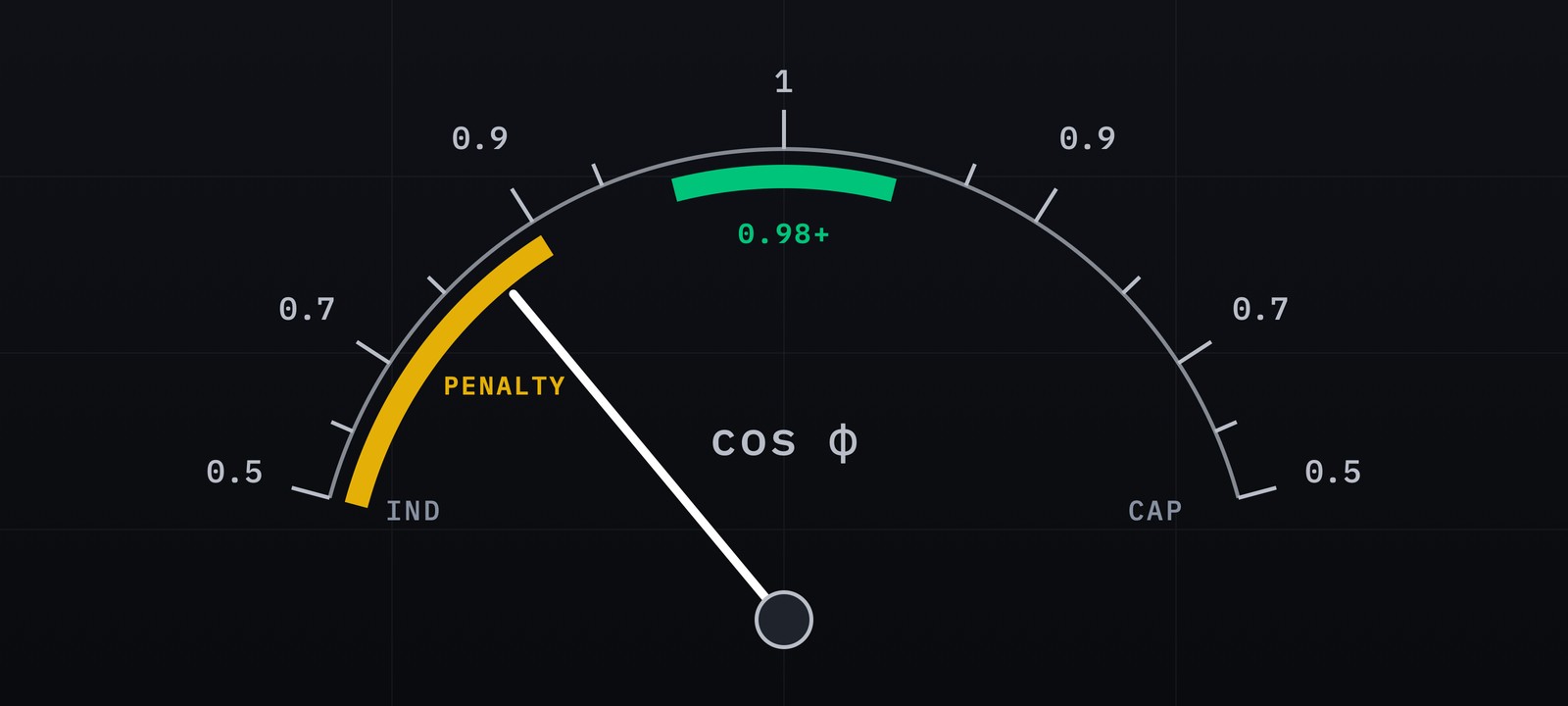
The table carries a warning. A power factor of 0.90, a figure many engineers regard as acceptable, sits below the threshold in most of the European markets listed, and in Brazil, Saudi Arabia and South Africa. The assumption that anything above 0.85 is fine comes from typical US tariffs, and it does not hold in most of the markets in Exhibit 2.
Turkey’s threshold of 0.98, matched by Finland’s 0.98 free band, leaves almost no margin for a site running uncompensated induction motors: in effect it requires near-unity correction. Qatar adds a different twist. There the requirement is a condition of connection, so correction becomes a licence to energise rather than an optional saving.
- The strictest threshold in Exhibit 2: Turkey, and Finland’s free band
- 0.98
- Below the threshold in most of the European markets listed
- 0.90
- The most lenient in Exhibit 2: Morocco
- 0.80
- What HarmoniQ corrects power factor to
- 0.98+
04The penalty you can’t see: demand inflation
Of the five models, demand inflation is at once the most expensive and the hardest to detect. It costs more than an explicit kvarh charge or a percentage surcharge because it acts on the demand charge, often one of the largest non-energy items on an industrial bill. And it is invisible, because the bill shows a demand figure without saying what that figure would have been at a better power factor.
Take a hypothetical steel fabrication plant drawing 1,500 kW of real power. This is what the demand line on its bill looks like at different power factors:
| Power factor | Billed demand | Reactive power | Billed above the 1,500 kW used |
|---|---|---|---|
| 0.98 Corrected | 1,531 kVA | 305 kvar | 31 kVA (2%) |
| 0.92 | 1,630 kVA | 639 kvar | 130 kVA (9%) |
| 0.87 | 1,724 kVA | 850 kvar | 224 kVA (15%) |
| 0.82 | 1,829 kVA | 1,047 kvar | 329 kVA (22%) |
| 0.75 | 2,000 kVA | 1,323 kvar | 500 kVA (33%) |
At 0.75 the plant is billed for 2,000 kVA: a third more than the 1,500 kW it actually uses, and 31% more than the same plant at 0.98. Nothing on the bill labels this as a power factor penalty. It simply reads “Maximum demand: 2,000 kVA”. Without knowing the real power underneath that figure, there is nothing to question.
This is the purest form of the hidden cost. In kVA-billing markets, the UK, India, South Africa and others, every demand charge on every bill is inflated by power factor, all the time, for every facility running below unity.
In Canada, Hydro-Québec takes a hybrid approach: demand is billed as the higher of measured kW or 90% of measured kVA. Below a power factor of 0.90 the kVA-derived figure takes over, quietly inflating the demand charge. The facility manager sees a demand figure and assumes it reflects the kW load. It does not.
The most expensive penalty is not the one on the bill. It is the one that is the bill: a demand figure inflated by reactive power, month after month, with no sign that it could be lower.
05How penalties compound across the bill
In a simple tariff, poor power factor inflates one charge. In the complex tariffs that govern most large industrial consumers, it inflates several at once, which is why the total impact is consistently larger than any single-line analysis suggests.
United Kingdom: three charges, one cause
A UK industrial consumer on a half-hourly metered supply pays three distribution charges that move with power factor:
- DUoS capacity charge, p/kVA/day. Distribution Use of System capacity charges are levied on the agreed maximum import capacity, set in kVA. Poor power factor inflates the capacity a site has to agree.
- Excess capacity charge. Demand above the agreed capacity attracts a charge of its own, so poor power factor makes every peak more expensive.
- Reactive power charge, p/kvarh. An explicit charge on reactive energy above 33% of active energy, equivalent to an average power factor of 0.95.
The pointAll three follow from the same underlying problem, and correcting power factor reduces all three at once. A facility that looks only at the reactive power line will underestimate what correction is worth.
France: subscription plus a reactive charge
Under France’s TURPE network tariffs, a business connection can pay for poor power factor three ways:
- Puissance souscrite, subscribed capacity. Where it is set in kVA, a facility at power factor 0.82 has to subscribe to about 20% more capacity than the same load needs at 0.98, and the fee recurs every month.
- Dépassement de puissance souscrite. Demand above the subscription triggers penalty charges at a multiple of the base rate. Where capacity is counted in kVA, poor power factor makes those overruns more frequent and more severe.
- Composante d’énergie réactive, CER. On HTA connections, a direct charge for reactive energy above tan φ = 0.4, a power factor of 0.93, outside off-peak hours.
The compounding is insidious: a higher subscription, more frequent overrun penalties and a direct reactive energy charge, all from one root cause. The same holds wherever a tariff has three or more charges that move with power factor, as in the UK, France and Spain’s six-period structure. Any analysis that looks at one of them alone will understate the opportunity.
06Who is most exposed
Power factor penalties do not fall on every facility equally. Some industries, by the nature of their electrical loads, run at structurally lower power factors, and so face structurally higher penalties. If your facility is among them, the bill is worth reading line by line.
| Industry | Typical causes of low power factor |
|---|---|
| Metalworks and steel fabrication | Arc furnaces, welders, large induction motors |
| Plastics moulding | Injection moulding machines, hydraulic presses |
| Textiles | Looms and spinning motors at partial load |
| Food processing | Refrigeration compressors, conveyor motors |
| Cold storage | Large compressor banks on variable load |
| Water and wastewater | Pump motors, aeration blowers |
| Commercial buildings, HVAC-heavy | Chillers, air-handling motors, variable-speed drives |
| Mining and minerals | Crushers, conveyors, mills |
The common thread is large induction motors running at partial load. A typical mid-sized induction motor runs at a power factor of 0.85–0.90 at full rated load and falls to about 0.70–0.75 at half load. Most industrial motors are sized for peak demand and spend most of their time well below it, so partial-load running is the norm, not the exception.
Other contributors to a poor site power factor:
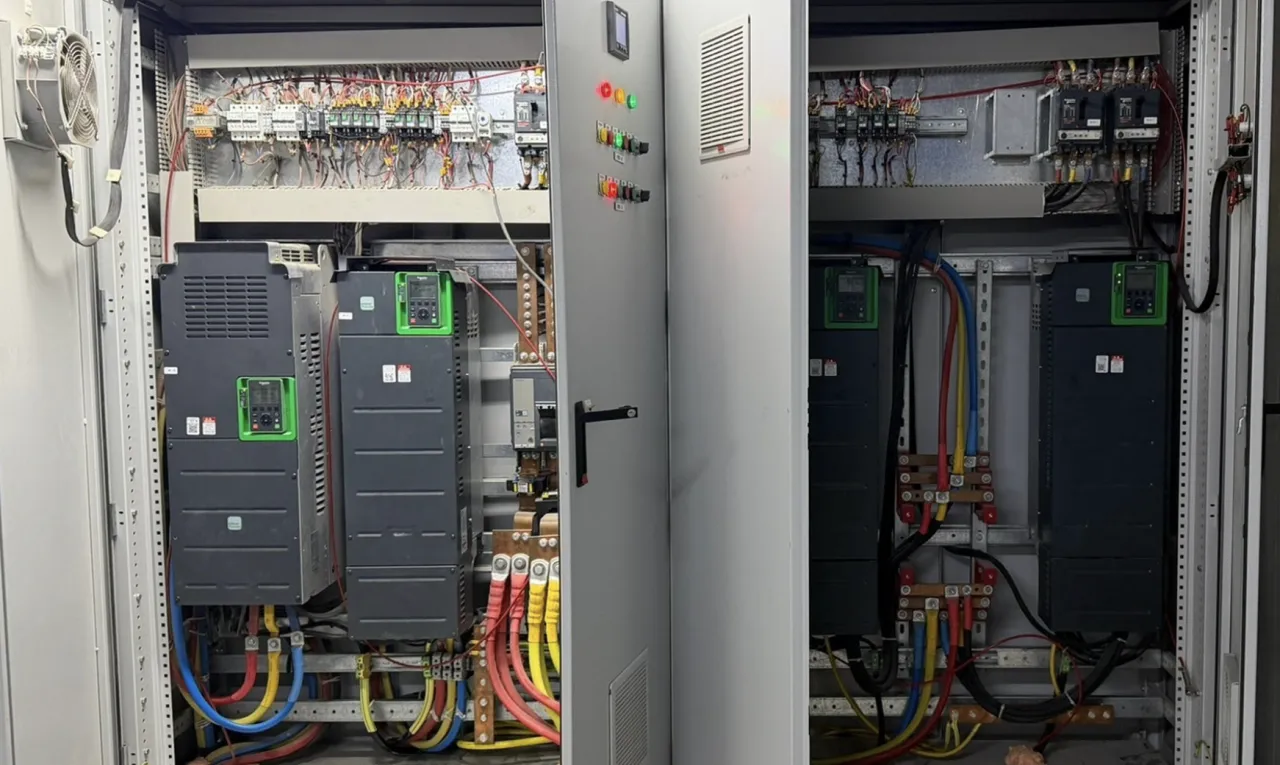
- Variable-speed drives without line-side mitigation. A six-pulse drive’s displacement power factor is high, but the pulsed current it draws adds harmonic distortion, which pulls the true power factor down. The standards section below explains the difference, and our article on drive harmonics explains the pulses.
- Welding equipment. Arc and resistance welders draw highly reactive, non-linear current.
- Large compressors. Reciprocating and screw compressors with direct-on-line starting and cyclic loading create significant reactive demand.
- Lightly loaded transformers. A transformer at low load draws magnetising current that is almost entirely reactive.
07How to eliminate penalties
The path from paying power factor penalties to paying none is not speculative. It is well-established engineering. The key is to approach it systematically, as a financial problem as much as an electrical one.
- Get your bills analysed Before touching any equipment, establish the financial baseline. Take twelve months of bills and find every component power factor inflates: demand charges in kVA or adjusted kW, reactive energy charges in kvarh, capacity subscriptions, and any surcharge or adjustment factor. The total is almost always larger than the most visible single line.
- Measure power factor at the incomer and the distribution boards The bill tells you the cost; measurement tells you the cause. Fit power quality analysers at the main incomer and the major distribution boards for at least seven days, ideally thirty. Map power factor by time of day, day of week and load, and find the circuits and loads that draw the most reactive power.
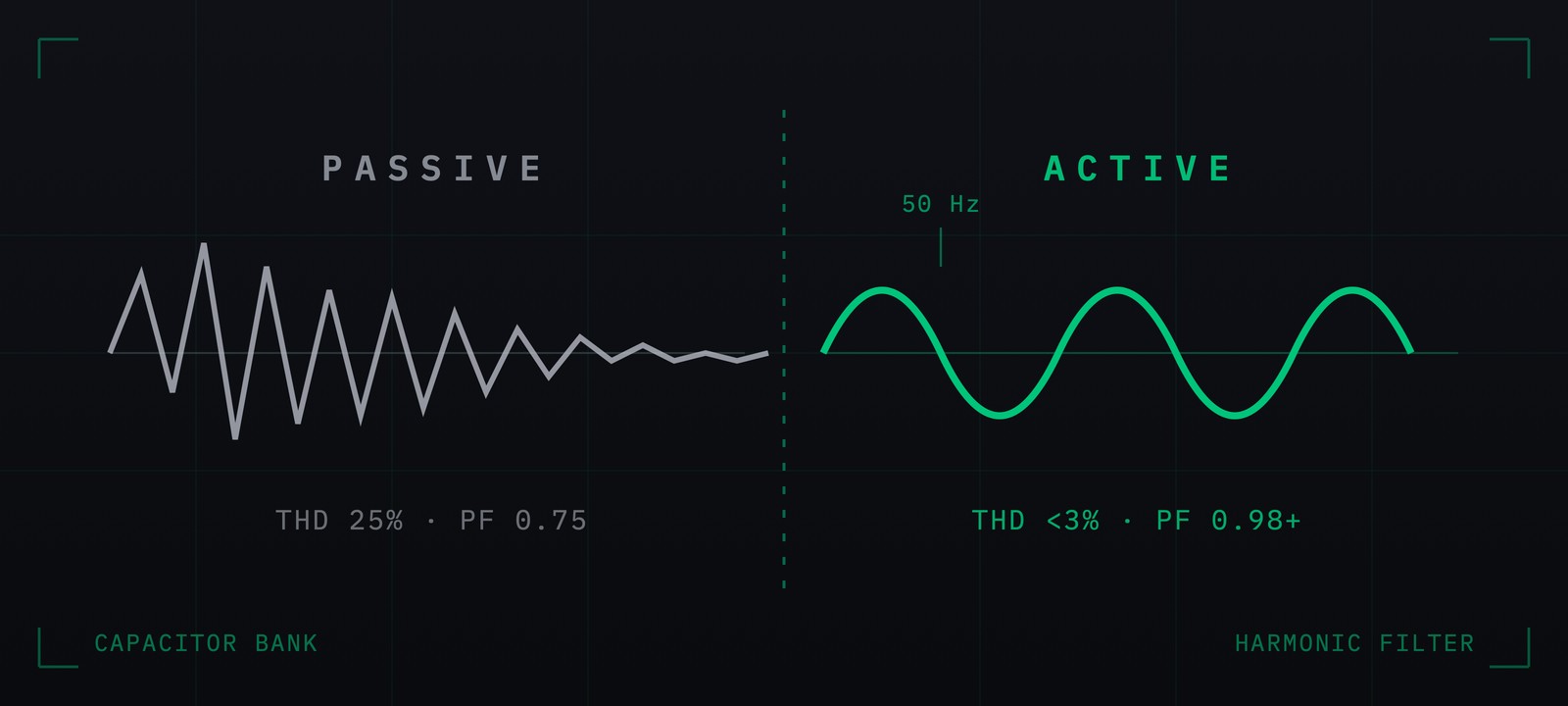
- Choose the right correction Capacitor banks are inexpensive and effective for steady reactive load, but they do nothing for harmonics, they respond slowly to changing loads, and they risk resonance on networks with non-linear loads. Active filters handle changing loads and harmonics, at a higher cost. Correction that combines reactive compensation, harmonic correction and phase balancing deals with more of the problem from one installation. Active vs passive power factor correction compares the approaches in plain English.
- Renegotiate capacity downwards Once power factor is corrected, peak kVA falls. In markets with subscribed or agreed capacity, France, Morocco, India and the UK among them, you can then lower the subscription and stop paying for capacity you no longer need. It is the step most often missed.
- Monitor continuously Power factor is not static. It drifts as loads change, equipment ages, schedules shift and new machinery arrives. Continuous monitoring, with alerts, keeps the correction effective and catches new sources of reactive demand before they start to cost money.
How HarmoniQ removes them
HarmoniQ corrects power factor to 0.98+, so reactive-power penalty charges fall away wherever the utility levies them, and the apparent power it frees lets a site lower its agreed capacity.
At the load
HarmoniQ Alpha
Fitted at each machine, it cleans the current where it is drawn, so every cable upstream carries less of it and runs cooler.
At the drives
HarmoniQ Delta
Fitted at the drives panel, it cleans the current where the drives distort it, before it spreads to the feeder, busbar and transformer.
At the incomer
HarmoniQ Sigma
At the main switchgear, it corrects reactive current where the network meets the grid, so the supply and the meter see cleaner current.
The Sigma at the incomer and the Alpha at the machines close the triangle in the figure above. Where drives add harmonic current, the Delta is needed as well for the true power factor to reach 0.98+. All three are shunt-connected, outside the main power path, so they install with zero operational disruption.
One step deserves emphasis. In markets with subscribed capacity, correcting power factor lowers peak kVA, which lets you lower the subscription itself. That is not a one-off saving but a recurring reduction in fixed charges, every month, for the life of the connection. A facility that corrects power factor but never renegotiates leaves part of the benefit on the table.
08The standards behind power measurement
Every penalty above rests on three things a meter records: kWh, a demand figure in kW or kVA, and kvarh. Two kinds of standard sit underneath them. One says how accurate a revenue meter has to be. The other says what the quantities mean, which matters more than it sounds once the current is distorted.
How utilities meter kWh, kVA and kvarh
- Active energy, kWh. A modern meter samples voltage and current many times a cycle and integrates their product. So kWh counts every watt the site draws, including the losses in its own cables and transformers downstream of the meter.
- Demand, kW or kVA. Demand is energy over a fixed interval, typically 15 or 30 minutes, half-hourly in the UK, and the bill takes the highest interval in the month. kW demand is the interval’s kWh divided by its length. kVA demand either combines the interval’s kWh and kvarh or multiplies RMS voltage by RMS current, depending on the meter, and the two methods agree only when voltage and current are clean and balanced.
- Reactive energy, kvarh. A reactive register integrates the power that oscillates between supply and load. Tariffs compare it with kWh over the period: the ratio kvarh ÷ kWh is tan φ, and the average power factor is kWh ÷ √(kWh² + kvarh²).
In North America, revenue meters are built and tested to ANSI C12.1, the Code for Electricity Metering, and its companion standards. In IEC jurisdictions the reference is the IEC 62053 series: IEC 62053-22 sets accuracy classes 0.2S and 0.5S for active energy, and IEC 62053-23 covers reactive energy, the measurement behind kvarh billing. Knowing your meter’s accuracy class matters if you ever want to verify, dispute or sub-meter your reactive energy.
IEEE 1459: what the quantities mean
IEEE 1459-2010, Standard Definitions for the Measurement of Electric Power Quantities Under Sinusoidal, Nonsinusoidal, Balanced, or Unbalanced Conditions, is the authoritative framework for splitting electrical power into its parts. On a clean sinusoid the familiar triangle is exact: S² = P² + Q². Once harmonic current flows, IEEE 1459 separates apparent power into a fundamental part, S1, made of P1 and Q1, which is the triangle the figure draws, and a non-fundamental part, SN, driven mostly by current distortion: S² = S1² + SN².
Two power factors follow. The displacement power factor, cos φ1 = P1 ÷ S1, is the triangle’s. The true power factor, P ÷ S, includes the distortion, and when voltage distortion is low it is close to cos φ1 ÷ √(1 + THD²), where THD is the current’s total harmonic distortion. A drive-heavy bus at a displacement power factor of 0.95 with 30% current THD has a true power factor of about 0.91.
Whether that difference reaches the bill depends on what the meter measures. A kVA demand computed from RMS voltage and current includes the harmonics; a kvarh register that counts only fundamental reactive energy does not. That is why two meters on the same supply can disagree, and why a site with harmonic loads can face more penalty exposure than its displacement power factor suggests.
09The bottom line
In most of the markets above, an industrial tariff carries some form of power factor penalty. It may be an explicit kvarh charge, a demand figure inflated by apparent power, an adjustment formula in the tariff schedule or a percentage surcharge on the whole bill. In complex tariffs it is often several of these at once.
The fix is neither novel nor speculative. Power factor correction is mature engineering with decades of field use, and its effect shows from the first full billing period after it is commissioned.
The barrier has never been technology. It has been visibility. A facility manager cannot fix a cost they cannot see, and the utility has no incentive to make it visible.
The first step is simply to read the bill through the right lens: find the components power factor inflates, add up the exposure across all of them, and set that against the cost of correction. For most facilities that pay these charges, the arithmetic is not close.
Sources
- UK Power Networks, Distribution Use of System Charging Methodology and Schedule of Charges 2024/25.
- Florida Power & Light (FPL), General Service Demand Rate Schedule GSD-1, effective January 2024.
- Consolidated Edison, Service Classification No. 9, General Large, P.S.C. No. 10, Electricity.
- Southern California Edison, Schedule TOU-8, Time-of-Use, General Service, Large.
- Comisión Federal de Electricidad (CFE), Tarifa HM, Servicio en Media Tensión con Demanda de 100 kW en adelante.
- Enedis, TURPE 6 HTA, Tarif d’Utilisation des Réseaux Publics d’Électricité, 2023.
- ARERA, Deliberazione 654/2015/R/eel, Disciplina dell’energia reattiva, Italy.
- Eskom Holdings SOC Ltd, Tariff & Charges Booklet 2024/25, South Africa.
- Hydro-Québec, Rate L, General Rate, Large-Power Customers, effective April 2024.
- TEPCO Energy Partner, High Voltage Power Supply Rate Schedule, Power Factor Adjustment.
- Tenaga Nasional Berhad (TNB), Tariff Schedule, Industrial Tariff, Malaysia.
- BC Hydro, Rate Schedule 1823, British Columbia.
- IEEE Std 1459-2010, Standard Definitions for the Measurement of Electric Power Quantities Under Sinusoidal, Nonsinusoidal, Balanced, or Unbalanced Conditions.
- IEC 62053-22 and IEC 62053-23, Electricity metering equipment, Particular requirements: static meters for active energy, and for reactive energy.
- ANSI C12.1, American National Standard for Electric Meters: Code for Electricity Metering.