In brief
- A meter measures only voltage and current. Everything on the bill, kW, kVA, power factor, THD and kWh, is calculated from them; thresholds, time bands and agreed capacity come from the tariff.
- kWh is a continuous integral, so a saving shows from the moment it starts. Demand is the highest average over a 15- or 30-minute interval, and sliding windows catch more of a short peak.
- Poor power factor, harmonics and imbalance all reach the bill: through kVA demand and reactive charges, and as losses the meter records as kWh. Temperature is never metered, but it raises them.
- An improvement shows in kWh at once and in full on the first complete billing period; under a demand ratchet, the demand charge can take up to 12 months to follow.
Every industrial electricity bill is the product of dozens of measurements, calculations and contractual mechanisms, most of them invisible to the person paying it. This report breaks down how a utility arrives at the kWh and kW figures on your invoice: which inputs come straight from the meter, which are calculated under IEEE and IEC standards, which come from the tariff, and how long a power quality improvement takes to reach your bottom line.
01The fundamental measurement: how meters calculate kWh
What the meter actually measures
At its core, a revenue-grade electricity meter measures only two physical quantities directly:
- Instantaneous voltage, V, sampled on each phase through a voltage transformer (VT, or PT) or a direct connection.
- Instantaneous current, I, sampled on each phase through a current transformer (CT).
Everything else, kW, kVA, kvar, power factor, THD and kWh, is calculated from these two raw inputs.
Modern digital meters use high-speed analogue-to-digital converters to sample the voltage and current waveforms many times in every cycle, thousands of times a second. That captures the full shape of each waveform, harmonic distortion included.
| Parameter | Source | Method |
|---|---|---|
| Voltage, V | Measured | VT or direct connection, sampled |
| Current, I | Measured | CT, sampled |
| Instantaneous power | Calculated | p(t) = v(t) × i(t), at every sample |
| Real power, kW | Calculated | The average of p(t) over each cycle, 20 ms at 50 Hz |
| RMS voltage and current | Calculated | The square root of the mean of the squared samples over a cycle |
| Apparent power, kVA | Calculated | Vrms × Irms |
| Reactive power, kvar | Calculated | From the fundamental voltage and current, or as √(kVA² − kW²), which also counts distortion |
| Power factor | Calculated | kW ÷ kVA: the true power factor, displacement and distortion together |
| THD | Calculated | Fourier analysis (FFT) of the sampled waveform, by the method of IEC 61000-4-7 |
| Energy, kWh | Calculated | ∫ kW · dt: real power integrated continuously over time |
| kW demand | Calculated | The average kW over each demand interval, 15 or 30 minutes |
The kWh calculation
kWh is the time integral of real power. The meter computes instantaneous power, p(t) = v(t) × i(t), at each sample, averages it over each cycle to give real power in kW, and accumulates the result over time:
kWh = ∫₀ᵀ P(t) dt
Here P(t) is the real power at time t, and T is the billing period. The meter performs this integration continuously, adding to the kWh register in real time. Because it samples the whole waveform, distortion included, the kWh figure captures all the real power delivered, fundamental and harmonic.
The pointkWh is a direct, continuous measurement. It reflects the energy consumed in real time, with no averaging window, no delay and no ratchet.
If losses fall at 2:00 pm, the meter registers fewer kWh from 2:00 pm onward. That is fundamentally different from kW demand, as the next section shows.
02kW demand: the running average and why it matters
How kW demand is measured
kW demand is an average over a fixed interval. The meter divides time into demand intervals and calculates the average kW drawn in each one. The highest average recorded in a billing period becomes the maximum demand, the figure the demand charge is billed on.
Standard demand intervals
| Region | Usual interval | Set by | Notes |
|---|---|---|---|
| North America | 15 minutes | Utility tariffs | Some utilities use 30 minutes |
| Great Britain | 30 minutes | The Balancing and Settlement Code | Half-hourly settlement for larger sites, profile classes 05 to 08, under BSC modification P272 |
| Continental Europe | 15 minutes | Tariffs and market rules | Interval metering for larger consumers |
| Australia and New Zealand | 30 minutes | Network tariffs | Usual for network demand charges |
| Middle East and Asia | 15 or 30 minutes | Utility tariffs | Varies by utility |
The 15-minute interval is the most widely used, and the norm in North America, where each utility’s tariff sets it. In Great Britain, the settlement period is half an hour.
Block interval or sliding window
Meters compute demand in one of two ways.
Method A
Block interval demand
Time is divided into fixed, non-overlapping blocks, every 15 minutes on the clock: 00:00, 00:15, 00:30 and so on. The meter averages each block on its own and resets at the end of it. It is the simpler method, and the more common.
Method B
Sliding window demand
The interval is divided into sub-intervals, such as a 15-minute window moving in 5-minute steps. After each step the window drops its oldest sub-interval and adds the newest, which smooths the profile and catches peaks that straddle block boundaries.
With block metering, a 10-minute spike that straddles two 15-minute blocks is split across both and looks smaller. A sliding window catches it whole. For the same load, sliding-window demand is never lower than block demand, and usually higher, which means a higher demand charge.
Worked exampleA site running at 400 kW takes a 10-minute spike to 1,000 kW, from 00:10 to 00:20. Block metering splits it: each block averages (10 × 400 + 5 × 1,000) ÷ 15 = 600 kW. A 15-minute window sliding in 5-minute steps catches 00:05 to 00:20 whole: (5 × 400 + 10 × 1,000) ÷ 15 = 800 kW.
03Power factor: how it inflates your bill
What the meter calculates
The meter calculates power factor from its voltage and current measurements:
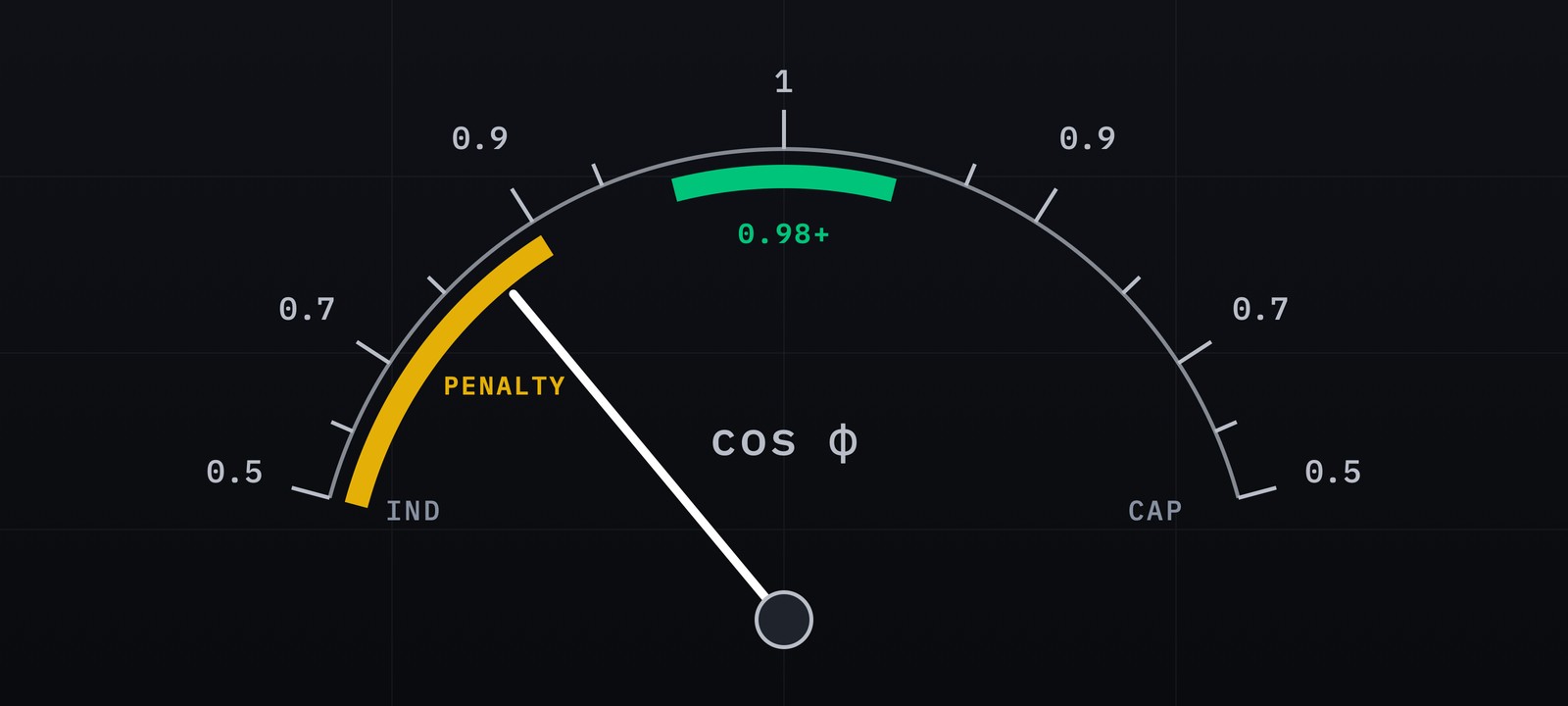
PF = kW ÷ kVA, real power divided by apparent power.
With clean, sinusoidal voltage and current, PF = cos φ, where φ is the phase angle between them. Once harmonics are present, IEEE 1459 defines the true power factor, which counts both displacement and distortion:
PFtrue = PFdisplacement × PFdistortion
Power factor is not a separate sensor. The meter calculates it from voltage and current, following the definitions in IEEE 1459, which covers sinusoidal, non-sinusoidal, balanced and unbalanced conditions.
How power factor affects billing
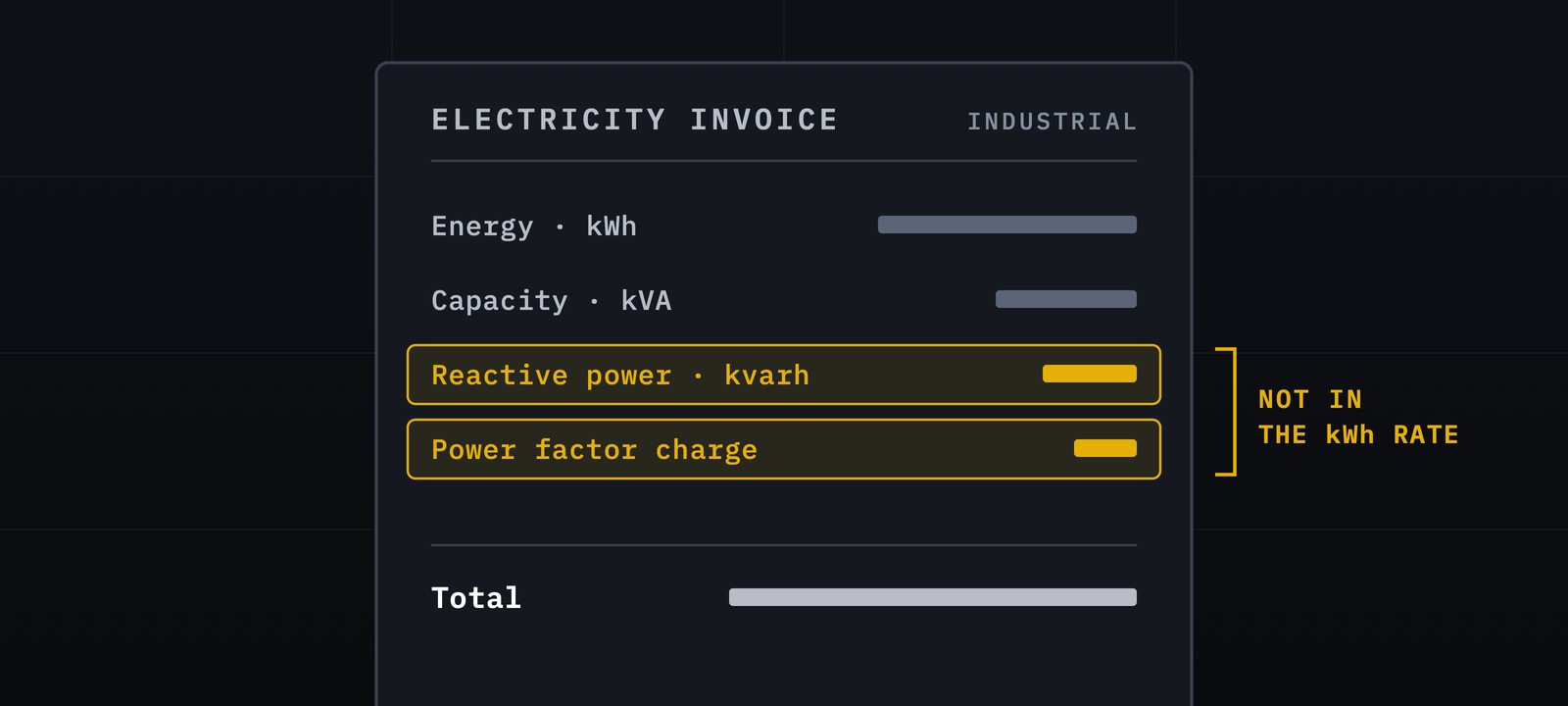
Utilities penalise poor power factor through one or more of four mechanisms:
| Mechanism | How it works | Common in |
|---|---|---|
| kVA demand billing | Demand is billed in kVA instead of kW. Since kVA = kW ÷ PF, a power factor of 0.80 inflates billed demand by 25% | The UK, Australia and parts of Asia |
| Reactive power charge | A charge per kvarh above a threshold, typically a power factor of 0.95 or 0.90 | The UK, through DUoS, and much of the EU |
| Power factor surcharge | A percentage surcharge on the whole bill below a threshold such as 0.90, in some tariffs escalating as power factor falls further | Mexico, British Columbia, Malaysia and Colombia |
| Power factor multiplier | Demand is multiplied by target ÷ actual power factor: at 0.80 against a 0.95 target, 0.95 ÷ 0.80 = 1.1875 | Parts of the US, and Japan |
Power factor is calculated from measured data, not measured directly. The threshold at which penalties apply, 0.90 or 0.95 for example, is a contractual parameter from the utility’s rate schedule, not a measurement. IEEE 1459 defines how the power factor itself should be calculated, especially when harmonics are present.
04Harmonic distortion: the hidden energy tax
What the meter measures
The meter computes total harmonic distortion (THD) by running a fast Fourier transform (FFT) on the sampled voltage and current, splitting each waveform into its fundamental and its harmonics. The standard definition, used by IEEE 519-2022, is:
THD = √(Σ Ih²) ÷ I1 × 100%, where Ih is the RMS current of the h-th harmonic and I1 that of the fundamental. Harmonics up to the 50th order are usually included, following IEEE 519 and IEC 61000-4-7.
THD is calculated by the meter from its samples. The limits that define acceptable distortion come from IEEE 519-2022, the standard for harmonic control in electric power systems.
How harmonics affect kWh
Harmonics raise kWh through several mechanisms, all of them real losses the meter records:
- More I²R loss in conductors. Harmonic currents flow in the same conductors as the fundamental and add to the total RMS current, and resistive loss rises with its square. The meter sees it as real power consumed.
- Eddy-current loss in transformer windings. It rises with the square of the harmonic order: per unit of current, the 5th harmonic, at 250 Hz on a 50 Hz system, causes 25 times the eddy-current loss of the fundamental (IEEE C57.110).
- Skin effect. At higher frequencies, current crowds towards the surface of a conductor, raising its effective resistance, most of all in large conductors.
- Neutral loading. Triplen harmonics, the 3rd, 9th, 15th and so on, add together in the neutral instead of cancelling, and can push the neutral current above the phase current.
| ISC/IL | h < 11 | 11 ≤ h < 17 | 17 ≤ h < 23 | 23 ≤ h < 35 | 35 ≤ h ≤ 50 | TDD |
|---|---|---|---|---|---|---|
| < 20 | 4.0 | 2.0 | 1.5 | 0.6 | 0.3 | 5.0 |
| 20–50 | 7.0 | 3.5 | 2.5 | 1.0 | 0.5 | 8.0 |
| 50–100 | 10.0 | 4.5 | 4.0 | 1.5 | 0.7 | 12.0 |
| 100–1000 | 12.0 | 5.5 | 5.0 | 2.0 | 1.0 | 15.0 |
| > 1000 | 15.0 | 7.0 | 6.0 | 2.5 | 1.4 | 20.0 |
IEEE 519 limits apply at the point of common coupling (PCC), usually the metering point between the utility and the customer. They are limits set by the standard, not meter readings: the meter measures the distortion, and the standard defines what is acceptable.
05Voltage imbalance between phases
What the meter measures
The meter measures the voltage on each of the three phases independently. Voltage imbalance, or unbalance, is then calculated in one of two standard ways:
| Standard | Definition | Limit |
|---|---|---|
| NEMA MG 1 and ANSI C84.1 | The largest deviation from the average of the three line voltages, as a percentage of that average | 3% at the revenue meter, at no load (ANSI C84.1); motors derated above 1% (NEMA MG 1) |
| IEC 61000-4-30 and EN 50160 | Negative-sequence voltage as a percentage of positive-sequence voltage: true symmetrical components | 2%, for 95% of the 10-minute values over a week (EN 50160) |
The voltage on each phase is measured directly, and the imbalance is calculated from it. The IEC method, symmetrical components, is the more rigorous, and the one IEC 61000-4-30 specifies for Class A power quality instruments.
How voltage imbalance affects your bill
Voltage imbalance rarely appears as a line on the bill, but its effects are captured in the kWh and kW readings:
- Negative-sequence current in motors. A small voltage imbalance drives a current imbalance several times larger, and the extra current raises the I²R loss in the windings. That loss is real energy, consumed and metered.
- Motor derating. NEMA MG 1 says a motor on a supply more than 1% unbalanced should be derated, run below its rating, to stay within its temperature limits. At 3%, the derating is about 10%.
- Higher maximum demand. The extra losses add to the kW drawn in every demand interval, so they raise the demand reading too.
So the phase voltages are measured, the imbalance is calculated by the meter or a power quality analyser, and the acceptable limits and derating factors come from the standards, not from the meter.
06Temperature: the off-meter variable
What the meter does not measure
Unlike every parameter above, temperature is not measured by the electricity meter. Yet it is one of the most significant factors in how much energy a facility actually uses, and therefore in what the meter registers.
How temperature affects your kWh
| Effect | Mechanism | Standard |
|---|---|---|
| Conductor resistance | Copper’s resistance rises about 0.39% per °C above 20 °C, so a 40 °C rise adds about 15.6%, and I²R losses rise with it | IEC 60228 |
| Transformer losses | Load losses rise with winding temperature, and by the Arrhenius rule insulation life halves for every 10 °C above rated temperature | IEEE C57.91 |
| Motor efficiency | Winding resistance rises with temperature, so a hotter motor turns more of its input into heat | NEMA MG 1, IEC 60034 |
| Cooling load | Higher ambient temperatures lengthen HVAC and refrigeration compressor run times, adding kWh directly | ASHRAE 90.1 |
The pointTemperature is entirely off-meter. The utility does not measure it, and no standard requires it to, yet it is a root cause of higher losses in conductors, transformers and motors, and the meter captures those losses as kWh.
That is why the Arrhenius rule matters: every 10 °C reduction in operating temperature halves the rate of insulation ageing, and cuts resistive losses too. Our article on the Arrhenius rule sets out the full analysis.
07Other key inputs and billing variables
Frequency
Measured directly, from the zero crossings of the voltage waveform. Grid frequency is tightly regulated, at 50 Hz in the UK and Europe and 60 Hz in North America, and rarely moves enough to affect billing, but the meter uses it to synchronise its sampling and its FFT.
Maximum Import Capacity
A contractual parameter, not a measurement: the maximum demand, in kVA or kW, that the distribution network operator (DNO) has agreed to supply. If measured maximum demand exceeds it, an excess capacity charge is levied. It is purely a tariff mechanism.
Time-of-use periods
The meter’s clock assigns each kWh and kW reading to a time-of-use band, such as peak, off-peak or shoulder. The bands are programmed into the meter from the tariff schedule: contractual, not measured, though they set the rate applied to each unit.
DUoS time bands
In the UK, Distribution Use of System charges vary by time band: red, amber and green. The meter records consumption in each band, and the network operator’s published tariff sets the charges. They are derived from the tariff, not from a measurement.
08Measured or standard-derived: the complete picture
Exhibit 7 brings every input together: what the meter measures, what it calculates and under which standard, and what comes from the tariff or the contract.
| Input | Category | Standard or source |
|---|---|---|
| Voltage, each phase | Measured | ANSI C12.1, IEC 62052-11 |
| Current, each phase | Measured | ANSI C12.1, IEC 62052-11 |
| Frequency | Measured | IEC 61000-4-30 |
| Real power, kW | Calculated, from V × I | IEEE 1459 |
| Apparent power, kVA | Calculated, Vrms × Irms | IEEE 1459 |
| Reactive power, kvar | Calculated, from the fundamental or from kVA and kW | IEEE 1459 |
| Power factor | Calculated, kW ÷ kVA | IEEE 1459 |
| THD, current and voltage | Calculated, by FFT | IEC 61000-4-7, IEEE 519 |
| Voltage imbalance | Calculated, from the phase voltages | IEC 61000-4-30, NEMA MG 1 |
| Energy, kWh | Calculated, ∫ kW · dt | ANSI C12.1, IEC 62053 |
| Maximum kW demand | Calculated, an interval average | The utility tariff: 15 minutes in North America, 30 in Great Britain |
| Temperature | Not measured by the meter | IEEE C57.91, NEMA MG 1 |
| Power factor penalty threshold | Tariff or contract | The utility’s rate schedule |
| Time-of-use bands | Tariff, programmed into the meter | The utility’s rate schedule |
| Maximum Import Capacity | Contract | The connection agreement with the network operator |
| Demand ratchet percentage | Tariff or contract | The utility’s rate schedule |
09How long power quality improvements take to reach the bill
This is the critical question. The answer depends on which part of the bill you are looking at, because each has a fundamentally different time lag.
- kWh: fewer from the moment power quality improves
- Immediate
- The first demand interval to record a lower average
- 15–30 min
- The first full billing period: every charge but a ratcheted demand
- 1 month
- The longest a demand ratchet can hold billed demand up
- 12 months
kWh, energy consumption
Immediate. kWh is a continuous integral, so the moment power quality improves, whether through better power factor, lower harmonic distortion or better-balanced phases, the meter registers fewer kWh from that instant on. There is no lag. The next bill reflects the lower consumption for whatever part of the month the improvement was running.
kW demand, within the current billing period
One demand interval, 15 to 30 minutes. After the improvement is switched on, the very next interval records a lower average. But the maximum demand for that billing period is already set by the highest interval before it, so the full demand benefit arrives in the first full billing period afterwards, usually the following calendar month.
Worked exampleIf a site’s peak demand of 800 kW fell on day 3, and a correction system is installed on day 15, its billed demand for that month stays at 800 kW.
kW demand, under a ratchet clause
This is where the lag becomes significant. Many commercial and industrial tariffs include a demand ratchet: a clause that sets the minimum billable demand at a percentage of the highest peak in the previous 11 or 12 months.
Worked exampleOn an 80% ratchet, a site whose demand once peaked at 800 kW is billed for at least 640 kW in each of the following 11 months, whatever it actually draws, until that peak drops out of the window.
Exhibit 8 sets out the lag for each part of the bill.
| Billing component | First impact | Full benefit | Why |
|---|---|---|---|
| Energy, kWh | Immediate | The first full billing period | Continuous integration, with no averaging |
| Demand, no ratchet | 15–30 minutes | The first full billing period | Maximum demand resets each period |
| Demand, with a ratchet | 15–30 minutes | Up to 12 months | An 80% ratchet on the trailing 11-month peak, for example |
| Power factor penalty or surcharge | Immediate | The first full billing period | Power factor is calculated over each billing period |
| Reactive power charge, kvarh | Immediate | The first full billing period | Integrated continuously, like kWh |
| Excess capacity charge | 15–30 minutes | The first full billing period | Maximum demand set against the agreed capacity |
The kWh benefit is immediate. The kW benefit can take up to twelve months to arrive in full, and many facility managers don’t realise their demand ratchet is the reason.
The complete timeline
For a facility whose power factor is corrected to 0.98+, with its harmonic distortion and phase imbalance reduced, the benefits arrive in this order:
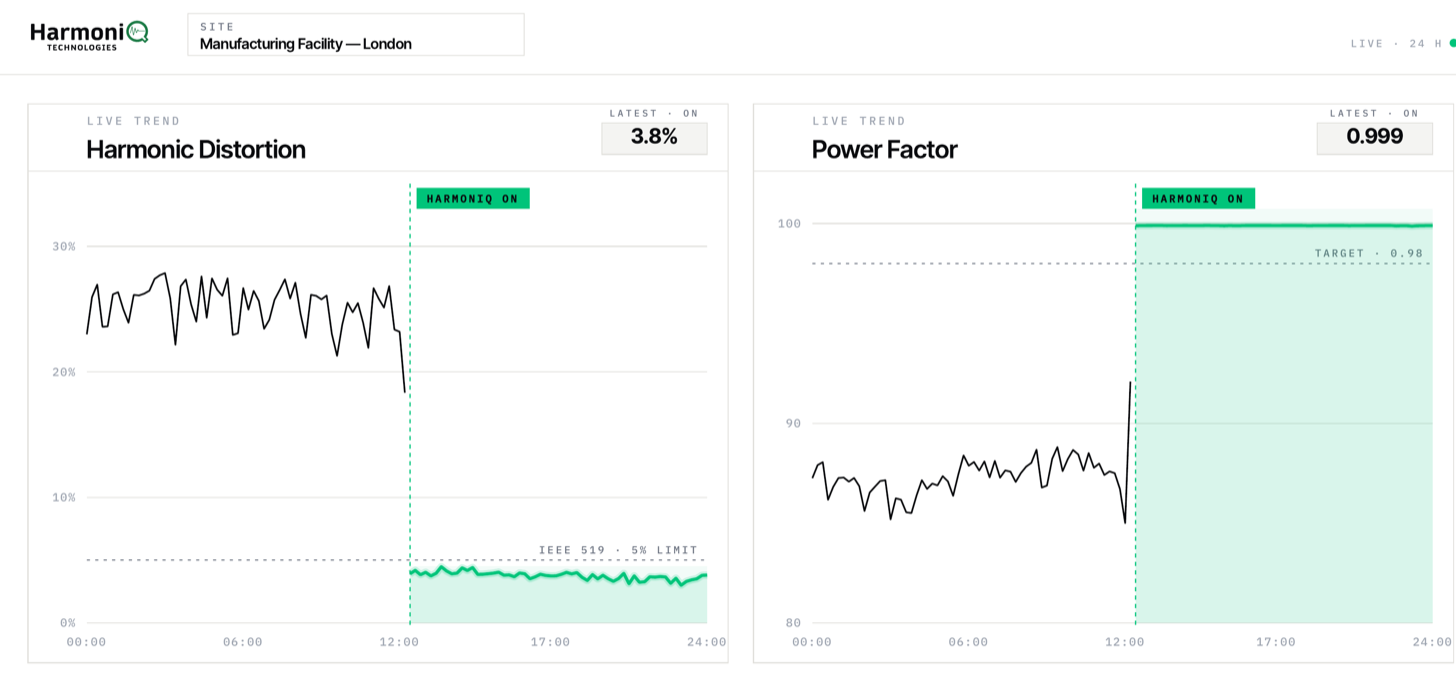
- At once kWh savings begin immediately. The next demand interval, 15 or 30 minutes, records a lower average, and the power factor the meter calculates rises to 0.98+.
- The first bill The kWh saving shows for the part of the month since the improvement, and power factor and reactive charges fall. Maximum demand may still reflect the old peak, if it came earlier in the period.
- The first full billing period The first period that runs entirely at the improved power quality. kWh, kW demand, power factor and reactive charges all reflect it in full, and power factor penalties fall away, unless a demand ratchet applies.
- Month 12, under a ratchet The ratchet lifts once the old peak has dropped out of the trailing 11-month window. From then on, billed demand follows the improved demand, with no floor.
With HarmoniQ
HarmoniQ’s performance guarantee is written against kWh at the meter: the one line on the bill that responds the moment the current is cleaned, with no averaging window, no ratchet and no tariff in between.
At the load
HarmoniQ Alpha
Fitted at each machine, it cleans the current where it is drawn, so every cable upstream carries less of it and runs cooler.
At the drives
HarmoniQ Delta
Fitted at the drives panel, it cleans the current where the drives distort it, before it spreads to the feeder, busbar and transformer.
At the incomer
HarmoniQ Sigma
At the main switchgear, it corrects reactive current where the network meets the grid, so the supply and the meter see cleaner current.
A site typically uses 10–20% fewer kWh for the same output, and because kWh is a continuous integral, the difference shows at the meter within minutes, which is what makes the on/off test possible. Power factor corrected to 0.98+ removes reactive-power penalties from the first full billing period. Capacity charges come down as the site lowers its agreed capacity, though a demand ratchet can hold billed demand up for as long as a year. Where all three lines apply, up to 25% comes off the total bill. All three units are shunt-connected, outside the main power path, so they install with zero disruption.
Sources and further reading
- ANSI C12.1, American National Standard for Electric Meters: Code for Electricity Metering: performance criteria for revenue meters, including demand measurement.
- IEEE Std 1459, Standard Definitions for the Measurement of Electric Power Quantities Under Sinusoidal, Nonsinusoidal, Balanced, or Unbalanced Conditions.
- IEEE Std 519-2022, IEEE Standard for Harmonic Control in Electric Power Systems: current distortion limits at the point of common coupling.
- IEEE Std C57.110, Recommended Practice for Establishing Liquid-Immersed and Dry-Type Power Transformer Capability When Supplying Nonsinusoidal Load Currents.
- IEEE Std C57.91, Guide for Loading Mineral-Oil-Immersed Transformers and Step-Voltage Regulators, including the Arrhenius thermal life model.
- IEC 61000-4-30, Testing and measurement techniques: Power quality measurement methods, Class A and Class S, including voltage unbalance.
- IEC 61000-4-7, General guide on harmonics and interharmonics measurements and instrumentation.
- IEC 62052-11 and the IEC 62053 series, Electricity metering equipment: general requirements, tests and test conditions, and particular requirements.
- EN 50160, Voltage characteristics of electricity supplied by public electricity networks.
- ANSI C84.1, Electric Power Systems and Equipment: Voltage Ratings (60 Hz).
- NEMA MG 1, Motors and Generators, section 14.36: derating for voltage unbalance.
- IEC 60034, Rotating electrical machines.
- IEC 60228, Conductors of insulated cables.
- Balancing and Settlement Code Modification P272, Mandatory Half-Hourly Settlement for Profile Classes 05–08, approved by Ofgem.
- ASHRAE Standard 90.1, energy standard for buildings, for cooling loads.