In brief
- Harmonics are currents at whole multiples of the 50 or 60 Hz supply, drawn by drives, UPS systems, LED drivers and other electronics. No meter flags them.
- They barely raise the RMS current, but their losses rise with frequency: a 5th-harmonic current makes 25 times the winding eddy loss of the same current at the fundamental.
- IEEE 519 limits them at the connection, IEC 61000 at the equipment, and IEEE C57.110 sets how far a transformer must be derated: in the worked example, to 900 kVA of 1,000.
- Measure first, with a Class A analyser for at least a week, then correct close to where the harmonics are made.
In a pre-electronic industrial facility, electricity was simple. Motors drew smooth sinusoidal current at 50 or 60 Hz, transformers saw a clean waveform, and the utility meter counted kilowatt-hours. A century of power-engineering practice was built on that assumption.
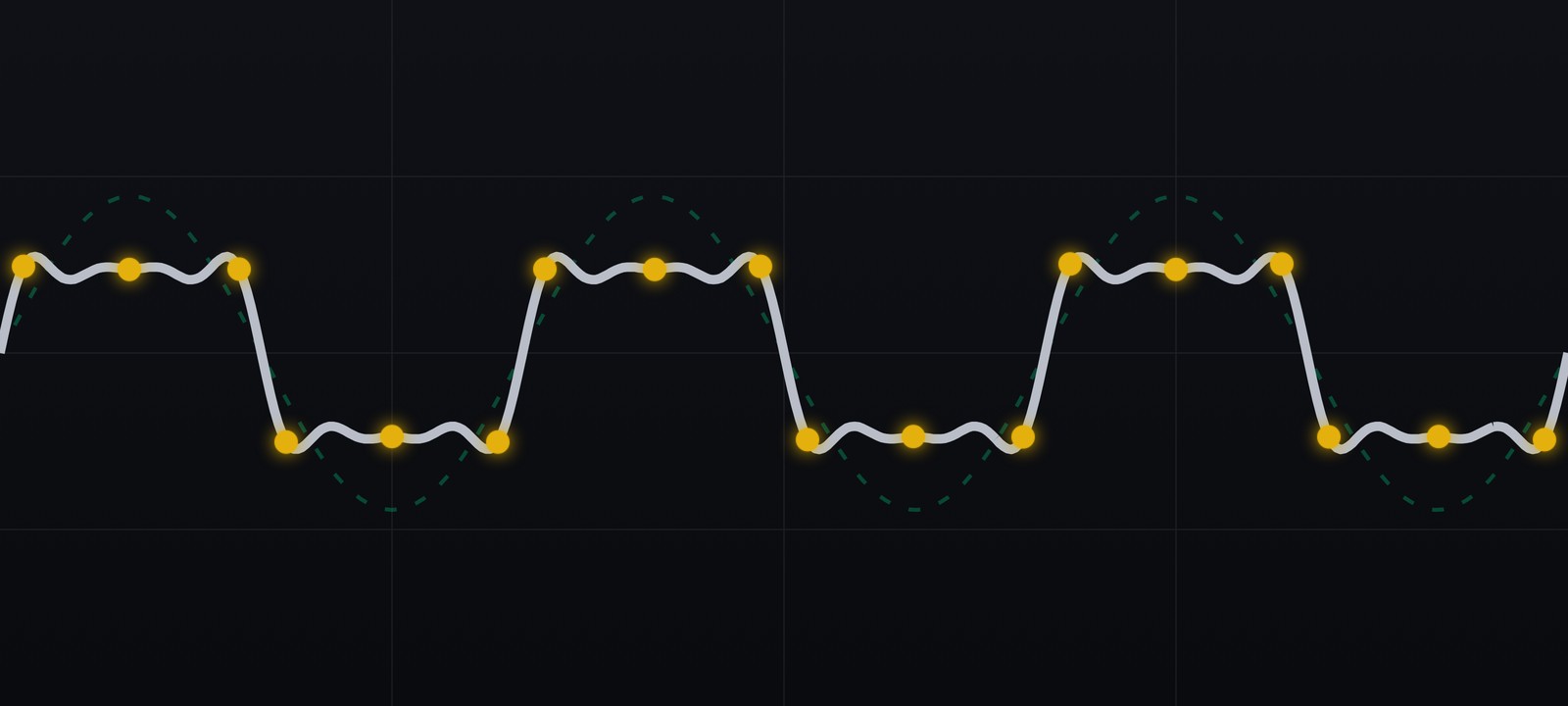
Modern facilities are different. Variable-speed drives, UPS systems, server power supplies, LED drivers, induction heaters, welding sets, EV chargers and PV inverters all draw or deliver current that is not a smooth sinusoid. Across a facility the result is a distorted current waveform: the fundamental at 50 or 60 Hz, plus a series of harmonics at whole multiples of it, 150, 250, 350, 550 Hz and higher.
No meter flags these currents and no line on the bill names them. A technician with a multimeter at the panel sees a current reading that looks normal, and the operator has no reason to suspect anything is wrong. Yet the harmonics are heating transformers, overheating motor windings, overloading capacitor banks and upsetting sensitive electronics, and all of that heat is electricity the site pays for.
This article explains what harmonics are, where they come from, why they are worse than they look, and what the internationally recognised standards, IEEE 519, the IEC 61000 series and IEEE C57.110, say about them.
01What harmonics actually are
Any periodic waveform, however complex or distorted, can be written as a sum of pure sine waves at whole multiples of a fundamental frequency. That is Fourier's theorem, and it is the whole basis of harmonic analysis. On a 50 Hz system the fundamental is 50 Hz and the harmonics sit at its multiples: the 3rd at 150 Hz, the 5th at 250 Hz, the 7th at 350 Hz, and so on, up to the 50th or beyond in some industrial spectra.
| Order | At 50 Hz | At 60 Hz | Sequence | Typical source |
|---|---|---|---|---|
| 3rd | 150 Hz | 180 Hz | Zero: adds in the neutral | Single-phase electronics: LED drivers, switch-mode supplies |
| 5th | 250 Hz | 300 Hz | Negative: turns against a motor | Six-pulse drives and rectifiers |
| 7th | 350 Hz | 420 Hz | Positive | Six-pulse drives and rectifiers |
| 9th | 450 Hz | 540 Hz | Zero: adds in the neutral | Single-phase electronics |
| 11th | 550 Hz | 660 Hz | Negative: turns against a motor | Six- and twelve-pulse converters |
| 13th | 650 Hz | 780 Hz | Positive | Six- and twelve-pulse converters |
On a clean supply, a purely resistive, linear load draws current at the fundamental only: its harmonic content is zero. A non-linear load draws current rich in harmonics. The current on a facility's main bus is the fundamental plus every harmonic current injected by every non-linear load downstream.
The industry measures distortion as total harmonic distortion, THD: the RMS of all the harmonic content divided by the fundamental. For current, THD = √(I₂² + I₃² + I₄² + …) ÷ I₁.
The pointTHD rises with the share of the load that is electronic: lowest on a site of direct-on-line induction motors, higher on a modern mixed site with HVAC drives and LED lighting, highest in drive-heavy process plants. The only figure that counts is the one measured at your own bus.
Add a 5th and a 7th harmonic below, the two largest in a six-pulse drive’s current, and watch the wave bend as THD climbs. The other two readouts look ahead to section 03: the RMS current barely moves, while the eddy loss in a transformer winding climbs far faster.
Current THD
23.3%
√(h5² + h7²): the harmonics’ RMS over the fundamental’s
RMS current
1.03×
√(1 + THD²): what a true-RMS meter reads, against the fundamental alone
Winding eddy loss
2.6×
IEEE C57.110’s harmonic loss factor: against the same RMS current at the fundamental
A 5th at 20% and a 7th at 12% of the fundamental give a current THD of 23.3%. The RMS current rises only 3%, but a transformer winding’s eddy loss is 2.6 times what the same RMS current would cause at the fundamental.
02Where harmonics come from
Any load that does not draw current in proportion to the voltage applied to it is non-linear, and a source of harmonics. The dominant sources in a modern industrial facility are these.
Variable-speed drives
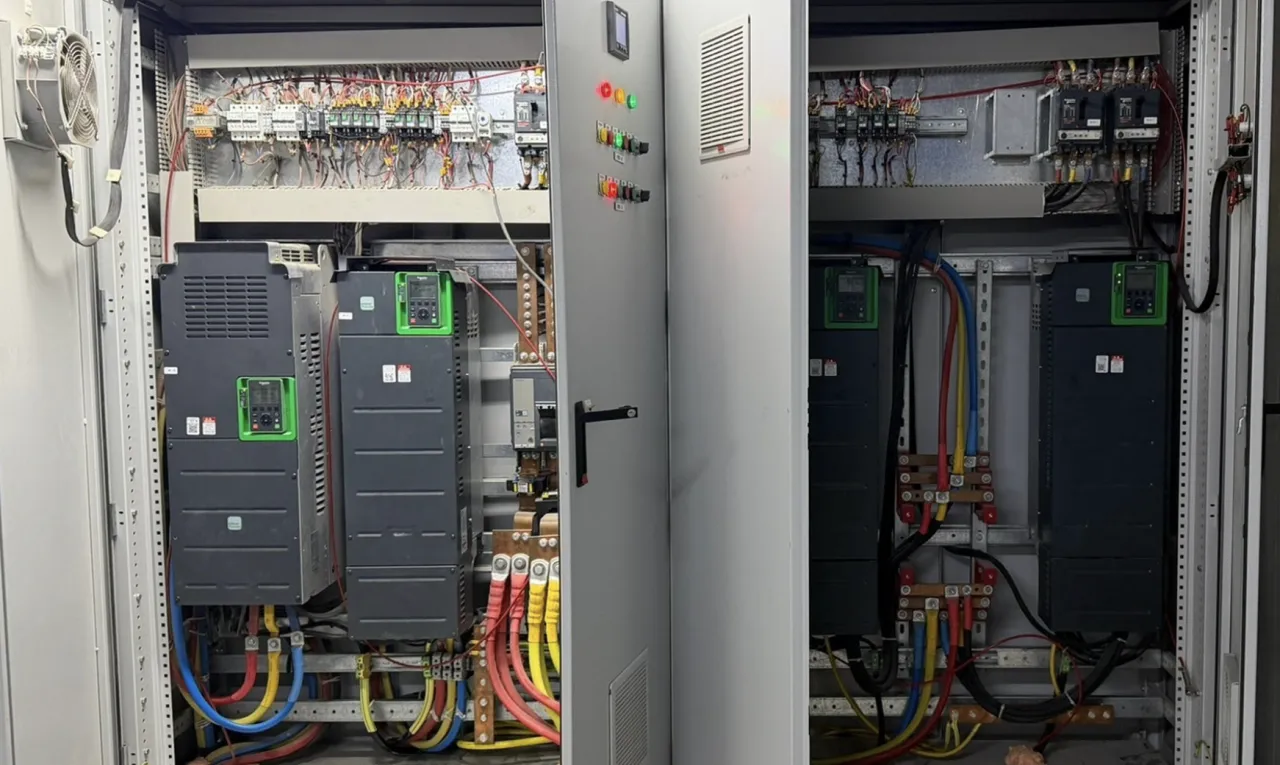
The largest single source of harmonic current in industry. The six-pulse diode rectifier at the front of a drive draws current in narrow pulses near the voltage peaks, producing a spectrum dominated by the 5th, 7th, 11th and 13th. How much distortion depends on the front end: a bare six-pulse bridge is the worst, line reactors and DC chokes cut it substantially, and twelve-pulse and active-front-end designs cut it much further, at a higher price and on far fewer installed drives. VSDs: The Harmonic Source Hiding in Every Modern Plant steps a drive through the whole ladder.
Source
UPS systems and rectifiers
UPS systems, battery chargers and DC power supplies all begin with a rectifier. Older UPS topologies are heavy harmonic sources; modern double-conversion units with active power-factor correction draw a near-sinusoidal current.
Source
Switch-mode power supplies
Every computer, server, LED driver and electronic ballast uses one. Individually they are small. In aggregate, across a large office or commercial building, they are prolific harmonic producers, particularly at the 3rd, 5th and 7th.
Source
Welding, induction heating and arc furnaces
High-power, rapidly switching loads in heavy industry. Arc furnaces in particular produce a time-varying, wideband spectrum that is hard to characterise and harder to filter.
Source
PV inverters
Photovoltaic inverters distort more as their output falls. The partial-load problem is acute: as irradiance drops, current distortion rises sharply.
03Why harmonics are worse than they look
The common misconception is that a current with 20% THD is only 20% worse than a clean sinusoid. Its RMS value is in fact barely 2% above the fundamental, √(1 + 0.2²) = 1.02, and yet the damage is far greater, because the losses harmonics cause depend on frequency as well as on current.
Harmonics barely move the RMS current. The losses they cause rise with frequency, so they cost far more than their share of the current suggests.
Eddy-current losses
Alternating magnetic fields induce circulating eddy currents in conductors and laminations, and eddy currents make heat. In a transformer winding, IEEE C57.110 models the eddy-current loss from each harmonic as proportional to the square of its current and the square of its order. A 5th-harmonic current produces 5² = 25 times the winding eddy loss of the same current at the fundamental, and a 7th 49 times. The standard rolls this up into a single harmonic loss factor for a load, worked through in section 05.
Skin effect
Alternating current crowds towards the surface of a conductor, and the effect strengthens with frequency. The skin depth in copper shrinks with the square root of frequency, from about 9 mm at 50 Hz to about 4 mm at 250 Hz, so in large cables and busbars the 5th harmonic flows through a thinner skin and meets a higher resistance than the fundamental. Over a facility's cable runs, that adds I²R loss that grows with the harmonic content.
Proximity effect
Where conductors run close together, each one's alternating field pushes the current in its neighbours to one side, raising their effective resistance further. Proximity effect also strengthens with frequency.
Negative-sequence rotor heating
In a three-phase system, some harmonic orders rotate backwards relative to the fundamental: the 5th, 11th, 17th and so on are negative-sequence. In a motor's stator they set up a field turning against the rotor, which brakes it and heats it. The rotor sees that field at a high frequency, where the resistance of its bars is far above its DC value, so the heat is out of all proportion to the current.
Triplen harmonics in the neutral
The 3rd, 9th, 15th and other multiples of three are zero-sequence. On a balanced three-phase system the fundamental currents cancel in the neutral; the triplens do not. They arrive in step and add, so the neutral carries three times each phase's triplen current. In an LED-heavy or SMPS-heavy building the neutral can carry more RMS current than any phase, a condition most buildings are not wired for, and the result is overheating and insulation damage.
In most industrial plants these effects do not act alone. They compound, in transformers, cables, motors and capacitors at once, before counting nuisance trips and malfunctions.
- The RMS current at 20% THD: barely above the fundamental
- 1.02×
- Winding eddy loss from a 5th-harmonic current, against the fundamental
- 25×
- The same from a 7th
- 49×
- Each phase’s triplen current, added together in the neutral
- 3×
04What harmonics cost
The financial impact arrives through six distinct mechanisms:
Cost 1
Transformer derating
A transformer feeding non-linear load runs hotter than its nameplate assumes, because of the extra winding eddy-current loss, and IEEE C57.110 sets out how far it must be derated to stay within its limits. In the worked example below, a 1,000 kVA transformer is good for about 900 kVA of a drive-dominated load: capacity paid for, and unavailable.
Cost 2
Cable and conductor overheating
Extra I²R loss, raised further by skin and proximity effect, lifts conductor temperatures and ages their insulation.
Cost 3
Motor insulation degradation
Harmonic heating raises winding temperature, and by the Arrhenius rule behind IEEE 117 and IEC 60085, every 10 °C of extra temperature roughly halves insulation life. The IEEE Arrhenius Rule works it through.
Cost 4
Capacitor bank failures
A capacitor's impedance falls as frequency rises, so harmonic currents flow into capacitor banks by preference. The banks overheat, lose capacity and eventually fail, faster still if the bank and the network's inductance resonate near a harmonic and amplify it. Why Capacitor Banks Don't Solve the Full Problem covers the rest.
Cost 5
Sensitive equipment malfunction
PLCs, CNC controllers, medical imaging and laboratory equipment can drop inputs, corrupt data or trip their protection as voltage distortion climbs.
Cost 6
True power factor degradation
Harmonic currents lower true power factor even when the displacement power factor looks healthy, because true power factor is the displacement power factor multiplied by 1 ÷ √(1 + THD²). At a displacement power factor of 0.95 and 30% current THD, true power factor is 0.91. Where a tariff bills apparent power or true power factor, the difference reaches the bill: Power Factor Penalties explains how.
05The standards that govern harmonics
Five internationally recognised standards define the limits, the measurement methods and the equipment tolerances for harmonics in industrial power networks.
IEEE 519-2022
IEEE Standard for Harmonic Control in Electric Power Systems. The reference for harmonic limits at the point of common coupling, the PCC: the boundary between the utility's network and the facility. It sets two kinds of limit. Voltage distortion is capped at 8% THD at 1 kV and below, and 5% from 1 kV to 69 kV, with 5% and 3% for any single harmonic. Current distortion is capped as total demand distortion, TDD: the harmonic current as a share of the site's maximum demand current, rather than of whatever fundamental happens to be flowing. The current limit scales with the short-circuit ratio at the PCC, ISC ÷ IL, because a stiff supply turns less harmonic current into voltage distortion.
| Short-circuit ratio | Each odd harmonic, 3rd to 9th | Each odd harmonic, 11th to 15th | TDD |
|---|---|---|---|
| Below 20 | 4.0% | 2.0% | 5.0% |
| 20 to 50 | 7.0% | 3.5% | 8.0% |
| 50 to 100 | 10.0% | 4.5% | 12.0% |
| 100 to 1,000 | 12.0% | 5.5% | 15.0% |
| Above 1,000 | 15.0% | 7.0% | 20.0% |
The current limits fall on the site, and the voltage limits on the utility, whose supply impedance turns the site's harmonic currents into voltage distortion. Compliance is judged statistically, against percentiles of a week or more of measurements, not against a single reading, and where a utility writes IEEE 519 into a connection agreement it becomes a contractual obligation.
The pointOne boundary matters as much as the numbers: the limits apply at the point of common coupling, and say nothing about the distortion inside the plant, in the transformers, cables and motors that carry it.
IEC 61000 series
Electromagnetic compatibility. The international framework for emission limits and measurement methods, organised in parts: environment and compatibility levels in Part 2, limits in Part 3, testing and measurement in Part 4. The parts that matter most for harmonics in industrial facilities:
- IEC 61000-3-2: harmonic emission limits for equipment drawing up to 16 A per phase.
- IEC 61000-3-12: harmonic emission limits for equipment drawing more than 16 A and up to 75 A per phase.
- IEC 61000-4-7: the general guide to measuring harmonics and interharmonics, and to the instruments that do it.
- IEC 61000-4-30: the power-quality measurement methods themselves. It defines Class A, the instrument class used where results must be comparable and defensible, as in compliance checks and contractual disputes.
Where IEEE 519 limits what a whole site puts onto the network, the 61000-3 limits apply to individual pieces of equipment connected to public low-voltage supplies.
IEEE C57.110-2018
IEEE Recommended Practice for Establishing Liquid-Immersed and Dry-Type Power and Distribution Transformer Capability When Supplying Nonsinusoidal Load Currents. The method for deciding how much harmonic load a transformer can carry. It splits load loss into I²R loss, winding eddy-current loss and other stray loss, and weights each harmonic by what it adds to each: the winding eddy loss by the square of the harmonic order, the other stray loss by roughly its 0.8th power. The weighting gives a harmonic loss factor for the load, and from it the most current the transformer can carry without exceeding its rated hot-spot temperature. Exhibit 3 works one through.
| Harmonic | Current · % of fundamental | Current squared | Order squared | Weighted · squared × order² |
|---|---|---|---|---|
| Fundamental | 100% | 1.0000 | 1 | 1.00 |
| 5th | 20% | 0.0400 | 25 | 1.00 |
| 7th | 12% | 0.0144 | 49 | 0.71 |
| 11th | 7% | 0.0049 | 121 | 0.59 |
| 13th | 5% | 0.0025 | 169 | 0.42 |
| Sum | 1.0618 | 3.72 |
Worked exampleThe current THD is 24.9%, √0.0618, yet the RMS current is only 3% above the fundamental, √1.0618 = 1.03. Dividing the weighted sum by the sum of the squared currents gives the harmonic loss factor: FHL = 3.72 ÷ 1.0618 = 3.5. The winding's eddy-current loss is three and a half times what the same RMS current would cause at the fundamental. Suppose that loss is 10% of the winding's I²R loss at rated current; the real figure is the manufacturer's. The most current the transformer can then carry without exceeding its rated hot-spot loss is √(1.10 ÷ (1 + 3.5 × 0.10)) = 0.90 of its rating. A 1,000 kVA transformer is good for about 900 kVA of this load.
Transformers built for harmonic duty carry a K rating, K-4, K-13, K-20 and up, for progressively heavier distortion; a standard transformer is in effect K-1. Normalised to the load's own RMS current, the K-factor of this spectrum equals its harmonic loss factor, 3.5, within a K-4 rating.
IEEE 1459-2010
Standard Definitions for the Measurement of Electric Power Quantities Under Sinusoidal, Nonsinusoidal, Balanced, or Unbalanced Conditions. The mathematics of power when the waveform is not clean. It separates apparent power into its fundamental, harmonic and unbalance components, and so gives true power factor a precise meaning on a distorted, unbalanced network.
IEC 60034-2-1
Rotating electrical machines, Part 2-1: standard methods for determining losses and efficiency from tests. The basis of a motor's nameplate efficiency and of its IE efficiency class. The tests run on a near-sinusoidal supply, so a motor fed a distorted voltage runs with higher losses than its nameplate implies. The True Cost of an Industrial Motor follows what that means over a motor's life.
06How to measure harmonics
The instrument for the job is a power analyser that meets IEC 61000-4-30 Class A. It measures over contiguous windows of 10 cycles at 50 Hz, or 12 at 60 Hz, about 200 ms each; analyses the harmonics in each window by the method of IEC 61000-4-7; and aggregates the results into 3-second, 10-minute and 2-hour values, time-stamped against a synchronised clock. Alongside harmonics it records flicker, unbalance and events such as voltage dips and swells.
The metrics to capture during a site assessment:
- Current THD: the distortion of the current the loads draw.
- Voltage THD: the distortion of the bus voltage, which reflects the upstream impedance and the harmonic loading together.
- The individual spectrum: which orders dominate. A 5th and 7th signature points to six-pulse drives, the 11th and 13th to drives and twelve-pulse rectifiers, heavy triplens to single-phase electronics.
- Time-of-day variation: harmonic content often peaks in drive-heavy production hours.
- K-factor: the harmonic content weighted as a transformer feels it.
- Total demand distortion: the harmonic current as a share of maximum demand current, the measure IEEE 519 uses. At light load a site can show a high current THD and still a low TDD.
Measure for at least a week, the period IEEE 519's statistics assume, so the record spans a full production cycle.
07How to eliminate harmonics
Three broad categories of mitigation exist, rising in effectiveness and cost.
Passive filters
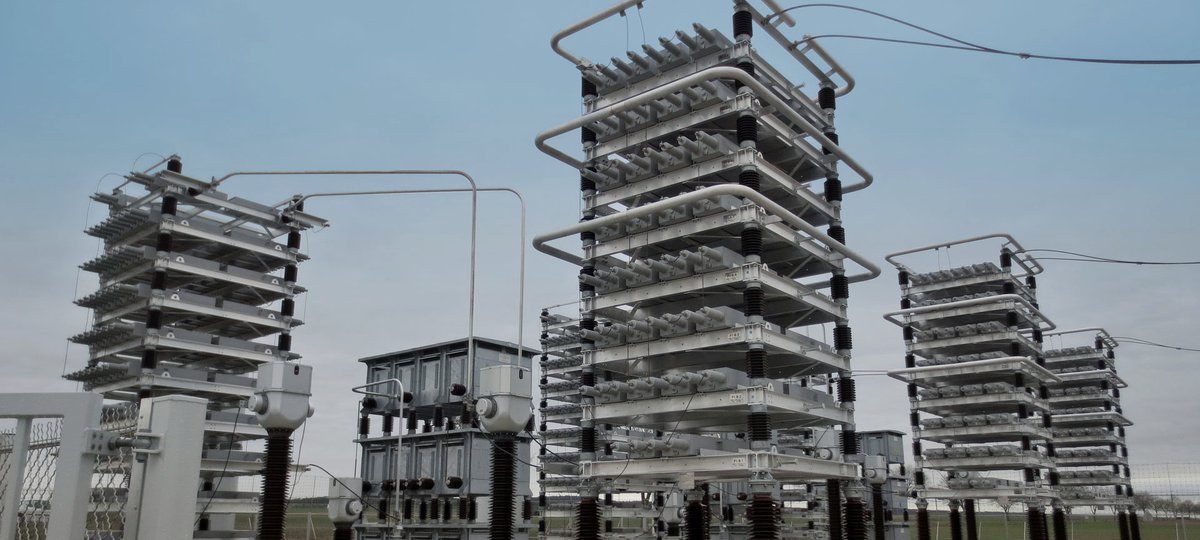
Tuned LC circuits that present a low impedance at one harmonic frequency and absorb that harmonic current before it travels upstream. Effective and inexpensive, but only for the orders they are tuned to, typically the 5th or 7th, and only for loads that do not vary much. They cannot follow a changing spectrum, and they interact with the network in ways that can cause resonance, amplifying harmonics rather than suppressing them.
Active filters
Power-electronic devices that measure the current waveform continuously, identify its harmonic components and inject an equal and opposite current that cancels them. Unlike passive filters they cover a wide band of orders at once, follow the load as it changes and bring no resonance risk of their own, and the result is easy to verify with the same Class A measurement.
Hybrid systems
A combination of the two: passive stages for bulk reactive compensation at the fundamental, active filtering for the harmonics. Common in heavy industry where the reactive load is very large and steady, with separate active filtering for the non-linear subset.
Where HarmoniQ fits
Correction works best close to where the harmonics are made, because cancelling them near their source keeps the distorted current out of the internal network altogether, not only out of the utility's meter.
At the load
HarmoniQ Alpha
Fitted at each machine, it cleans the current where it is drawn, so every cable upstream carries less of it and runs cooler.
At the drives
HarmoniQ Delta
Fitted at the drives panel, it cleans the current where the drives distort it, before it spreads to the feeder, busbar and transformer.
At the incomer
HarmoniQ Sigma
At the main switchgear, it corrects reactive current where the network meets the grid, so the supply and the meter see cleaner current.
Less reactive current and less distortion mean less heat in every transformer, cable and motor downstream: by the Arrhenius rule, the source of our figure of a 2–4× extension of downstream equipment life. The product page has the detail.
If a site runs drives, UPS systems, LED lighting or rectifier-fronted equipment, which today describes almost every industrial site, assume it has a harmonic problem until a measurement says otherwise.
08Summary
Harmonics are the defining power-quality problem of the modern industrial network. They are the unavoidable by-product of the power electronics that run every facility, and they do steady, compounding damage that never appears on the bill as a line of its own but shows up in every other measure that matters: equipment life, energy efficiency, network capacity and process reliability.
The standards framework is mature. IEEE 519 sets the limits at the connection, IEC 61000 sets equipment limits and measurement methods, IEEE C57.110 sets transformer capability, and IEEE 1459 sets the mathematics of power. The mitigation technology is mature and commercially available too. What is usually missing is measurement: many sites have never had a power analyser on the main bus long enough to see what is there.
A site assessment with IEC 61000-4-30 Class A instruments, over a representative load cycle, is the place to start. Everything else follows from what it finds.