
In brief
- Every PV inverter builds its AC output by fast switching, and no inverter does it perfectly: each one injects some harmonic current into the network it feeds.
- Distortion rises at partial output, because the harmonic current stays roughly constant while the useful current falls, and the inverters across a site add up.
- Capacitor banks correct power factor at the meter but leave the internal network distorted, can resonate with inverter harmonics and are damaged by them. Detuning protects the bank, not the network.
- Correcting distortion where it starts protects the internal network. HarmoniQ removes harmonic current, reactive power and phase imbalance close to where each arises, and corrects power factor to 0.98+.
Every solar panel produces direct current. To feed it into a building’s electrical network or the grid, an inverter converts it to alternating current, and that conversion is where the problem begins.
The distortion it creates is easy to miss. It rises as output falls, it adds up across every array on a site, and the usual fix, a capacitor bank at the incomer, can make it worse. This article explains how inverters create harmonics, what they do inside a site’s network, why capacitor banks fall short, and how to correct the distortion where it starts.
01How solar inverters create harmonics
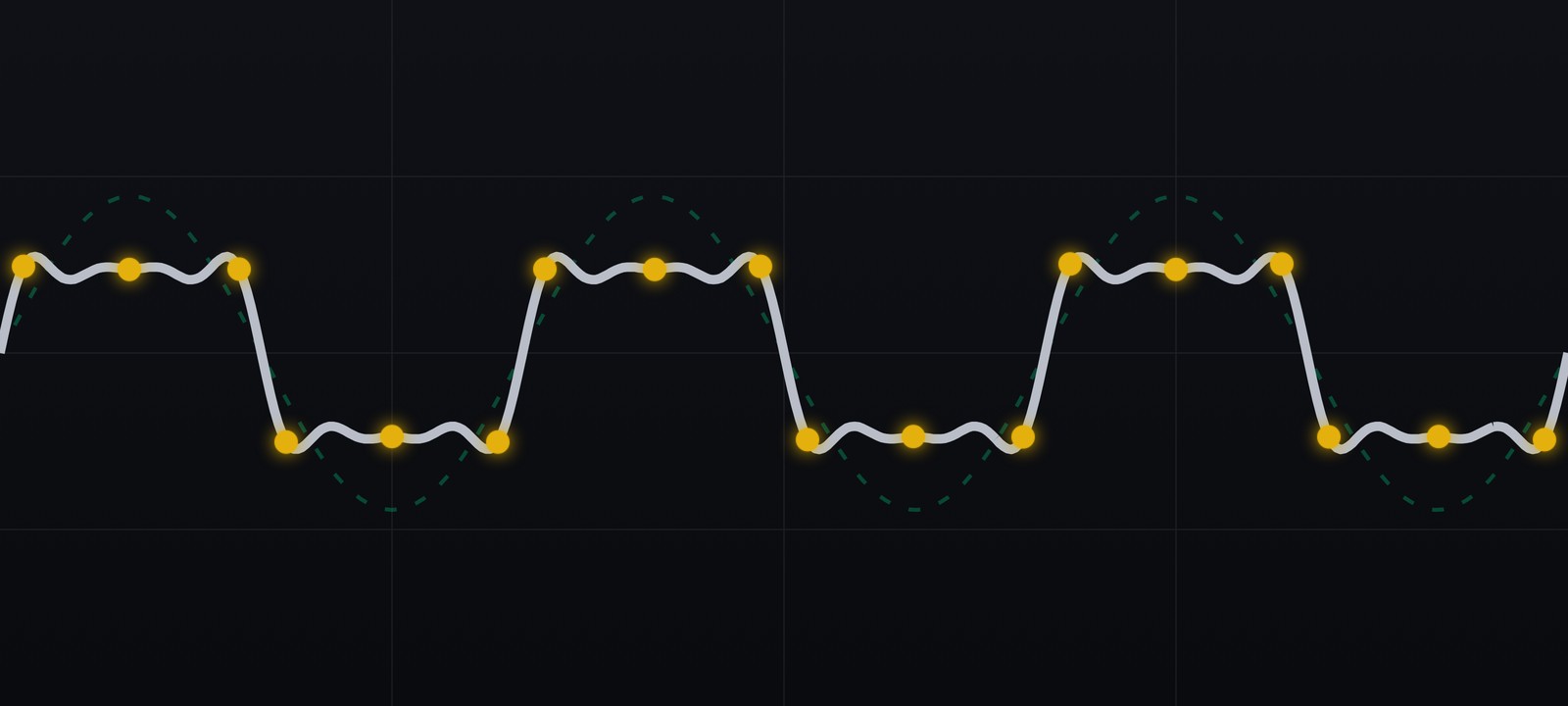
Solar inverters use pulse-width modulation, or PWM: semiconductor switches turn on and off thousands of times a second to build an AC waveform out of a DC input. The process is inherently imperfect. Each switching event leaves small transients that distort the output current, injecting harmonics, currents at multiples of the fundamental 50 or 60 Hz, into the network.
The dominant harmonics from PV inverters are the 3rd, 5th, 7th, 11th and 13th. Better inverters suppress them more effectively, but no inverter eliminates them entirely. Grid-connection rules cap them rather than forbid them: IEEE 1547-2018, the North American interconnection standard, limits the total harmonic current a grid-connected inverter may inject to 5% of its rated current.
The partial-load problem
This is where solar becomes uniquely challenging. Unlike a motor running at a steady load, PV output moves constantly with cloud cover, the time of day and the season. At partial output, THD rises sharply, because the harmonic currents stay roughly constant while the fundamental current falls. A system delivering clean current at noon can be injecting far more distortion, as a share of its output, by late afternoon.
Worked exampleTake an inverter whose harmonic current is 3% of its rated current, and suppose it stays at that level as output falls. At full output its current THD is 3%. At half output it is 6%, and at a quarter, 12%: the same amps of distortion, set against a smaller fundamental. Measured against its rated current, as IEEE 1547 measures it, the inverter stays at 3% throughout, inside the limit.
02The impact on your electrical network
Harmonic distortion from PV inverters does not stay at the solar installation. The harmonic current flows back through the site’s cables and transformer towards the supply, and the voltage distortion it creates on the way reaches every piece of equipment on the same busbars.
Distributed PV compounds the problem
A single rooftop installation might inject modest harmonics. But industrial and agricultural operations often deploy PV across several buildings, rooftops and sites. Each inverter injects its own harmonic current, and these add up across the network: not quite arithmetically, since currents at different phase angles partly cancel, but to a total higher than any single source would suggest.
Consequences
| Effect | Mechanism | Financial impact |
|---|---|---|
| Increased I²R losses | Harmonic currents flow through cables and transformers, making heat without doing useful work | Higher electricity consumption: energy wasted as heat |
| Transformer overheating | Eddy-current losses in transformer windings rise with the square of the harmonic order | Shorter transformer life, and a risk of failure |
| Motor degradation | Harmonic voltages create opposing torques and extra heating in motor windings | Lower efficiency, shorter motor life |
| Capacitor bank failure | Capacitors absorb harmonic current disproportionately, then overheat and fail early | Replacement costs, and the loss of power factor correction |
| Sensitive equipment malfunction | PLCs, control systems and measuring instruments are sensitive to voltage distortion | Production errors, false alarms, downtime |
| Demand and penalty charges | Harmonics lower the true power factor even when the displacement power factor looks acceptable | Higher kVA demand where the meter measures RMS current, and penalties under some tariffs |
Many organisations install PV to cut energy costs and carbon emissions. But the harmonic distortion it brings raises electrical losses across the site’s network, eroding part of the saving the solar was meant to deliver.
The pointWithout harmonic mitigation, the true return on a PV investment is lower than the business case assumes.
Power factor and voltage
Solar also changes the power factor the meter sees. Inverters running at unity power factor supply real power, kW, but no reactive power, so the site’s motors still draw all their kvar from the grid. With less kW imported and the same kvar, the power factor at the meter falls, sometimes far enough to cross a penalty threshold the site used to clear.
Worked exampleA site drawing 500 kW at a power factor of 0.95 takes about 164 kvar from the grid. At midday the roof supplies half the real power, so the meter sees 250 kW and the same 164 kvar: a power factor of about 0.84, below most of the thresholds in our article on power factor penalties.
Export moves the voltage too. When the panels produce more than the site uses, current flows back towards the grid and the voltage at the point of connection rises. On a weak feeder at midday it can approach the upper limit equipment is built for, and inverters protect themselves by cutting their output or disconnecting. That is a job for the inverters’ own settings, the network operator, or a tap change on the site’s own transformer. HarmoniQ doesn’t control voltage, and it is no remedy for voltage rise.
03Why capacitor banks don’t solve this
Capacitor banks are the most common power factor correction technology in industrial and commercial facilities. They are effective at correcting displacement power factor, the phase shift between voltage and current at the fundamental frequency. But they cannot address harmonic distortion, and in many cases they make it worse.
Three reasons capacitor banks fail with PV harmonics
- They only correct at the point of connection. Capacitor banks are usually installed at the main incoming supply, the point of common coupling (PCC) with the grid, where they correct the power factor the utility meter sees. But the harmonic distortion from the PV inverters is in the internal network: the cables, transformers, motors and equipment. The capacitor bank at the front door does nothing for the damage happening inside.
- They can amplify harmonics through resonance. A capacitor’s impedance falls as frequency rises, while the network’s inductive impedance rises. At the frequency where the two meet, they form a parallel resonance that amplifies harmonic voltages and currents, sometimes to destructive levels. Adding a bank to a network with PV inverters can move that resonance onto a harmonic the inverters produce, magnifying the very problem it was meant to solve. Our article on capacitor banks works the resonance through.
- Harmonics destroy capacitor banks. Because a capacitor’s impedance falls at higher frequencies, a bank absorbs harmonic current disproportionately. The result is internal heating, dielectric stress and premature failure: the equipment installed to improve power quality becomes a casualty of the harmonics it cannot address.
Detuned reactors: a partial fix
Some installations add detuning reactors to capacitor banks, to move the resonance below the harmonics present. That protects the capacitors, but it does not eliminate the harmonics themselves. The distortion keeps circulating through the network, causing losses and wearing equipment.
The pointDetuning is a defensive measure, not a solution.
04The solution: correction at the source
Removing harmonic distortion, rather than absorbing it or moving its resonance, takes an active approach: injecting compensating currents in real time, equal and opposite to the harmonics detected, so that the two cancel.
How active filtering works
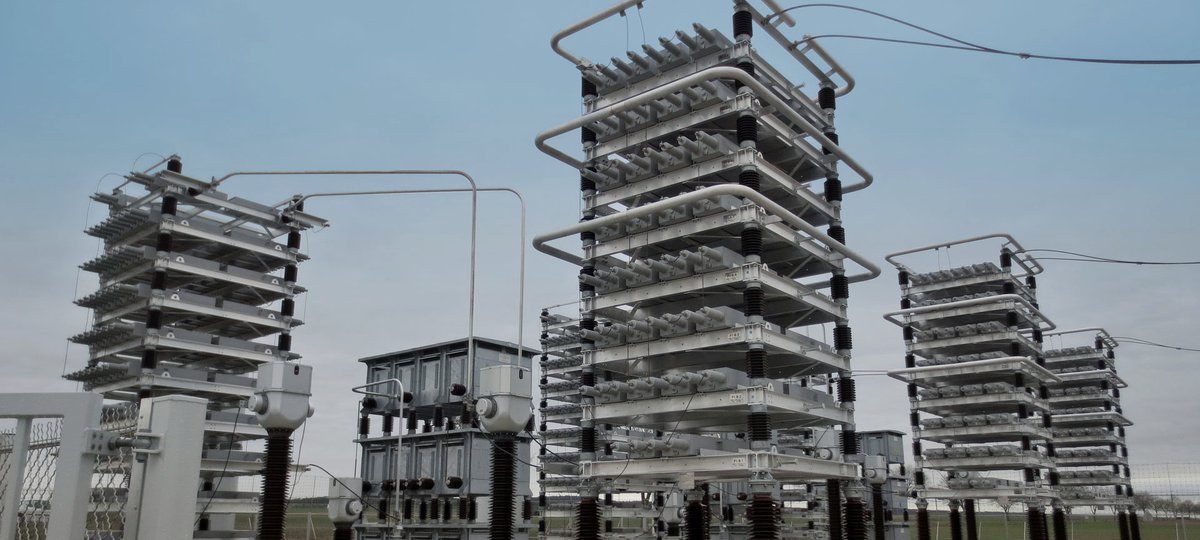
An active harmonic filter is power electronics connected in parallel with the load. It monitors the current continuously and identifies each harmonic component, its frequency, amplitude and phase, then injects a mirror-image current for each one, so the current between the filter and the supply returns towards a clean sine wave.
Unlike capacitor banks, active filters are current sources, not passive reactive elements, so they do not add the resonance risk a capacitor bank brings. They also adapt as the harmonic spectrum changes, which matters for PV, where the harmonic profile shifts continuously with irradiance. Our explainer on active harmonic filters sets out what the category does and where it stops.
Local correction versus centralised correction
This is the critical distinction. A shunt correction device cleans only the current between itself and the supply. Capacitor banks correct at one central point. Active correction can be deployed locally, at individual distribution boards or PV connection points, dealing with distortion close to where it starts.
| Approach | Corrects power factor | Removes harmonics | Protects the internal network | Adds resonance risk |
|---|---|---|---|---|
| Capacitor bank, central | Yes | No | No | Yes, high |
| Detuned capacitor bank | Yes | No | No | Low |
| Active filter, central | Yes | Yes, between it and the supply | Partly: upstream of the main board only | No |
| Active filter, local | Yes | Yes | Yes, upstream of each board | No |
05The HarmoniQ approach
How HarmoniQ corrects it
HarmoniQ removes harmonic current, reactive power and phase imbalance close to where each arises, throughout the internal network rather than only at the meter, and corrects power factor to 0.98+.
At the load
HarmoniQ Alpha
Fitted at each machine, it cleans the current where it is drawn, so every cable upstream carries less of it and runs cooler.
At the drives
HarmoniQ Delta
Fitted at the drives panel, it cleans the current where the drives distort it, before it spreads to the feeder, busbar and transformer.
At the incomer
HarmoniQ Sigma
At the main switchgear, it corrects reactive current where the network meets the grid, so the supply and the meter see cleaner current.
All three are shunt-connected, outside the main power path, and install with zero disruption to production. Every unit improves power factor where it sits, and 0.98+ is what the three achieve together, without adding the resonance risk a capacitor bank brings. Reactive-power penalties fall away wherever the utility levies them.
The result is cleaner current across the site. Downstream equipment runs cooler and lasts longer, with a 2–4× extension of its life; the site typically uses 10–20% fewer kWh for the same output; and less of the solar’s saving is lost as heat in the network.
06Applicable standards
Power quality in PV-connected networks is governed by internationally recognised standards, and they fall into two groups. Some set limits the inverter or the generating plant must meet, and its manufacturer or installer answers for those. Others set limits the site must meet where it connects to the grid. HarmoniQ is designed to help a site meet IEEE 519-2022 at its point of common coupling.
| Standard | Scope | Applies to | Key limits |
|---|---|---|---|
| IEEE 519-2022 | Harmonic control at the point of common coupling | The site, where it meets the utility | At most 8% voltage THD, and 5% for any single harmonic, on systems up to 1 kV |
| IEEE 1547-2018 | Interconnection of distributed energy resources | The inverter, as connected | Harmonic current limits for grid-connected inverters, with total rated-current distortion at most 5% |
| IEC 61000-3-2 | Harmonic current emissions, equipment up to 16 A per phase | Equipment manufacturers | Limits for each harmonic, by class of equipment |
| IEC 61000-3-12 | Harmonic current emissions, equipment over 16 A and up to 75 A per phase | Equipment manufacturers | Limits for larger equipment, set by the short-circuit ratio where it connects |
| IEC 62109-1 and -2 | Safety of power converters for PV systems | Inverter manufacturers | Safety requirements for PV inverters |
| EN 50549 | Connection of generating plant to distribution networks | The generating plant, PV included | European requirements for plant running in parallel with the network |
The split matters when distortion turns up. Every inverter on a site can meet its own product limits, measured against its rated current, while the site as a whole exceeds IEEE 519 at its point of common coupling, because the harmonic currents of many inverters, drives and other loads add up there.
07Summary
Solar PV is an essential part of the energy transition. But the power electronics that connect it to an electrical network create harmonic distortion that degrades power quality, heats equipment and erodes part of the return on the solar investment.
Capacitor banks, the most common mitigation, correct power factor at the meter but leave the internal network exposed. Worse, they risk a harmonic resonance that amplifies the problem.
The answer is correction deployed locally, dealing with distortion where it starts. HarmoniQ corrects power factor and removes harmonic current and phase imbalance throughout the network, so a solar installation keeps more of the value it was built to deliver.
Sources
- IEEE Std 519-2022, IEEE Standard for Harmonic Control in Electric Power Systems, Institute of Electrical and Electronics Engineers.
- IEEE Std 1547-2018, IEEE Standard for Interconnection and Interoperability of Distributed Energy Resources with Associated Electric Power Systems Interfaces.
- IEC 61000-3-2, Electromagnetic compatibility (EMC), Part 3-2: Limits, Limits for harmonic current emissions (equipment input current up to and including 16 A per phase), International Electrotechnical Commission.
- IEC 61000-3-12, Electromagnetic compatibility (EMC), Part 3-12: Limits, Limits for harmonic currents produced by equipment connected to public low-voltage systems with input current over 16 A and up to and including 75 A per phase.
- IEC 62109-1 and IEC 62109-2, Safety of power converters for use in photovoltaic power systems: Part 1, General requirements; Part 2, Particular requirements for inverters.
- EN 50549-1 and EN 50549-2, Requirements for generating plants to be connected in parallel with distribution networks: Part 1, low-voltage networks; Part 2, medium-voltage networks.
- IEEE Std C57.110-2018, IEEE Recommended Practice for Establishing Liquid-Immersed and Dry-Type Power and Distribution Transformer Capability When Supplying Nonsinusoidal Load Currents.