In brief
- Industrial electricity prices differ many times over between markets, and national averages hide wide spreads within them: by emirate in the UAE, by state in the United States, by network in Australia.
- The dearest markets add taxes, network fees and carbon costs to the energy; the cheapest rest on regulated tariffs or legacy hydropower. Many are rising, so the direction matters as much as the rate.
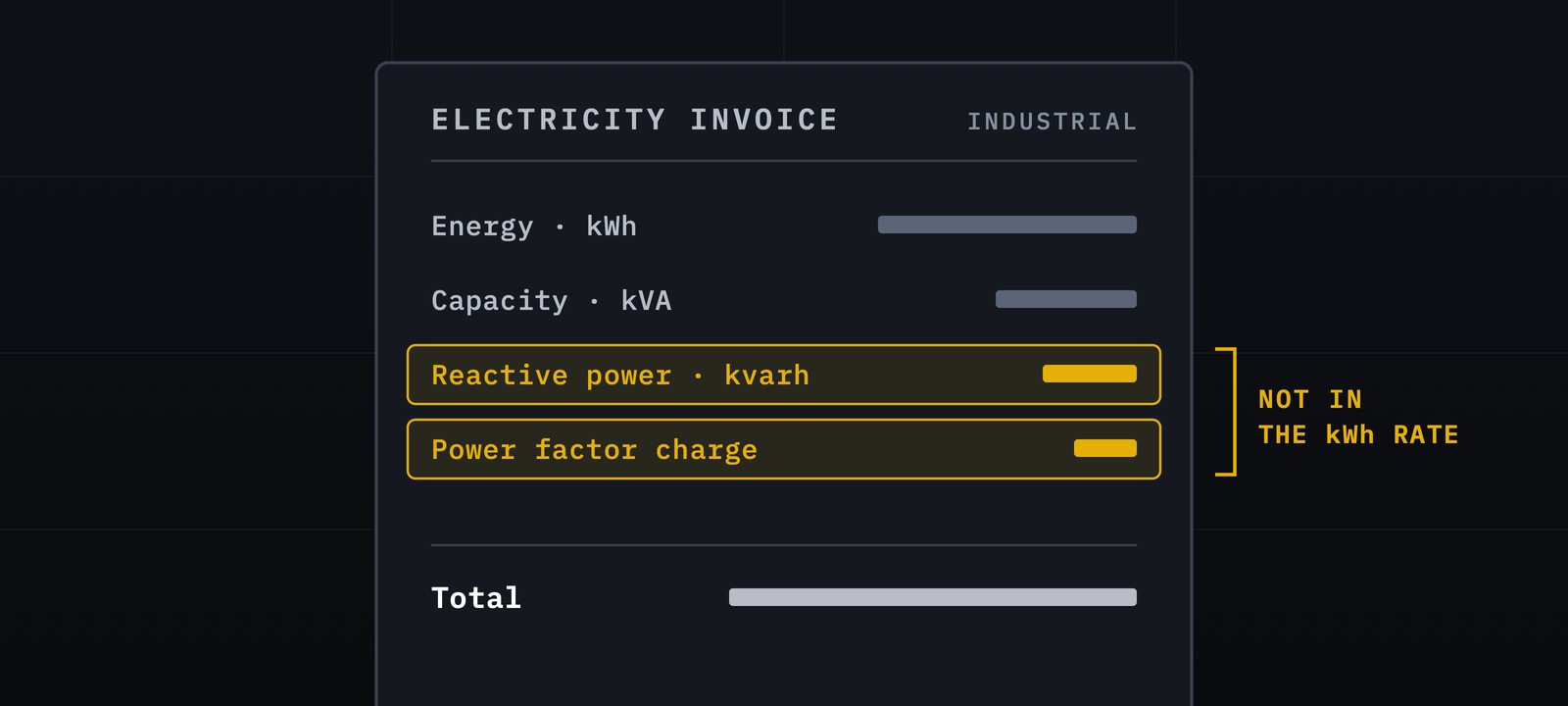
- The headline rate leaves out what a site’s own power quality adds: heat from wasted current, metered as kWh; power-factor penalties; and demand and capacity charges inflated by reactive power.
- With HarmoniQ, a site typically uses 10–20% fewer kWh; where penalties and capacity charges fall too, up to 25% comes off the total bill. Where power is cheap, 2–4× longer equipment life matters most.
If you operate industrial facilities in more than one country, you already know that electricity costs are not remotely comparable from one market to the next. A plant in Germany pays many times per kilowatt-hour what a plant in Kuwait does, and a food processing plant in Italy pays far more than an identical operation in Texas.
These are not marginal differences. They reshape supply chains, redirect capital investment and decide which industries can survive in which places. Yet the global picture of industrial electricity pricing remains surprisingly opaque. The data is scattered across national regulators, reported in different currencies at different voltage levels, and often published years late.
This article draws on the International Energy Agency, the US Energy Information Administration, Eurostat and national regulators and utilities to show what industrial operators pay around the world, and why the headline rate alone can mislead. It quotes a price only where a regulator, a utility or a statistics office publishes it, and names the source; elsewhere it describes the market rather than putting a number on it.
01The global picture
Industrial electricity prices span an extraordinary range. At the bottom, regulated tariffs in the Gulf supply industry at a few US cents per kilowatt-hour. At the top, European markets carrying carbon costs, grid charges and energy taxes charge many times as much. Most of the industrial world sits between the two.
Worked exampleA hypothetical plant using 10 GWh a year pays $100,000 a year for every US cent on the price of a kilowatt-hour. A gap of ten cents between two markets is a million dollars a year, for exactly the same output.
The range has moved over the past decade. The European energy crisis of 2021 to 2023 and the spread of carbon pricing have pushed the top of it up, while subsidy reform in the Middle East has lifted the bottom, from a very low base.
National figures hide a second spread, inside each country. Many markets have no single industrial price: tariffs are set by each utility, state, province or network, and a national average can sit far from what any one site pays.
Exhibit 1 shows six markets where a single national figure misleads.
| Market | What varies | Why |
|---|---|---|
| United Arab Emirates | By emirate | Each emirate’s utility sets its own tariff: commercial power costs 20 fils per kWh in Abu Dhabi, against 23 to 38 fils plus a fuel surcharge in Dubai. |
| United States | By state and utility | Rates are set utility by utility and differ widely from state to state. The EIA’s national average for industry, about 9 US cents per kWh in the first seven months of 2026, sits between New Mexico at about 5 cents and Hawaii at about 38. |
| Australia | By network and state | Each distribution network sets its own charges, and wholesale prices differ between the states of the National Electricity Market. |
| Canada | By province | Each province runs its own system. Québec’s hydro-based rates are among the lowest in North America. |
| India | By state | Each state’s regulator sets its own industrial tariffs, which carry a cross-subsidy for farms and households. |
| Norway | By price area | Five price areas. Subsea cables link the south to continental Europe and the UK; the north is far less connected. |
So a single national price is a starting point, not an answer. What a site actually pays depends on its utility, its region, its voltage level and its contract.
02The most expensive markets
The world’s most expensive industrial electricity markets share a common profile: high policy costs layered on top of already high generation costs, compounded by grid charges and environmental levies.
The pointIn most of them, the cost of generating the electricity is only part of the final industrial tariff. The rest is taxes, network fees and policy instruments.
Exhibit 2 sets out the markets at the top of the range and what drives each.
| Market | What drives the price |
|---|---|
| Germany | Network fees, levies and the carbon price, on top of the energy |
| Italy | Gas-fired generation on imported gas, and system charges |
| United Kingdom | Gas setting the wholesale price, the Carbon Price Support and network charges |
| Ireland | Gas-dominated generation in a small market |
| Japan | Imported LNG, and less nuclear power since 2011 |
Germany has been among the most expensive major industrial electricity markets for more than a decade. Its renewables surcharge, the EEG levy, has been off bills since July 2022, but network fees, levies and balancing costs remain, and the EU Emissions Trading System puts a carbon price into the electricity itself. Together they have pushed energy-intensive manufacturers to move production to cheaper places.
Italy and Japan share a common vulnerability: heavy dependence on imported gas for power generation. Gas-fired plants set much of Italy’s wholesale price, which leaves its industrial tariffs exposed to international gas markets. Japan’s turn away from nuclear power after Fukushima raised the share of imported LNG in its generation, and its industrial rates with it.
The United Kingdom sits where several cost pressures meet: gas-fired plants that often set the wholesale price, a Carbon Price Support rate on top of the carbon price itself, and Transmission Network Use of System (TNUoS) charges that vary by location, so that factories in southern England pay more than those in Scotland.
03The cheapest markets
At the other end of the range, a handful of countries supply industry at rates a European manufacturer would not recognise. They fall into two groups: fuel exporters that hold domestic energy prices down as a matter of economic policy, and hydropower-rich countries with minimal fuel costs.
| Market | Why it is cheap |
|---|---|
| Kuwait | Tariffs set by the state far below the cost of supply, on domestic oil and gas |
| Qatar | Abundant gas and domestic price controls |
| Saudi Arabia | Regulated tariffs and low-cost domestic fuel: SAR 0.20 per kWh for industry, about 5.3 US cents (Saudi Electricity Company) |
| Canada, Québec | Hydro-Québec’s heritage pool of older hydro stations, at a regulated price |
| Norway | Hydropower, though subsea cables now carry European prices into the south |
| Paraguay | Its half of the Itaipu dam’s output, far more than it consumes |
| Ethiopia | Hydropower, including the Grand Ethiopian Renaissance Dam |
| Kazakhstan | Coal-fired generation and regulated prices |
Kuwait offers the clearest example of a subsidised industrial market. Its Ministry of Electricity, Water and Renewable Energy supplies power at tariffs that cover only a fraction of the cost of generating it, a level at which electricity is close to a free input in the manufacturing cost stack.
Canada’s province of Québec represents the hydropower model. Hydro-Québec’s heritage pool, a fixed block of output from its older large hydroelectric stations, is priced low by law, and its industrial rate for large-power customers, Rate L, passes the advantage on. Hydro-Québec’s own annual comparison of North American electricity prices puts its large-power customers among the lowest-priced on the continent, which makes Québec one of the most cost-competitive places in the developed world for energy-intensive manufacturing.
Norway has long enjoyed similar advantages, but subsea cables to the UK, Germany and the Netherlands now carry continental prices into its southern price areas. During the 2022 European energy crisis, prices in the south rose sharply while the less-connected north stayed low: a reminder that cheap generation does not guarantee cheap electricity when cables carry distant price signals.
04Where tariffs are rising
Static price comparisons miss an equally important dimension: the trajectory. Some of the cheapest markets have seen the steepest rises, while some expensive markets have levelled off.
| Market | What moved the tariff |
|---|---|
| Saudi Arabia | Subsidy reform, in steps since 2016 |
| United Arab Emirates | Tariff reform, emirate by emirate |
| Germany | The 2022 gas crisis and carbon costs |
| United Kingdom | Gas prices and network charges |
| France | Nuclear outages in 2022, and the reform of ARENH, its regulated access to nuclear power |
| Türkiye | Lira depreciation and fuel import costs |
| Pakistan | Subsidy cuts under IMF programmes |
| Egypt | Subsidy phase-out and currency devaluation |
| Nigeria | Tariff reform by the regulator, NERC, and naira devaluation |
| United States | Gas prices and grid investment, at a slower pace than Europe |
Three patterns stand out.
Gulf subsidy reform. Saudi Arabia’s industrial tariff has risen in steps since 2016, to the level in Exhibit 3, as the Kingdom reduces its fiscal dependence on hydrocarbon subsidies under Vision 2030. The UAE has reformed its tariffs too, emirate by emirate. These reforms are structural: operators in the Gulf who have relied on cheap electricity as a permanent competitive advantage need to reassess.
Europe after the energy crisis. Wholesale gas and electricity prices have retreated from their 2022 peaks, but industrial tariffs in Germany, the UK and Italy remain well above their 2019 levels. The structural causes of the crisis, dependence on imported gas, underinvestment in domestic generation and carbon pricing, have not gone away.
Tariff reform in developing economies. Across sub-Saharan Africa, South Asia and parts of Latin America, governments under fiscal pressure, several of them in IMF programmes, are cutting electricity subsidies and moving to cost-reflective tariffs. Pakistan, Egypt and Nigeria have all raised industrial tariffs significantly since 2020, with further reforms scheduled.
The pointFor an operator making a capital commitment of a decade or more, the direction of travel matters as much as today’s rate.
05What drives industrial electricity prices
Headline rates hide a complex cost stack, and knowing what you are actually paying for is the first step to finding where savings can be made. A typical industrial bill has five distinct layers, each driven by different factors and each open to different strategies.
1. Generation cost
The cost of producing the electricity, set mainly by the fuel mix. Markets built on legacy hydropower, such as Québec, Norway and Paraguay, or on low-cost coal, such as South Africa and India, have structurally lower generation costs. Markets dependent on imported gas, such as Japan, the UK and Italy, face higher generation costs, largely beyond the control of any individual consumer.
2. Network charges
Transmission and distribution costs: building, maintaining and running the grid. These charges are usually regulated, and vary with voltage level, location on the grid and the consumer’s peak demand. In the UK, TNUoS charges differ from zone to zone; in Germany, network fees (Netzentgelte) are a large share of the industrial tariff.
3. Taxes, levies and policy costs
The layer that varies most between markets, and has grown fastest. It covers carbon pricing, such as the EU ETS and the UK’s Carbon Price Support, renewables levies, capacity market payments and environmental levies. In much of Europe it adds substantially to the price; in the Gulf states and much of sub-Saharan Africa it is negligible.
4. Demand charges and capacity costs
Charges based on peak demand rather than energy consumed, billed per kW or kVA of the highest demand recorded in the billing period. They reward flat load profiles and penalise peaky or variable operations. They are also directly affected by power factor: a facility with poor power factor registers higher apparent demand, inflating this charge even when its productive load has not grown.
5. Reactive power and power quality charges
The most variable layer, and the least understood. In some markets, among them Qatar, Bahrain and the UAE, reactive power is not billed at all. In others, such as Italy, Kuwait, Mexico, Colombia and South Africa, it is charged through kvarh charges, power factor surcharges or kVA-based demand billing. It is the one layer entirely within a facility’s own control, and the one most often ignored.
Exhibit 5 sets the five layers side by side: what sets each, and what a site can do about it.
| Layer | What sets it | What a site can move |
|---|---|---|
| Generation | The fuel mix and the wholesale market | Its own consumption: fewer kWh for the same output |
| Network charges | The regulator, by voltage level, location and peak demand | Its peak demand, in kW or kVA |
| Taxes, levies and policy costs | Government policy | Mostly charged per kWh, so they fall with consumption |
| Demand and capacity charges | The tariff: peak kW or kVA, or an agreed capacity | Power factor: correcting it cuts billed kVA and frees capacity |
| Reactive power and power quality charges | The tariff’s power factor threshold | Power factor: corrected above the threshold, the charge falls away |
The structure matters for efficiency strategy. Where taxes, levies and network charges make up much of the tariff, as in Germany, every kWh saved avoids its share of them too. Where generation is most of a small bill, as in Saudi Arabia, a cut in consumption trims a bill that was already small, and the case rests on other things.
06Why price alone doesn’t tell the whole story
International price comparisons, this article included, report the headline tariff: the all-in rate per kilowatt-hour of active energy consumed. It is the number governments publish, energy agencies track and procurement teams negotiate against.
For an industrial facility, though, the headline rate is an incomplete measure. What a site actually pays is shaped by charges that sit on top of the published rate, or inside it, and those charges are set not by the market but by the facility’s own electrical characteristics.
Poor power quality reaches the bill three ways: as heat in the site’s own cables, transformers and motors, which the meter records as kilowatt-hours; as penalties for poor power factor; and as demand and capacity charges inflated by reactive power. The mechanisms vary by market. The most significant are these.
Reactive power penalties
As our companion article on the hidden cost on every industrial electricity bill explains, reactive power is the part of the current that sustains the magnetic fields in motors and transformers and does no work. Utilities charge for too much of it through kVA demand charges, kvarh penalties or power factor multiplier formulas, and our article on power factor penalties sets out how each works.
Worked exampleFor the same output, a facility at a power factor of 0.75 registers 27% more kVA of demand than one at 0.95 (0.95 ÷ 0.75 = 1.27), and pays for it wherever demand is billed in kVA.
Demand charge ratchets
Many industrial tariffs bill demand on the highest peak recorded in the billing period, and some on the highest peak of the preceding 12 months, so a single 15-minute spike can set the demand charge for a year. A facility with poor power factor registers every peak higher in kVA, and where the meter computes kVA from RMS current, harmonic current raises it too. Under a ratchet, that inflation is carried forward.
Harmonic-related losses
Harmonic distortion, caused by non-linear loads such as variable-speed drives, rectifiers and LED lighting, adds current that does no useful work. It heats the cables, transformers and switchgear it flows through, and that heat is metered in kilowatt-hours like any other load. It shows up as consumption higher than the site’s output would suggest, never as a separate charge, which makes it invisible in bill analysis.
Capacity subscription inflation
Where customers subscribe to a fixed capacity, as in France, Morocco and India, a subscription counted in kVA has to cover apparent power, not only active power. A facility with poor power factor must subscribe to more capacity than its productive load needs, and pays every month for grid access it does not use productively. Correcting power factor can move it to a lower subscription, cutting a fixed cost every month after.
The combined effect never appears in an international price comparison, but it appears on the bill every month.
The pointTwo identical factories in the same country, on the same tariff, consuming the same number of kilowatt-hours, can pay materially different electricity bills. The difference is not in the rate they negotiated: it is in their power quality.
07Implications for industrial strategy
The interplay between headline prices and the costs a site’s power quality adds creates different priorities depending on where a facility operates.
High-cost markets
Every kWh counts
Each kilowatt-hour saved also avoids the network fees, levies and carbon costs billed on it.
Mid-cost markets
Penalties carry the case
Moderate rates, several of them rising, with some of the most severe power factor penalties anywhere.
Low-cost markets
Equipment life and capacity
The bill is small, but the heat, the wear and the capacity tied up by poor power quality are not.
In high-cost markets: every percentage point matters
For a facility in Germany, Italy or the United Kingdom, even small efficiency gains produce significant absolute savings, because every kilowatt-hour saved avoids not only the energy price but the taxes, levies and network charges billed on it. Where the same correction also removes reactive power penalties and demand charge inflation, the saving reaches well beyond the energy line.
In these markets, power quality correction is no marginal improvement. European manufacturers competing with Asian and North American rivals already carry a structural cost disadvantage on electricity, and narrowing it by even a few percentage points, through power factor correction, harmonic mitigation and demand management, can decide whether a plant remains viable.
In mid-cost markets: the rising-cost imperative
Facilities in markets such as Türkiye, Brazil, Mexico and India face a different calculus. Their headline rates are moderate by global standards, but several are rising, and the efficiency case strengthens as they climb. These markets also tend to have some of the most aggressive reactive power penalties: Mexico’s CFE caps its surcharge for poor power factor at 120% of the whole bill, and Colombia’s penalty multiplier escalates to 12 times the base rate.
For multinational operators, mid-cost markets are often the strongest opportunity: moderate rates amplified by severe penalties, in economies where tariff reform is gathering pace.
In low-cost markets: equipment life and capacity
In Kuwait, Qatar or Québec, the direct case for power quality correction on bill savings alone is smaller, because the bill itself is small. But cheap electricity does not mean cheap power quality problems. Reactive current still heats cables and transformers. Harmonics still heat windings and age insulation.
In low-cost markets the case shifts from the bill to equipment life and capacity. A facility paying a few cents per kilowatt-hour may barely notice its energy saving in the operating budget. It will notice motors, transformers and cables that last longer, and capacity freed in a connection it thought was full, which can defer an upgrade.
The Arrhenius rule, by which every 10 °C reduction in operating temperature roughly doubles insulation life, applies whatever the local utility charges per kilowatt-hour. Power quality problems impose physical costs denominated in equipment failures, not electricity rates.
For multinational operators: portfolio-level thinking
The most sophisticated industrial operators do not decide site by site. They assess their whole portfolio and rank interventions by local price, penalty structure, power quality baseline and equipment condition together. A manufacturer with plants in Germany, Mexico, Saudi Arabia and India faces four very different cost structures, but a single class of power quality problems that shows up differently in each.
The German plant may yield the largest absolute saving. The Mexican plant may yield the largest percentage reduction, as its penalties fall away. The Saudi plant may yield the greatest gain in equipment life. The Indian plant may yield the most valuable freed capacity on a constrained grid connection. All four are worth addressing; the sequence and the justification differ.
With HarmoniQ
Wherever a site sits on the price range, it typically uses 10–20% fewer kWh for the same output, and saves up to 25% of its total bill where power-factor penalties fall away and capacity charges come down too.
At the load
HarmoniQ Alpha
Fitted at each machine, it cleans the current where it is drawn, so every cable upstream carries less of it and runs cooler.
At the drives
HarmoniQ Delta
Fitted at the drives panel, it cleans the current where the drives distort it, before it spreads to the feeder, busbar and transformer.
At the incomer
HarmoniQ Sigma
At the main switchgear, it corrects reactive current where the network meets the grid, so the supply and the meter see cleaner current.
What changes from market to market is which line carries the case. Where power is dear, it is the kWh, and the performance guarantee is written against kWh at the meter. Where penalties are severe, it is power factor, corrected to 0.98+ across the site. Where power is cheap, it is equipment that runs cooler and lasts 2–4× longer, and capacity freed. All three units are shunt-connected, outside the main power path, so they install with zero disruption.
Understanding the global electricity price landscape is the first step. Understanding what your facilities actually pay, the headline rate plus what their power quality adds, is the second. The gap between the two is where the opportunity lies.
Sources and further reading
- International Energy Agency (2024), World Energy Outlook 2024, IEA, Paris.
- International Energy Agency (2023), Energy Prices and Taxes: Quarterly Statistics, IEA, Paris.
- US Energy Information Administration (2025), Electric Power Monthly, Table 5.6.A, Average Retail Price of Electricity to Ultimate Customers by End-Use Sector.
- Eurostat (2025), Electricity Prices for Non-Household Consumers, dataset nrg_pc_205.
- Bundesnetzagentur (2024), Monitoring Report 2024: Developments in the German Electricity and Gas Markets, Federal Network Agency, Bonn.
- Saudi Electricity Company (2024), Electricity Tariff Schedule for Industrial Consumers, SEC, Riyadh.
- Hydro-Québec (2025), Comparison of Electricity Prices in Major North American Cities, 2025 edition.
- ARERA, Autorità di Regolazione per Energia Reti e Ambiente (2024), Relazione Annuale sullo Stato dei Servizi e sull’Attività Svolta, Rome.
- Agency for the Cooperation of Energy Regulators (2024), ACER Market Monitoring Report: Electricity Wholesale Markets, ACER, Ljubljana.
- Comisión Federal de Electricidad (CFE), Tarifa HM, Servicio en Media Tensión con Demanda, Mexico.
- Comisión de Regulación de Energía y Gas (CREG), Resolución CREG 015 de 2018, Colombia.
- IEEE Std 519-2022, IEEE Standard for Harmonic Control in Electric Power Systems, Institute of Electrical and Electronics Engineers.
- IEEE Std 1-2021, IEEE Standard for General Principles for Temperature Limits in the Rating of Electrical Equipment, Institute of Electrical and Electronics Engineers.