In brief
- Industrial current is distorted three ways: reactive power shifts it in time, harmonics change its shape, and imbalance loads the three phases unequally.
- Each wastes energy as heat in cables, transformers and motors: at power factor 0.80, a site carries 25% more current and makes 56% more heat for the same work.
- The three are physically independent, so correcting one leaves the others in place. HarmoniQ removes all three, with units at the machines, at the drives and at the incomer.
- With all three removed, the same production typically takes 10–20% fewer kWh, power factor reaches 0.98+, and downstream equipment lasts 2–4× longer.
Consider a water supply. If the water in the pipes carries grit, sediment and air pockets, every pump in the system works harder. Bearings wear faster. Filters clog. Energy use climbs. The root cause is not the pumps. It is the quality of what flows through them.
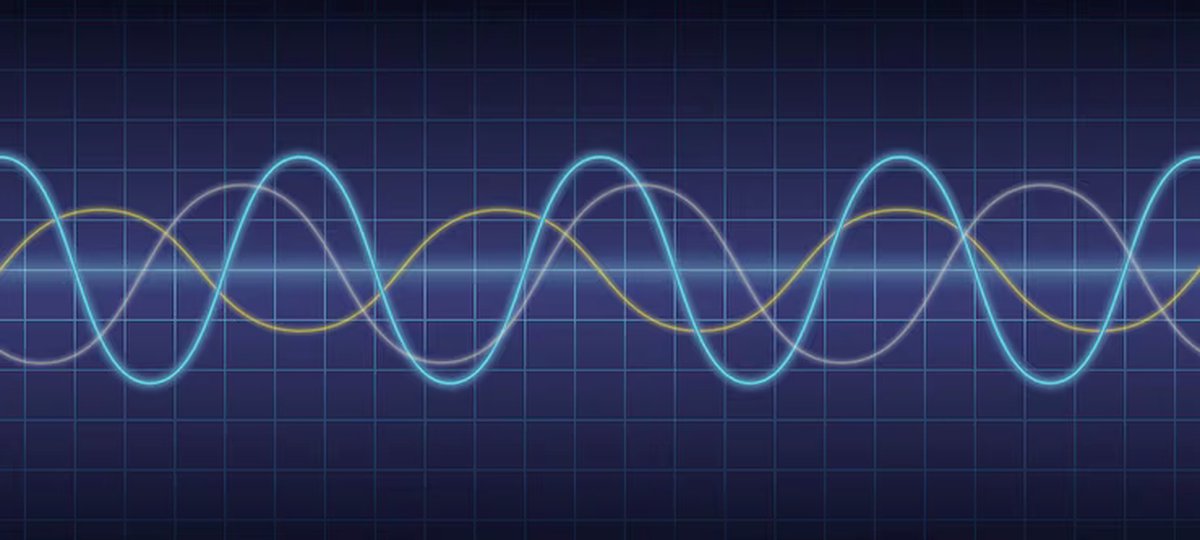
Electrical current works the same way. In a perfect world, the current in an industrial facility's cables would be a smooth sine wave, rising and falling 50 or 60 times a second in step with the supply voltage. In reality it never is. Motors, variable-speed drives, rectifiers and switching power supplies all distort it.
The distortion has real, measurable consequences: excess heat in cables, busbars and transformer windings; energy drawn from the grid but never turned into useful work; equipment that ages early under thermal stress and vibration; and utility penalties for sites whose consumption falls outside acceptable limits. That energy is consumed, billed and paid for, and it produces only heat, vibration and wear. Remove the distortion and the same production typically takes 10–20% fewer kilowatt-hours, measured at the site's own meter.
This reference explains what causes each kind of distortion, and how HarmoniQ prevents the waste it causes.
01Three kinds of distortion
Industrial current distortion falls into three distinct categories. Each has different causes and different effects, and correcting one does not correct the others. That is why HarmoniQ uses three complementary units, placed through the network, rather than a single device.
| Distortion | What happens | What it costs |
|---|---|---|
| Reactive power | Inductive loads make the current lag the voltage; extra current flows back and forth without delivering work | I²R heat in every conductor it passes through, capacity occupied, and power-factor penalties |
| Harmonic distortion | Non-linear loads draw current in pulses, distorting the shape of the waveform | Extra heating from skin and eddy-current effects, transformer derating, nuisance tripping and interference |
| Phase imbalance | The three phases are loaded unequally | Neutral current, and negative-sequence current that heats motors without making torque |
02Reactive power and power factor
In any circuit with inductance, and virtually every industrial motor is an inductive load, the current does not rise and fall in step with the voltage. It lags behind, because the changing magnetic field inside the motor opposes the change in current (Lenz's law). To deliver the same real work despite the lag, the equipment draws more total current. The extra current flows back and forth through the cables without ever becoming mechanical work.
The pointThis is reactive current. It is real current: it flows through real cables, generates real I²R losses and occupies real capacity in transformers and switchgear. But it does no useful work.
The power triangle
Power factor is real power (kW) divided by apparent power (kVA). At a power factor of 0.80, only 80% of the current in the cables is doing useful work. The relationship is Pythagorean: at 0.80 the reactive component is √(1² − 0.8²) = 0.60 of the apparent power, which makes reactive power 75% of real power, far more than the 20% a straight subtraction suggests. A facility at 0.80 carries 25% more current than it would at unity, and because I²R loss follows the square of the current, it makes 56% more heat in every conductor for the same work.
| Power factor | Reactive power per unit of real power | Current drawn | I²R heat |
|---|---|---|---|
| 1.00 | 0 | 1.00× | 1.00× |
| 0.98 | 0.20 | 1.02× | 1.04× |
| 0.95 | 0.33 | 1.05× | 1.11× |
| 0.85 | 0.62 | 1.18× | 1.38× |
| 0.80 | 0.75 | 1.25× | 1.56× |
| 0.75 | 0.88 | 1.33× | 1.78× |
At fixed voltage, real power is √3·V·I·PF, so the current for the same work scales as 1/PF and the heat as 1/PF². At a power factor of 0.75 a facility draws a third more current than its work requires. Uncorrected sites with heavy motor load commonly run well below unity, which is why utilities penalise a low power factor.
03Harmonic distortion
Where reactive power shifts the whole current waveform in time, harmonic distortion changes the shape of the waveform itself.
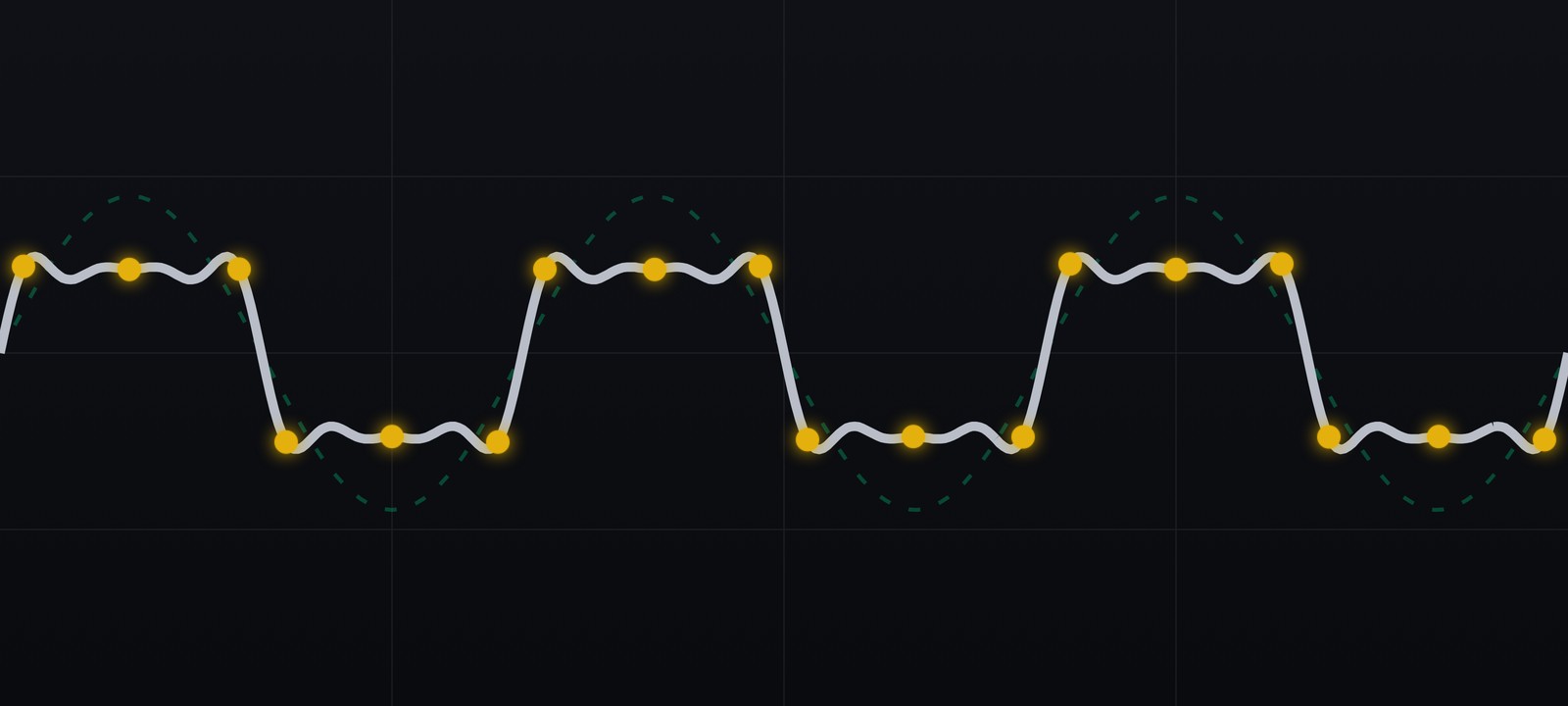
A pure sine wave contains one frequency, the fundamental, at 50 Hz or 60 Hz. But many modern loads are non-linear: variable-speed drives, LED drivers, rectifiers, UPS systems and switch-mode power supplies all draw current in short, sharp pulses rather than smooth waves. Fourier analysis resolves those pulses into components at whole multiples of the fundamental: on a 50 Hz system, the 3rd harmonic at 150 Hz, the 5th at 250 Hz, the 7th at 350 Hz and higher.
Total harmonic distortion (THD) is the single-number measure: the root-sum-square of all the harmonic components divided by the fundamental, as a percentage. Its effects are insidious.
- Extra cable and transformer heating. Higher-frequency current meets a higher effective resistance because of the skin effect: current at 250 Hz penetrates less deeply into a conductor, shrinking the usable cross-section and raising I²R losses.
- Transformer derating. Under IEEE C57.110, transformers carrying harmonic-rich load must be derated, because winding eddy-current losses rise with the square of the harmonic order.
- Eddy currents. High-frequency currents induce circulating currents in transformer cores and motor stators that make heat without doing work. Core eddy-current losses scale with the square of both frequency and flux density.
- Nuisance tripping. Harmonic currents can trip protective devices when the peak current crosses a threshold even though the RMS current is within limits.
- Electromagnetic interference. High-frequency currents radiate fields that interfere with PLCs, instrumentation and process control.
Sites with heavy drive and non-linear load commonly measure current distortion well above what IEEE 519-2022 allows at the point of common coupling. The standard limits voltage THD to 8% on low-voltage systems, and current distortion, measured as total demand distortion, to between 5% and 20%, depending on how large the site's load is relative to the short-circuit strength of its supply. Drives are usually the main source, as our article on drives explains.
04Phase imbalance
Three-phase power arrives as three AC voltages, each offset by 120 degrees. Ideally each phase carries the same current at the same amplitude. In practice that almost never happens.
Unequal load distribution, single-phase loads, long cable runs with unequal impedances and upstream supply conditions all contribute. The result is phase imbalance: the three phase currents differ in magnitude and may drift from their ideal 120-degree spacing. Unbalanced phases push current into the neutral that would cancel in a balanced system, and they create negative-sequence currents that rotate against a motor's normal field, causing:
- Increased motor heating. A small voltage unbalance drives a much larger current unbalance, which is why NEMA MG 1 asks for motors to be derated once voltage unbalance passes 1% and advises against running them above 5%. A widely used rule of thumb puts the extra temperature rise of the hottest winding at about twice the square of the percentage unbalance: roughly 8% at 2% unbalance and 18% at 3%.
- Reduced efficiency. The counter-rotating field reduces net torque, so the motor needs more current for the same mechanical load.
- Mechanical vibration. The forward and reverse fields interact to produce a torque pulsation at twice supply frequency, accelerating bearing wear.
Every extra degree counts: by the IEEE Arrhenius rule, insulation life halves for every 10 °C a winding runs above its rating, as our article on the Arrhenius rule shows.
05How HarmoniQ removes all three
Most power-quality fixes address one kind of distortion at one point. Capacitor banks correct power factor at the incoming feed, the meter point. That avoids the utility's penalty, but the dirty current still flows through every cable, motor and transformer inside the network. The equipment still draws it, still overheats and still wastes energy. The meter looks better; the network does not. Why the location decides the result is the subject of a separate article.
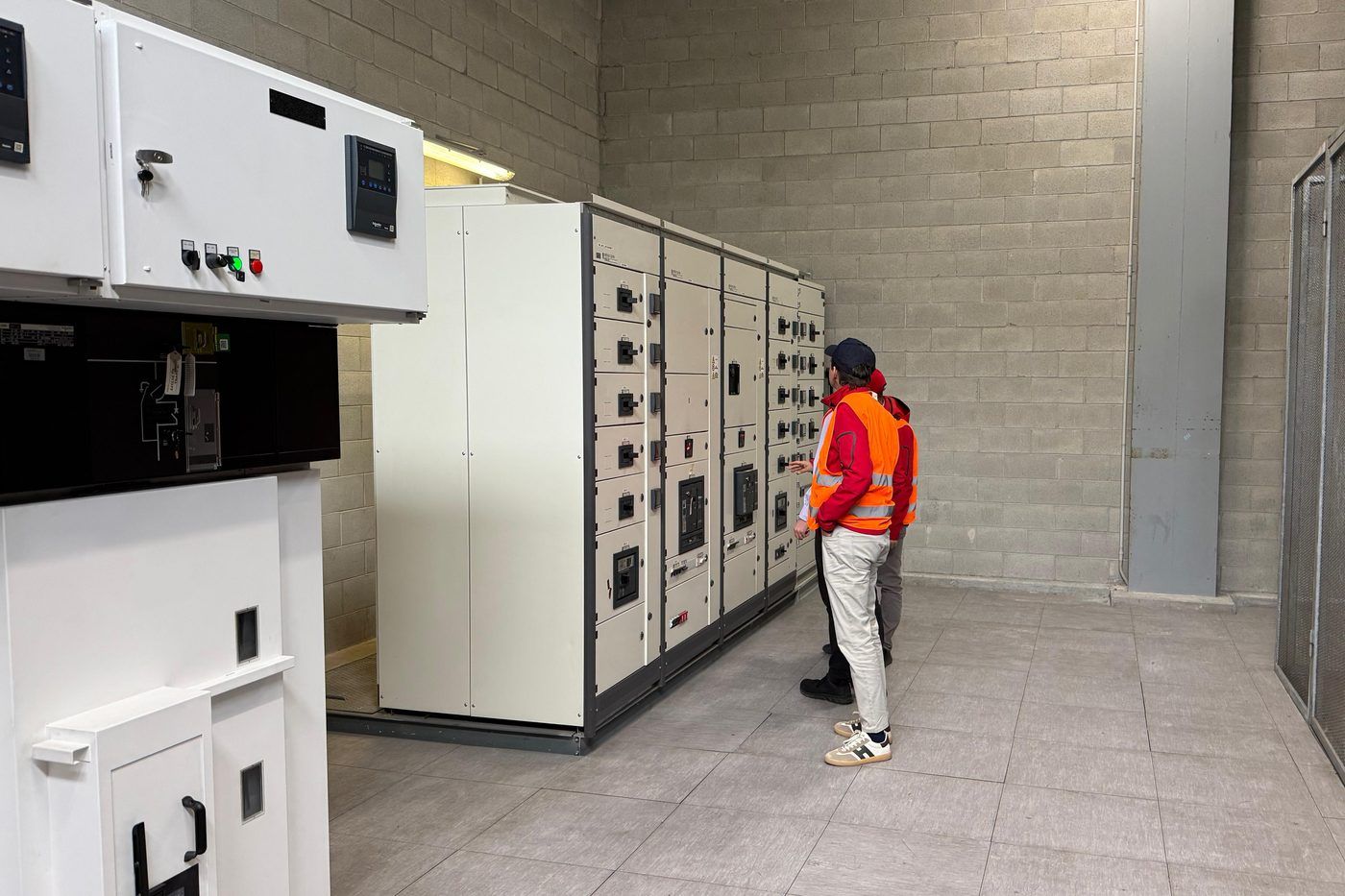
HarmoniQ deploys as one integrated system across the network, with each unit placed where it does most good: the Alpha at the machines and the Delta at the drives, inside the network, where current is drawn and harmonics are born, so the current is cleaned before it travels; and the Sigma at the incomer, the top of the network, where the supply arrives. Every unit improves power factor where it sits. They differ in where they go and in what else they take on, as Exhibit 3 sets out.
| Unit | Sits at | Used where | What it does |
|---|---|---|---|
| HarmoniQ Alpha | Each machine, on the circuit that feeds it | Machines on a fixed-speed supply: motors, compressors, pumps and fans | Improves power factor, smooths the waveform and cuts the current drawn; trims harmonics, without a Delta’s finish |
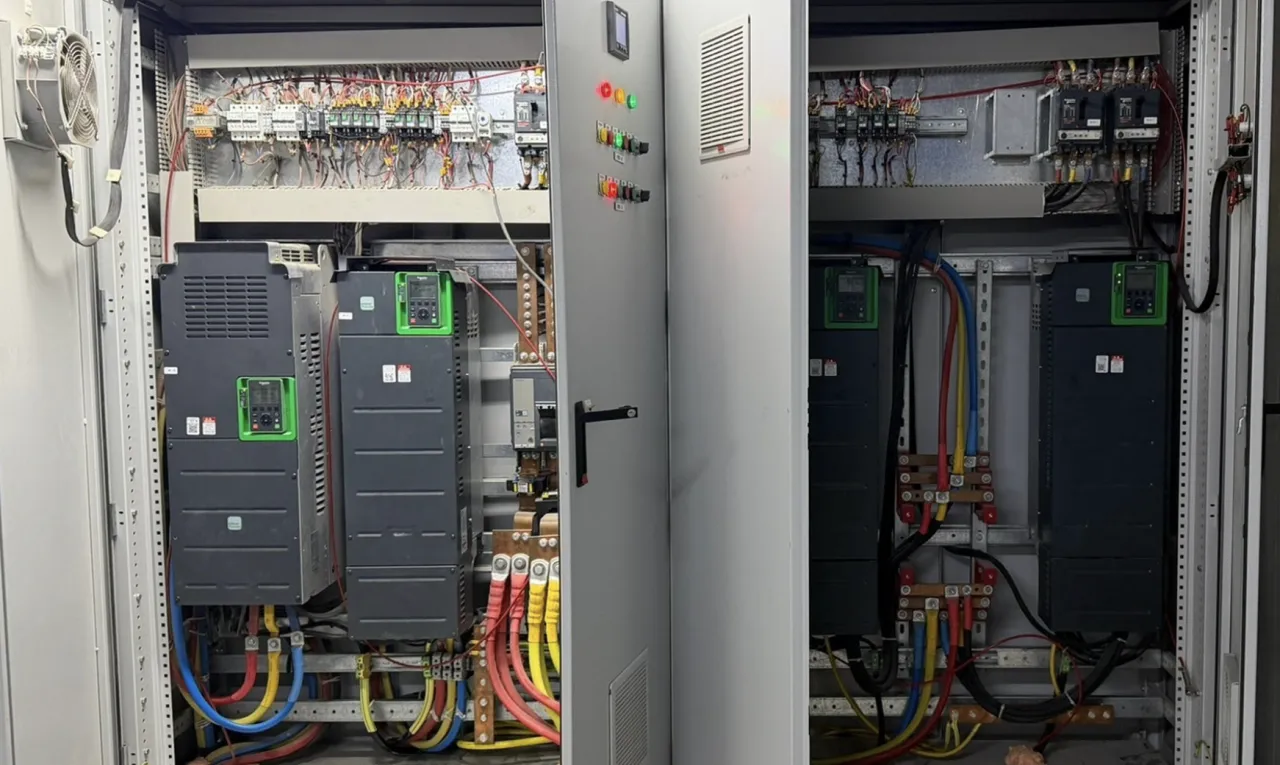
| HarmoniQ Delta | The drives, where harmonics are born | Wherever drives push harmonics high | Cancels harmonic current at its source, set for how much of each harmonic it cancels and how hard it works on power factor, which it improves too |
| HarmoniQ Sigma | The incomer, the top of the network | Where the incoming feed is already distorted, as with solar panels and their inverters | Works on the current where the supply arrives, and improves power factor too, without adding the resonance risk a capacitor bank brings |
At the load
HarmoniQ Alpha
The Alpha works at the load, on the circuit that feeds each machine on a fixed-speed supply: the motors, compressors, pumps and fans. It is the all-rounder. It improves power factor strongly, smooths the current waveform and lowers the total current each machine draws for the same work, so every conductor back to the incomer carries less of it. It trims harmonics too, though without a Delta’s finish, and a machine fed by a drive generally gets a Delta instead.
At the drives
HarmoniQ Delta
The Delta works at the drives, the source of most harmonic current on a modern site, and wherever drives push harmonics high it is the unit a site needs. It cancels that current where it is born. The physics is superposition: two currents of equal amplitude and opposite phase sum to zero, so with the Delta in place the drives' harmonic current is cancelled where it is drawn, instead of travelling up the network. It tracks many harmonic orders at once, and its settings decide how much of each it cancels, which it deals with first and how hard it works on power factor, which it improves as well.
At the incomer
HarmoniQ Sigma
The Sigma works at the incomer, the top of the network, where the supply arrives. It matters most where that feed is already distorted before it reaches the site's own loads, as on sites with solar panels and their inverters. It improves power factor too, without adding the resonance risk a capacitor bank brings. The 0.98+ the utility's meter sees is HarmoniQ's result as a system, not the Sigma's alone.
Why all three are needed
A site that corrects only power factor still carries its harmonic losses. One that cancels only harmonics leaves its reactive power to the meter. One that corrects both but ignores imbalance still carries unbalanced current, and the extra heat that comes with it. The three distortions are physically independent, so correcting one leaves the others in place. IEEE 1459, the standard that defines power under these conditions, makes the same separation: it splits a three-phase site's apparent power into the fundamental active power that does the work, the fundamental reactive power, the unbalanced power, and the non-fundamental power the harmonics carry. That is what network-wide means here: every kind of distortion removed, by units placed where the current is drawn, where the drives distort it and where the supply arrives.
06What changes
The effect is measurable from the day the system is commissioned. These are the figures we publish.
- Power factor, as the utility’s meter measures it at the incomer
- 0.98+
- Fewer kWh for the same output, metered before and after
- 10–20%
- Longer downstream equipment life, by the IEEE Arrhenius rule
- 2–4×
- Disruption to install: shunt-connected, never in the supply path
- 0
- Harmonic distortion: cancelled where it is made, designed to meet IEEE 519-2022.
- Phase imbalance: reduced, with current balanced across the three phases.
Savings are measured against a metered baseline taken before installation, at the customer's own meter, and the guarantee is written against those kilowatt-hours, never against the bill. How a saving is proven is set out in Weather Normalisation: Proving Energy Savings Are Real and How We Prove It: The On/Off Test.
07Standards and certification
HarmoniQ is designed to meet, or to enable compliance with:
- IEEE 519-2022, harmonic control.
- IEEE 1459, power definitions under non-sinusoidal conditions.
- IEEE C57.110, transformer derating under harmonic load.
- IEC 61000, the electromagnetic compatibility family.
- ISO 50015, measurement and verification of energy performance.
The equipment is tested and certified at manufacturer level: CE marked under the EU Declaration of Conformity, evaluated by Intertek to UL 810 and CSA C22.2 No. 190, and EMC tested, with accredited third-party reports to EN 61000-6, result Pass.