
In brief
- European industry pays among the highest electricity prices in the developed world: the EU-27 averaged about €0.18/kWh in the first half of 2025, two to three times the US rate.
- Prices vary widely: on the Band ID midpoints, a Swedish plant pays about a third of what an identical German plant pays, and the dearest markets hold the most industry.
- Regulation keeps raising the bar, through the Energy Efficiency Directive, the CSRD and a tightening ETS, while an ageing grid delivers a supply whose quality is getting worse.
- Every 1% of consumption not wasted is worth three times as much in Germany as in Sweden. HarmoniQ’s saving is three invoice lines: 10–20% fewer kWh, penalties eliminated and capacity charges reduced.
In 2022 Europe went through its most severe energy crisis since the oil embargo of 1973. Russian pipeline gas, the EU’s largest single source of imported gas, was curtailed sharply after the invasion of Ukraine, and wholesale electricity prices rose to many times their pre-crisis levels. Industry took the brunt of it. Factories cut production. Energy-intensive plants, aluminium smelters among them, curtailed or stopped output, and chemical production fell sharply.
By 2025 wholesale prices had come down from their peaks, but not to where they started. Carbon pricing, the cost of integrating renewables, an ageing grid and the loss of cheap pipeline gas have set a new, higher floor for industrial electricity across the continent. European industry now works in a different cost environment from the one it knew five years ago.
This article looks at that environment in detail: the price gaps between countries, the regulation tightening around them, the grid constraints that will last for decades, and why power quality belongs in any European industrial energy strategy.
01A structural cost disadvantage
European industrial electricity prices are among the highest in the developed world. This is not a hangover from 2022. It is a structural feature of European energy markets, built over more than a decade by policy, geography and the economics of the energy transition.
By the IEA’s figures, industrial electricity across the EU-27 averaged about €0.18/kWh in the first half of 2025: roughly two and a half times the US industrial rate of $0.07–0.08/kWh, and well above China’s $0.08–0.10/kWh. The IEA and Eurostat put European industrial prices at two to three times those in the United States. For the energy-intensive industries (steel, chemicals, cement, glass, aluminium and paper), a gap of that size is existential.
- EU-27 industrial average per kWh, first half of 2025
- €0.18
- United States industrial rate per kWh
- $0.07–0.08
- China’s industrial rate per kWh
- $0.08–0.10
Three forces sustain the premium.
- Gas after the crisis. Before 2022, Europe’s electricity prices were anchored to relatively cheap pipeline gas from Russia. That anchor has gone. Europe now buys much of its gas as LNG on global spot markets, competing with Asian buyers for cargoes from the US, Qatar and Australia, and LNG carries the cost of liquefaction, shipping and regasification. Eurostat’s data show EU gas import prices in 2025 still 40–60% above pre-crisis levels in real terms, and wherever gas-fired plant sets the marginal price, that cost flows straight into electricity.
- Carbon pricing. The EU Emissions Trading System is the world’s most mature carbon market, and its reforms have tightened the cap on emissions. Every gas- and coal-fired power station must buy an allowance for each tonne of CO₂ it emits, and the cost passes into the wholesale price. The European Commission’s own modelling puts it at €0.02–0.04/kWh on the average wholesale price, depending on the generation mix.
- Network and policy costs. European tariffs carry substantial levies for grid investment, renewable support, capacity mechanisms and energy taxes. In Germany, network charges and surcharges have long made up a large share of the industrial price: the EEG renewables surcharge went in mid-2022, but other levies have risen to pay for the grid expansion the Energiewende needs. In the UK, too, network charges and policy costs are a substantial share of the industrial bill.
The result is a cost structure that punishes waste far harder than those of Europe’s main competitors. Whatever share of its consumption a plant stops wasting, each kilowatt-hour saved is worth about two and a half times as much in the EU as in the US, on the IEA’s prices.
02Country by country
The European average hides wide variation between countries. Industrial prices run from under €0.07/kWh in the Nordic countries, where hydropower provides cheap baseload, to over €0.25/kWh for smaller industrial users in Germany and Italy, where dependence on gas and high network costs compound each other.
Exhibit 1 compiles the most recent comparable data from Eurostat, national regulators and the IEA for non-household consumers in Eurostat’s Band IC (500–2,000 MWh a year) and Band ID (2,000–20,000 MWh a year), which between them cover most small and medium industrial sites.
| Country | Band IC · 500–2,000 MWh | Band ID · 2,000–20,000 MWh | Main cost driver |
|---|---|---|---|
| Germany | €0.22–0.27 | €0.17–0.22 | Network charges, carbon pass-through |
| Italy | €0.21–0.26 | €0.16–0.21 | Gas dependency, system charges |
| Ireland | €0.20–0.25 | €0.15–0.19 | Island grid, gas dependency, PSO levy |
| United Kingdom | £0.19–0.24 | £0.15–0.19 | UK ETS, capacity market charges |
| Belgium | €0.19–0.23 | €0.14–0.18 | Distribution charges, federal surcharges |
| Austria | €0.17–0.22 | €0.13–0.17 | Hydro baseload, but high network charges |
| Netherlands | €0.16–0.20 | €0.12–0.16 | Gas price exposure, energy tax |
| France | €0.14–0.18 | €0.11–0.15 | Nuclear baseload, offset by network (TURPE) and excise charges |
| Spain | €0.14–0.19 | €0.11–0.15 | Iberian mechanism legacy, renewable integration |
| Poland | €0.14–0.18 | €0.11–0.15 | Coal transition, rising ETS exposure |
| Czech Republic | €0.14–0.18 | €0.11–0.14 | Nuclear base, coal phase-out costs |
| Denmark | €0.12–0.17 | €0.09–0.13 | Wind-dominated, high taxes |
| Finland | €0.08–0.12 | €0.06–0.10 | Nuclear expansion (Olkiluoto 3), hydro, wind |
| Norway | €0.06–0.11 | €0.05–0.09 | Hydropower |
| Sweden | €0.06–0.10 | €0.05–0.08 | Hydro and nuclear baseload |
Three patterns stand out.
- The spread is enormous. On the Band ID midpoints, a plant in Sweden pays roughly a third of what an identical plant in Germany pays for the same kilowatt-hour: a permanent asymmetry inside the single market.
- The dearest markets hold the most industry. Germany, Italy, the UK and Belgium are among Europe’s most industrialised economies, so the plants most exposed to global competition sit where electricity costs most.
- Stability has not returned. Even in cheaper markets such as France and Spain, volatility has risen since 2022, driven by renewable intermittency, cross-border flows and a shrinking share of dispatchable baseload. For a plant running continuous processes, peak-hour spikes can lift the effective rate well above the headline figure.
The pointAt €0.15–0.25/kWh, every inefficiency in how electricity is used becomes a competitive disadvantage. Power quality, how cleanly a plant draws its current, decides how much of that electricity does work and how much becomes heat in cables, transformers and motors. In these markets it is a first-order operating concern.
03A tightening regulatory framework
European plants face more than high prices. Regulation increasingly mandates efficiency, requires transparent reporting and penalises non-compliance. Three EU frameworks bear directly on the case for power quality.
The Energy Efficiency Directive
The recast Energy Efficiency Directive, adopted in 2023 and due in national law by late 2025, sets a binding EU target to cut final energy consumption by 11.7% against the 2020 reference projections for 2030. For industry it brings three concrete obligations.
- Energy audits. Large energy users without a certified energy management system must have an energy audit at least every four years, carried out by qualified auditors and based on measured consumption and electrical load profiles.
- Energy management systems. Enterprises using more than 85 TJ of energy a year must run a certified energy management system, usually to ISO 50001.
- A national savings obligation. Each member state must deliver new energy savings of 1.49% of final consumption a year on average, rising to 1.9% from 2028, through obligation schemes, alternative measures or direct regulation of industrial consumers.
The directive works like a ratchet: every year the bar rises. Plants that have already taken the obvious gains, LED lighting and variable-speed drives among them, have to look deeper into their electrical systems for the next tranche, and the losses power quality addresses are ones a conventional audit rarely sees.
The Corporate Sustainability Reporting Directive
The CSRD has been phasing in since January 2024, requiring companies in scope to report under the European Sustainability Reporting Standards. The energy requirements are detailed and quantitative: total energy consumption by source, energy intensity, the reductions achieved and progress against targets.
It also asks for Scope 2 emissions on both the location-based and the market-based method. Renewable certificates can improve the market-based figure, but only using less electricity moves the location-based one, and a reduction measured at the meter, before and after, is evidence an auditor can check.
The EU ETS and the carbon border
The ETS now lowers its emissions cap by 4.3% a year from 2024, against 2.2% before. The faster tightening is designed to push the carbon price up over time, and every rise is carried in the price of each kilowatt-hour a plant wastes.
The Carbon Border Adjustment Mechanism, fully operational from 2026, puts a carbon price on imports of the goods it covers, matching what EU producers pay under the ETS. It levels the field on embedded carbon, but does nothing to lower what European producers pay for energy. The one lever left to them is to use less of it per unit of output.
Europe’s industry cannot set the price of gas, the carbon price or the cost of the grid. It can decide how much of the electricity it buys becomes heat.
04An ageing grid under new strain
Much of Europe’s grid was built in the 1960s and 1970s to carry predictable baseload from large central power stations to industrial centres. That world has gone. Renewable generation, the electrification of transport and heating, and the spread of power-electronic loads have created conditions the original network was never designed for.
Ageing infrastructure
The European Commission estimates that 40% of the EU’s distribution grid is over 40 years old. A network built for the loads of its day runs closer to its limits under today’s: its voltage moves more as load changes, and the harmonic currents it carries distort that voltage more. For the plants connected to it, the quality of supply is deteriorating, with wider voltage fluctuations, more harmonic distortion and more frequent transients.
Investment is not keeping pace with demand, as national grid operators acknowledge. In the UK, National Grid ESO reported a queue of 733 GW of projects waiting to connect in 2024, with connection dates for new generation and large loads stretching more than ten years out in many regions. In Germany, grid expansion in the northern states has lagged behind offshore wind, and the congestion is paid for every year in redispatch.
- Of the EU’s distribution grid over 40 years old, by the European Commission
- 40%
- Projects waiting to connect in the UK in 2024, by National Grid ESO
- 733 GW
- How far out connection dates stretch in many UK regions
- 10+ years
Renewables and power quality
The growth of wind and solar has brought large environmental gains, and new power quality challenges at every level of the grid. Solar inverters and wind-turbine converters connect through power electronics, which add harmonic currents, at multiples of the 50 Hz fundamental, to networks that were never designed to carry them, and distort the voltage other equipment receives.
Inside the plant, a distorted supply compounds the plant’s own problems. Motors fed a distorted voltage draw more current, run hotter and work less efficiently. Capacitor banks installed for power factor correction can resonate with harmonics, failing early and risking dangerous overcurrents. Variable-speed drives, now common across European industry, are both a source of harmonic distortion and a victim of it.
So European plants face two problems at once: some of the highest electricity prices in the developed world, and a supply whose quality is getting worse. Equipment designed for a clean 50 Hz sine wave increasingly receives distorted, variable power that cuts efficiency, raises losses and wears electrical and mechanical components faster. The grid will not fix this in time. A plant cannot clean up the grid either, but it can stop adding to the distortion, and stop paying for current that does no work.
05The power quality opportunity
High prices, tightening regulation and a deteriorating supply make an unusually strong case for power quality in European plants. The arithmetic is simple: the value of avoided waste scales with the price of the kilowatt-hour.
Take a hypothetical plant drawing an average of 2 MW around the clock: 17,520 MWh a year, inside Band ID. Exhibit 2 prices each 1% of its consumption at the Band ID midpoints in Exhibit 1.
| Market | Price per kWh | Electricity a year | Each 1% not wasted |
|---|---|---|---|
| Germany | €0.195 | €3.42m | €34,000 |
| Italy | €0.185 | €3.24m | €32,000 |
| United Kingdom | £0.170 | £2.98m | £30,000 |
| France | €0.130 | €2.28m | €23,000 |
| Sweden | €0.065 | €1.14m | €11,000 |
| United States | $0.075 | $1.31m | $13,000 |
The same proportional saving is worth three times as much in Germany as in Sweden, and more than two and a half times its value in the United States. Where the avoidable waste comes from is well understood.
Reactive power penalties
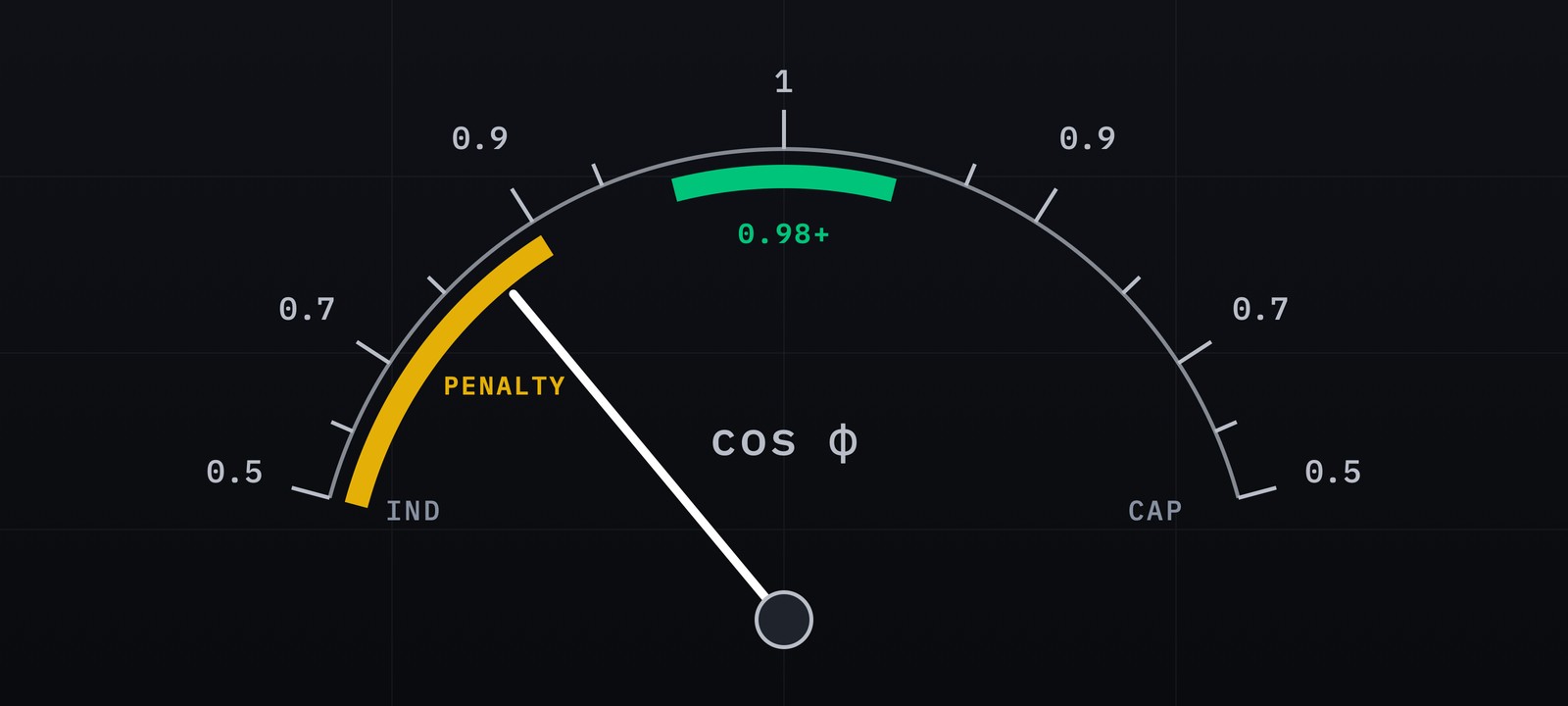
Reactive power charges are a long-standing feature of European industrial tariffs, and they are enforced. Italy and Spain both charge for reactive energy once power factor falls below cos φ 0.95: Italy under ARERA’s tariff rules, Spain under Real Decreto 1164/2001. In Germany, network operators charge for reactive energy beyond a cos φ threshold set in each operator’s price sheet. In the UK, distribution network operators levy excess reactive power charges on the Distribution Use of System bill when a site draws more reactive power than its threshold allows.
The pointA penalty is a charge for current that did no work. Correct the power factor at source and it falls away.
Harmonic and imbalance losses
Beyond reactive power, harmonic distortion and phase imbalance waste energy inside the plant. Harmonic currents from non-linear loads, such as variable-speed drives, rectifiers, arc furnaces and LED drivers, circulate through the distribution system and make heat without doing work: extra I²R loss in every conductor, eddy-current and hysteresis loss in transformer cores, stray-flux heating in motor windings. Imbalance does the same through neutral current, and through negative-sequence current that heats a motor without adding torque. How large these losses are varies from site to site, which is why the only figure worth acting on is a measured one.
How HarmoniQ states the saving
HarmoniQ works on the plant’s side of the meter.
At the load
HarmoniQ Alpha
Fitted at each machine, it cleans the current where it is drawn, so every cable upstream carries less of it and runs cooler.
At the drives
HarmoniQ Delta
Fitted at the drives panel, it cleans the current where the drives distort it, before it spreads to the feeder, busbar and transformer.
At the incomer
HarmoniQ Sigma
At the main switchgear, it corrects reactive current where the network meets the grid, so the supply and the meter see cleaner current.
All three are shunt-connected, outside the supply path, and install with zero disruption to production.
We state the result as three separate lines on one invoice (Exhibit 3), and write our guarantee against only the first: kilowatt-hours at the meter, because the bill also moves with tariffs and charges outside our control.
| Line | What changes | HarmoniQ |
|---|---|---|
| Energy | Current that did no work stops becoming heat, so the meter records fewer kilowatt-hours for the same output. The guarantee is written against this line. | 10–20% fewer kWh |
| Power-factor penalties | Power factor corrected to 0.98+, clear of thresholds such as Italy’s and Spain’s cos φ 0.95 | Eliminated, where levied |
| Capacity charges | Correction frees apparent power, so a site charged for agreed capacity in kVA can lower it | Reduced |
| Total | Where all three lines apply | Up to 25% off the total electricity bill |
These are typical ranges. At a site with no penalty and no capacity charge, the bill saving is close to the energy saving alone, and the figure that counts for any plant is the one measured at its own meter.
06What Europe’s industrial leaders are doing
The most sophisticated European operators already treat power quality as a strategic priority rather than a maintenance afterthought. Their approaches share three elements that set them apart from the compliance-driven mindset still common across European industry.
Continuous monitoring
Leading plants have moved beyond periodic audits to continuous monitoring at every significant node: Class A power quality analysers to IEC 61000-4-30 at the point of common coupling, at each main distribution board and at critical load centres. They record voltage, current, power factor, harmonics to the 50th order, transients, flicker and imbalance, and so show where energy is being wasted and why.
A four-yearly audit is a snapshot. Continuous monitoring captures the full range of operation that drives real losses: start-up transients, load cycling, seasonal swings and the interactions between machines. What it finds often differs from what the audit predicted.
Power quality in the sustainability report
Under the CSRD, companies must disclose quantified energy efficiency improvements, which ties power quality investment directly to sustainability reporting. Lower harmonic distortion and a better power factor show up as measured reductions in energy consumption and Scope 2 emissions: auditable, verifiable and attributable to a specific technical measure.
Location-based Scope 2 is consumption multiplied by the grid’s emission factor, so every kilowatt-hour not drawn comes off it in proportion. That has moved power quality from the facilities team to the executive and the board, because investors, customers and regulators all read the same figure.
Efficiency as competitive advantage
The most important shift is to treat energy efficiency as competitive strategy rather than cost reduction. A European manufacturer cannot match American or Chinese energy prices. It can close the efficiency gap. The price that decides competitiveness is the price of each useful kilowatt-hour: what a plant pays, divided by the share of it that ends up as output. A plant that turns more of each kilowatt-hour it buys into work lowers that figure without any change of tariff.
Leaders also use efficiency investment to reach preferential finance. EU and national schemes co-finance projects that demonstrably reduce industrial energy use, among them Germany’s EEW programme (Bundesförderung für Energie- und Ressourceneffizienz in der Wirtschaft) and the UK’s Industrial Energy Transformation Fund. A measured baseline and a measured result are what such schemes ask for.
The path forward
Europe’s industrial energy problem will not resolve itself. The forces behind today’s prices are permanent features of the continent’s energy landscape: carbon pricing, a restructured gas market, grid investment and the cost of integrating renewables. The direction of travel is towards higher prices and tighter regulation, not lower.
In that environment, the difference between a well-run electrical system and a neglected one is a competitive dividing line.
One plant
Measured and corrected
Runs at a power factor of 0.98+, with its harmonic current inside IEEE 519 and its phases balanced.
The other
Left as installed
Runs at a lagging power factor with distorted, unbalanced current, and pays for it every hour of every day.
The two need not differ in equipment or process. The difference is whether the electrical system has been measured, understood and corrected, or left as it was installed, decades ago, for conditions that no longer apply.
For European industry, the case for power quality investment is no longer theoretical. It is arithmetic.
Sources
- Eurostat, Electricity prices for non-household consumers, bi-annual data (nrg_pc_205).
- International Energy Agency, World Energy Outlook 2025, Paris.
- Directive (EU) 2023/1791 on energy efficiency (recast), Official Journal of the European Union, L 231, 20 September 2023.
- Directive (EU) 2022/2464, the Corporate Sustainability Reporting Directive, Official Journal of the European Union, L 322, 16 December 2022.
- National Grid ESO, Connections Register, Q4 2024.
- ARERA (Autorità di Regolazione per Energia Reti e Ambiente), Deliberazione 568/2019/R/eel and subsequent updates; Spain, Real Decreto 1164/2001.
- IEC 61000-4-30, power quality measurement methods; IEEE 519-2022, harmonic control in electric power systems.
Figures are drawn from the public regulatory and market sources above and reflect conditions in 2024–2025. Tariffs, charges and exchange rates change, so check any figure with the relevant regulator or network operator before relying on it.