In brief
- A capacitor bank corrects displacement power factor at the fundamental, so the penalty goes and the meter looks better.
- It cannot touch harmonics, imbalance or neutral current, and in a drive-heavy network it can resonate: here a 300 kvar bank multiplies the 7th harmonic voltage almost six-fold.
- A detuning reactor protects the bank but does not clean the network: the drives’ harmonic currents still flow through every feeder.
- Banks still suit linear loads with low measured distortion. Most modern plants need harmonics removed at the drives, and reactive power and imbalance corrected where they arise.
Capacitor banks have been correcting power factor for about a century. They are reliable, well understood, widely installed and cheap relative to what they save on one narrow part of the utility bill. For most of the last century they were the right answer to the industrial power quality problem as it was then defined.
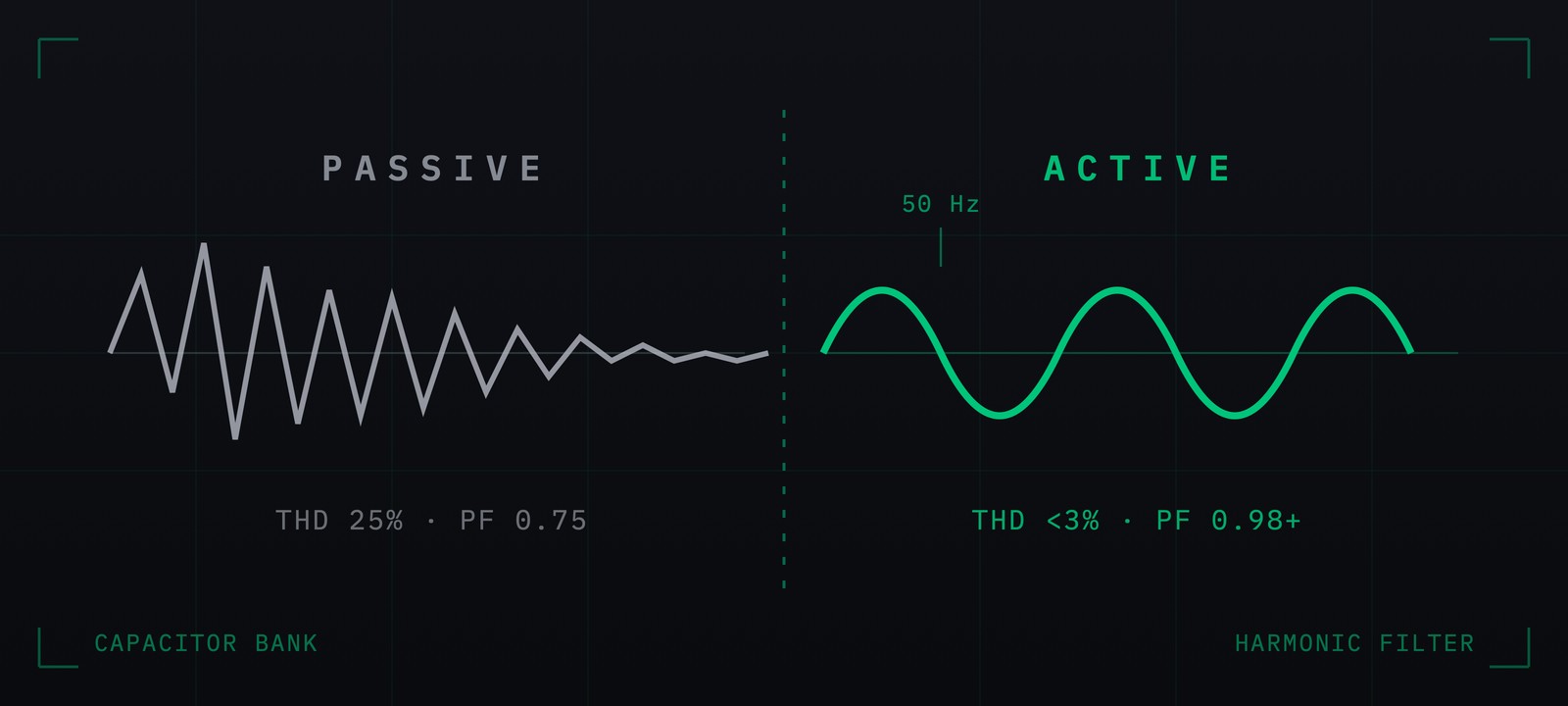
The problem has since changed. A modern plant runs few purely linear loads. Variable-speed drives, UPS systems, LED lighting, induction heating, rectifiers and battery chargers now draw much of its current, and they draw it in pulses. Those pulses inject harmonic currents into the network: currents at 150, 250 and 350 Hz and higher on a 50 Hz supply, on top of the fundamental.
Capacitor banks were not designed for this. They compensate reactive power at the fundamental frequency only. Harmonic distortion, phase imbalance and neutral current are invisible to them, and resonance is a risk they bring with them. After a bank goes in, the meter reports a better power factor and the utility stops charging the penalty. The bill improves. The network behind the meter goes on wasting energy and heating equipment, because the underlying problem was never only power factor. It was power quality.
What the meter sees
Power factor
A single number: the ratio of real to apparent power at the utility meter. A capacitor bank improves it.
What the network carries
Power quality
The condition of the current and voltage waveforms across the whole network. A capacitor bank does not correct it.
01What capacitor banks actually do
The physics is straightforward. Inductive loads, such as motors, transformers and welding sets, draw current that lags the voltage. The lagging part is reactive current, and the apparent power it adds is reactive power, measured in kvar. Reactive current does no useful work, but it flows through every conductor between the load and the utility's substation, and heats each one on the way.
A capacitor does the opposite: its current leads the voltage. Connect a bank in parallel with an inductive load and the two cancel at the connection point. The leading current from the bank meets the lagging current of the motor, and the current flowing upstream falls to roughly the real-power component alone.
This is displacement power factor correction, and for a linear load at the fundamental frequency it is elegant and effective. The meter sees a power factor close to unity, the penalty is avoided, and the losses upstream of the bank fall.
The operative words are for a linear load at the fundamental frequency.
02What capacitor banks cannot do
The moment a network carries non-linear loads, which today means almost every industrial network, the problem extends beyond displacement power factor into the harmonic domain. A capacitor bank has no answer to any of the following.
Harmonic current
A non-linear load draws its current in pulses. Mathematically, a pulsed waveform is the fundamental plus a series of harmonics: the 5th, 7th, 11th, 13th and higher. Each harmonic current flows through the network and heats cables and transformers just as the fundamental does, and in a transformer it costs more. The winding eddy-current loss rises with the square of the harmonic order as well as the square of the current (IEEE C57.110), so a 5th-harmonic current produces 5² = 25 times the winding eddy-current loss of the same current at the fundamental.
A capacitor bank cancels none of it. A capacitor's impedance falls as frequency rises, so harmonic currents are drawn into the bank itself, heating it, forcing it to be derated and shortening its life. Section 03 shows why that is the least of the trouble.
True power factor
The power factor a utility bills is often, in effect, what engineers call displacement power factor: the cosine of the angle between the fundamental voltage and the fundamental current. The stricter measure of how well current is being used is true power factor, which counts the harmonics as well (IEEE 1459 defines both). True power factor is the displacement power factor divided by √(1 + THD²), where THD is the current's total harmonic distortion. So a site whose meter reads 0.99 while its current carries 30% THD has a true power factor of 0.99 ÷ √1.09, about 0.95. The meter sees the 0.99. The copper losses respond to the 0.95.
- What the meter reads: displacement power factor
- 0.99
- What the copper responds to: true power factor, with 30% current THD
- 0.95
Voltage sags and switching transients
Motor starts, compressors cycling and large welders draw inrush current that pulls the voltage down for a fraction of a second. A deep enough sag trips drives, drops out contactors and stops lines. A fixed capacitor bank cannot respond to a sag at all, and an automatic bank switches its steps over seconds, far too slowly for an event measured in cycles. Switching a bank is, in fact, one of the commonest causes of transients on a network: energising one produces a brief, ringing overvoltage that can trip variable-speed drives.
Phase imbalance
Industrial sites rarely load their three phases equally. Single-phase loads, different equipment schedules and asymmetric wiring all contribute. Imbalance puts current on the neutral, creates negative-sequence currents that heat motor rotors without making torque, and adds copper losses across the network. A capacitor bank is connected equally across the three phases: it corrects the average power factor and does nothing to rebalance them.
Neutral current
Triplen harmonics (the 3rd, 9th and 15th) do not cancel across the three phases of a four-wire system. They add in the neutral. LED drivers, computer power supplies and other single-phase electronics are prolific sources of them, and on a triplen-rich load a neutral sized for fundamental current alone can carry more current than any phase conductor, and overheat. A capacitor bank does nothing to reduce triplens.
03When capacitor banks make it worse
This is the part that gets overlooked. In a harmonic-rich network a capacitor bank is not merely incomplete. It can amplify the harmonics, through parallel resonance.
Seen from the loads, a bank at the main board sits in parallel with the supply transformer's leakage inductance. The transformer's reactance rises with frequency and the bank's falls, so at one harmonic order the two are equal. There, in parallel, they present a very high impedance, and any harmonic current injected near that order produces a large harmonic voltage, and a large current circulating between the bank and the transformer.
The order is easy to find. At the fundamental the transformer's reactance is V²/Ssc, where Ssc is the short-circuit power at the bus, and the bank's is V²/Qc, where Qc is its rating in kvar. At harmonic order h the first is h times larger and the second h times smaller, so they meet at the resonance order hr = √(Ssc/Qc).
Worked exampleA 1,000 kVA transformer with 6% impedance, on a stiff supply, has a short-circuit power of about 16.7 MVA (1,000 ÷ 0.06). Fit a 300 kvar bank and the resonance falls at √(16,667 ÷ 300), the 7.5th harmonic: right beside the 7th, which six-pulse drives produce in quantity. A bigger bank pulls the resonance lower, towards the 5th. In the figure below, slide the bank up from zero and watch the resonance walk down through the 13th, the 11th and the 7th. Then fit a detuning reactor.
Resonance · harmonic order
7.5
373 Hz · within one order of the 7th
Worst amplification
×5.8
The 7th: 2.4% → 13.9% of the supply voltage
Voltage distortion · THD
14.7%
At the bus · 4.7% with no bank
A 300 kvar bank resonates with the transformer at harmonic order 7.5, within one order of the 7th. The 7th harmonic voltage is 5.8 times its no-bank level, and voltage distortion at the bus rises from 4.7% to 14.7%.
Representative network: a 1,000 kVA, 400 V transformer at 6% impedance on a stiff supply, so Ssc ≈ 16.7 MVA (9.6 mΩ at 50 Hz). 400 kW of six-pulse drives inject Ih = I1/h at the 5th, 7th, 11th and 13th, as ideal current sources. 300 kW of resistive load damps the network (R = V²/P ≈ 0.53 Ω). A bank's size is its output at 50 Hz; the detuned bank adds a 7% series reactor, tuning it to h = 1/√0.07 ≈ 3.8 (189 Hz). Motors, cables and the drives' own response are left out: they shift and damp the peak, which is why a real site is measured before a bank is chosen. Amber marks a resonance within one order of a drive harmonic, or a voltage over IEEE 519-2022's limits for a bus at 1 kV or below (5% for any one harmonic, 8% THD); green, a harmonic the bank leaves lower than with no bank.
In this network the 300 kvar bank multiplies the 7th harmonic voltage almost six-fold, and voltage distortion at the bus goes from under 5% to almost 15%. The consequences are familiar to anyone who has investigated a resonance:
- The bank overheats and fails, sometimes violently. The application guides for shunt capacitors, IEEE 1036 among them, make a harmonic resonance check part of a bank's design for exactly this reason.
- Voltage distortion rises across the network, upsetting sensitive loads that ran without trouble before the bank was installed.
- Transformers and cables run hotter, as the amplified harmonic current circulates through them.
- Fuses blow and breakers trip, and nobody can see why, because the symptoms started only after the "solution" went in.
The usual mitigation is a detuning reactor in series with each capacitor step. It tunes the bank below the lowest drive harmonic: with the common 7% reactor, to the 3.8th harmonic, 189 Hz on a 50 Hz supply (1 ÷ √0.07 = 3.78). Above that order the bank looks inductive, so it can no longer resonate with the transformer at the 5th or the 7th. Switch the reactor on in the figure: the resonance drops below the 5th, and every drive harmonic ends up lower than with no bank at all.
That protects the bank. It does not clean the network. The drives' harmonic currents are unchanged, and they still flow through every feeder and distribution board between the drives and the main board. The share a detuned bank soaks up is a side effect of where it is tuned, not its purpose: it is sized to survive harmonics, not to remove them. It has stepped out of the crossfire.
What a detuned bank actually doesIt corrects displacement power factor and protects itself from resonance. It is not designed to remove harmonic current from the network, and it does not protect the equipment downstream, rebalance the phases or reduce neutral current. It is a capacitor bank with a seat belt, not a power quality solution.
04What the bill shows, and what the network is doing
The commonest reason a facility believes its capacitor bank is working is that the bill improved. The penalty line disappeared and the apparent demand fell. That benefit is visible, measurable and real.
The bank is doing its job: displacement power factor correction at the revenue meter. What the bill does not show is what happens inside the network, between the bank and the loads it was meant to serve.
Take a hypothetical plant full of variable-speed drives, with a newly installed detuned bank. The bill now shows the power factor the utility wants, and the penalty is gone. The finance director sees a line item disappear. The engineer sees the meter. Neither sees this:
- Harmonic current in the internal network. Every drive's harmonic current still flows through its own feeder and the boards upstream of it. Resistive loss follows the RMS current, which harmonics raise by a factor of √(1 + THD²), and skin effect raises a conductor's resistance at the higher orders on top of that.
- Harmonic loss in the transformer. Its winding eddy-current loss climbs with the square of the harmonic order, so the 5th counts 25 times and the 7th 49 times (IEEE C57.110). The detuned bank diverts part of the lowest orders before they reach it. The rest still arrives.
- Motor heating. Harmonics create pulsating torques and negative-sequence currents that heat motor rotors without doing useful work. By the Arrhenius rule, every 10 °C a winding runs above its rating halves its insulation life: a winding running 10 °C hot reaches the end of a 20-year insulation life in about 10 years. IEEE 117 sets how motor insulation is tested for thermal ageing, and NEMA MG 1 derates motors run on distorted supplies.
- Demand charges. The bank has cut the displacement part of the apparent power. The harmonic part remains. Where a utility bills on true kVA, or applies a true-power-factor clause, the billing benefit is smaller than expected.
The bill improved. The network did not.
05Where capacitor banks still make sense
None of this condemns capacitor banks. It states what they are for. A bank is the right answer when:
Case 1
The loads are overwhelmingly linear
Large synchronous motors, induction motors started direct on line without drives, resistive heating. These are increasingly rare in modern industry, but they survive in some older plants, water utilities and simple pumping stations.
Case 2
The only symptom is a penalty on the bill
With harmonic distortion verified as low by measurement, and no sensitive equipment upset by switching transients.
Case 3
The bank sits on the utility's side
At transmission or distribution level, managed by engineers with detailed knowledge of the local harmonic environment.
Case 4
It complements active harmonic correction
Supplying bulk displacement correction while an active filter deals with the harmonics. This is a legitimate hybrid design in some high-kvar installations.
For a typical modern plant, with variable-speed drives, UPS systems, LED lighting or rectifier loads, which describes almost every manufacturing plant, cold store and hospital, a capacitor bank treats one symptom of a larger problem and leaves the rest untouched.
06What complete correction requires
Correcting power factor and correcting power quality are different engineering problems. The second asks for four things a capacitor bank cannot give:
- Harmonics removed close to where they are made. Removing harmonic current at the drives keeps it out of the internal network altogether, rather than only out of the meter, and it has to be done without creating a new resonance.
- Reactive power corrected continuously, as the load changes. A load profile moves minute by minute as lines cycle, compressors stage and ventilation modulates. A bank sized for average conditions and switched in steps is the wrong size for most moments of real operation.
- Imbalance corrected phase by phase, at the loads where it arises, which a bank connected equally across the phases cannot do.
- True power factor, not displacement alone. The whole apparent power corrected, harmonics included, rather than only its fundamental component. A true power factor near unity and a displacement power factor near unity with heavy distortion are different things on every cable in the plant.
Where HarmoniQ fits
HarmoniQ's three units each work where they sit.
At the load
HarmoniQ Alpha
Fitted at each machine, it cleans the current where it is drawn, so every cable upstream carries less of it and runs cooler.
At the drives
HarmoniQ Delta
Fitted at the drives panel, it cleans the current where the drives distort it, before it spreads to the feeder, busbar and transformer.
At the incomer
HarmoniQ Sigma
At the main switchgear, it corrects reactive current where the network meets the grid, so the supply and the meter see cleaner current.
All three are shunt-connected, so nothing in the plant runs through them. A single-element fix that addresses one part of the problem is not a complete solution. It is a partial one that the utility meter happens to reward.
The rule of thumb: if a facility has variable-speed drives, UPS systems, LED lighting, induction heating, welding or battery chargers, and almost every modern plant has at least two, a capacitor bank alone addresses only the displacement part of its power quality problem. The rest goes on wasting energy, inflating demand charges and shortening equipment life, however clean the bill looks.
07Summary
Capacitor banks are a mature, reliable technology that solves one specific problem: displacement power factor at the fundamental frequency. For the era in which they were developed, that was enough. For the modern industrial load, it is not.
Harmonic current, phase imbalance, neutral current, resonance and the gap between displacement and true power factor all bear on the efficiency and equipment life of an industrial site, and a capacitor bank corrects none of them. The bill improves because the meter reports displacement power factor. The cables, transformers and motors inside the network respond to the whole current waveform, which the bank has not cleaned.
The answer is not to abandon capacitor banks where they still make sense. It is to recognise that power factor correction and power quality correction are different problems, and to size the response to the problem actually present. For most modern plants that means removing harmonics at the drives and correcting reactive power and imbalance where they arise, then proving the result at the site's own meter.